
We read your photo as:
Calculate the rise in water level for Question 1.
ScanSolve AI Answer
Step-by-step solution
5 stepsCalculate the rise in water level for Question 1.
The volume of the metal cube is .
The cross-sectional area of the cylinder is .
When the cube is lowered into the cylinder, it displaces a volume of water equal to its own volume. This displaced volume causes the water level to rise.
The volume of displaced water can be expressed as , where is the rise in water level.
Therefore, .This matches option A, .
The water level rises by .
Calculate the radius of the cylinder for Question 2.
The radius of the spherical metal bob is .
The water level rises by .
The volume of the spherical bob is given by .
The volume of water displaced in the cylinder is given by , where is the radius of the cylinder.
Since the bob is fully immersed, the volume of displaced water is equal to the volume of the bob:Substitute the given values:
Divide both sides by :
The radius of the cylinder is .
Identify the principle for Question 3.
The principle of the transmissibility of pressure in a fluid at rest in all directions is known as Pascal's Law. Pascal's Law states that a pressure change at any point in a confined incompressible fluid is transmitted throughout the fluid such that the same change occurs everywhere.
The correct answer is .
Identify the incorrect statement about liquid pressure for Question 4.
Let's analyze each statement:
- A. At a point in a liquid is proportional to the depth (). This statement is correct.
- B. At any point in a liquid is the same at the same level. This statement is correct.
- C. Is exerted equally in all directions at any point. This statement is correct (a consequence of Pascal's Law).
- D. At a particular depth depends on the shape of the vessel. This statement is incorrect. Liquid pressure at a given depth depends only on the density of the liquid, the acceleration due to gravity, and the depth, not on the shape or volume of the container.
The statement that is NOT correct is .
Calculate the height of the atmosphere for Question 5.
Given:
- Normal atmospheric pressure, .
- Acceleration due to gravity, .
- Uniform density of the atmosphere, . The formula for hydrostatic pressure is , where is the height. Rearrange the formula to solve for :
Substitute the given values:
The height of the atmosphere is .
Still stuck on this one?
Ask a follow-up, and the answer starts from this question.
More Geography Questions
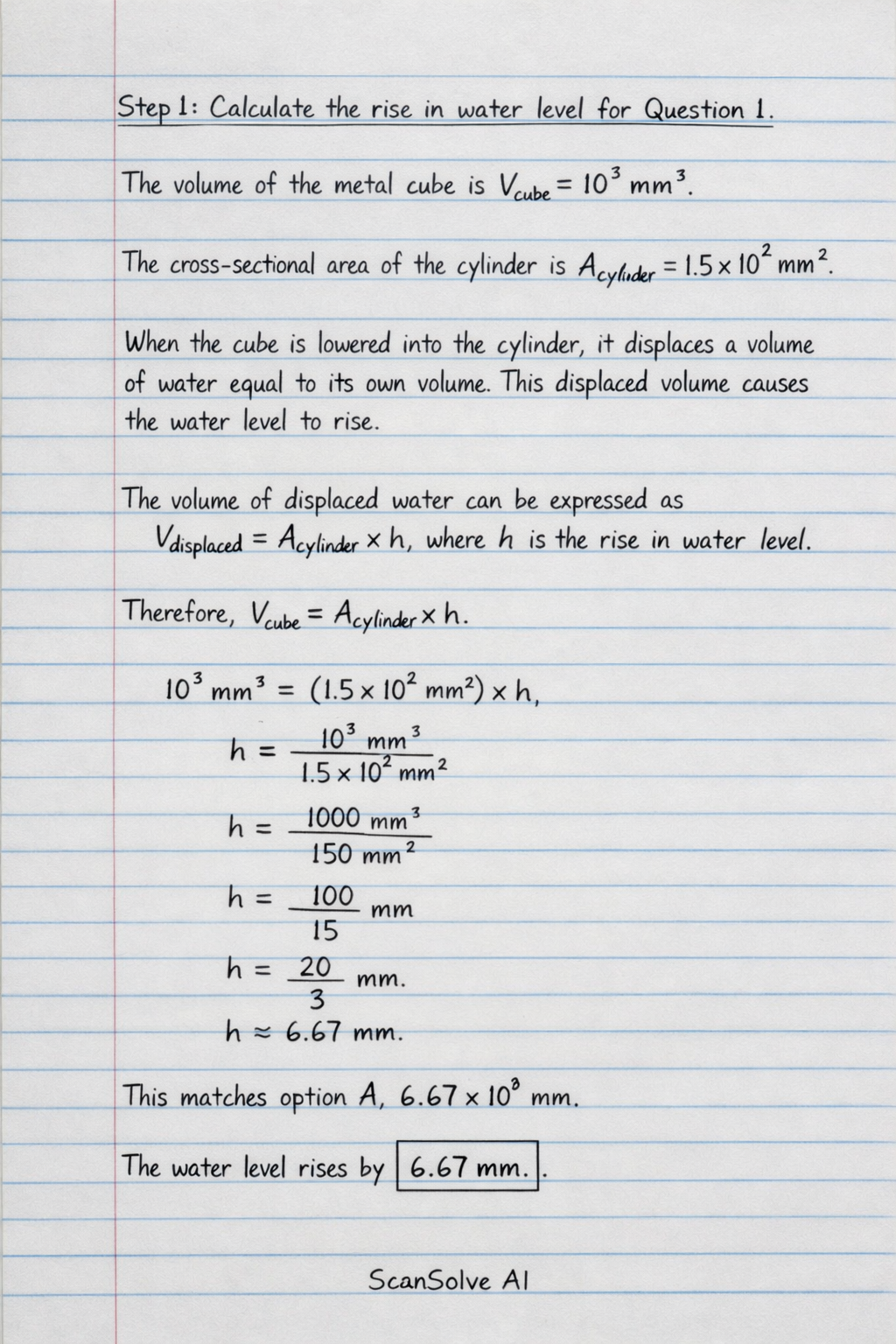
Handwritten Step-by-Step Solution
Get this as a handwritten image on WhatsApp — like a tutor wrote it for you.
Try on WhatsApp