
We read your photo as:
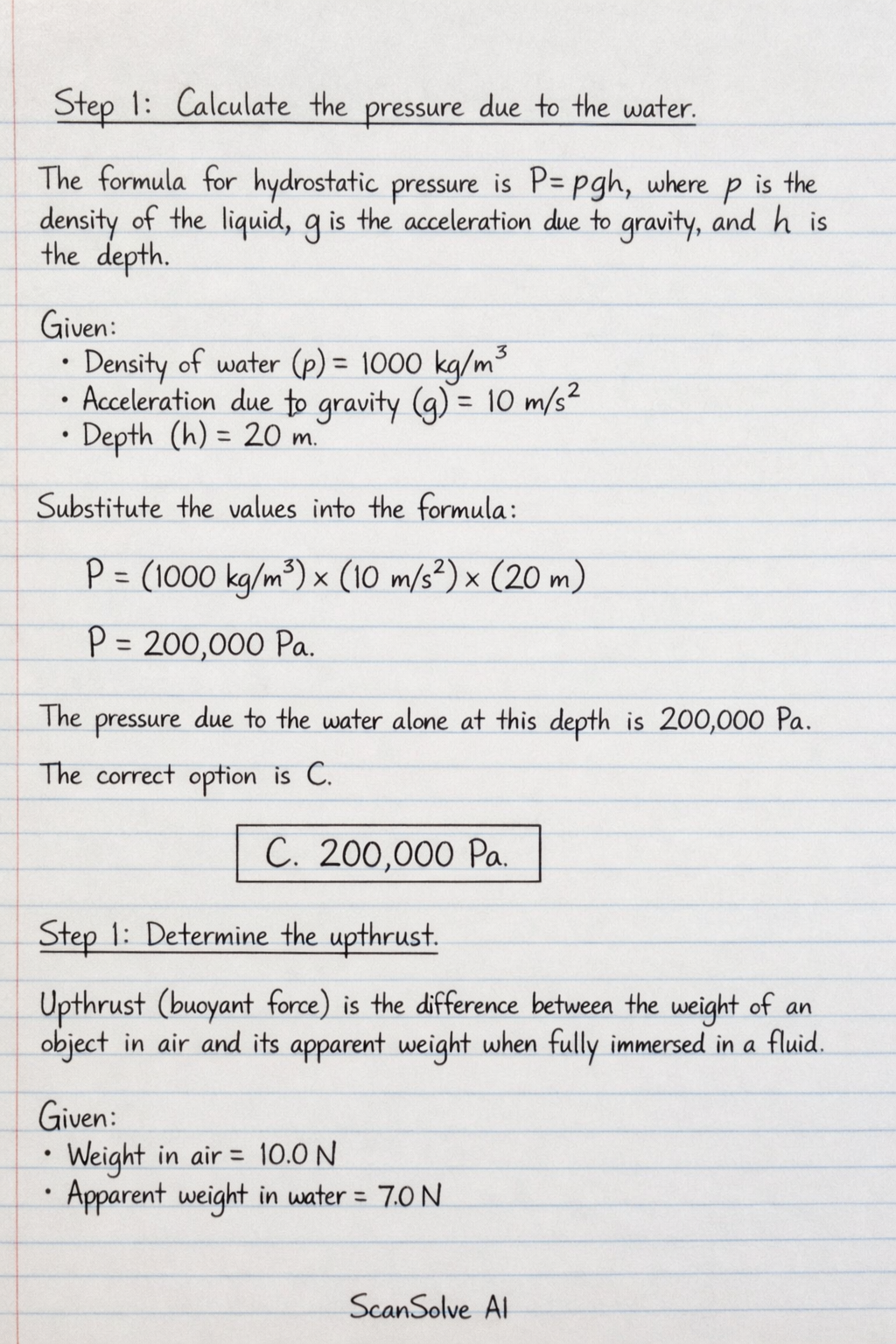
Calculate the pressure due to the water.
ScanSolve AI Answer
Answer
Step-by-step solution
4 stepsCalculate the pressure due to the water.
The formula for hydrostatic pressure is , where is the density of the liquid, is the acceleration due to gravity, and is the depth.
Given:
- Density of water () =
- Acceleration due to gravity () =
- Depth () =
Substitute the values into the formula:
The pressure due to the water alone at this depth is .
The correct option is C.
Determine the upthrust.
Upthrust (buoyant force) is the difference between the weight of an object in air and its apparent weight when fully immersed in a fluid.
Given:
- Weight in air =
- Apparent weight in water =
Calculate the upthrust:
The upthrust on the object is .
The correct option is B.
A liquid rises in a capillary tube due to surface tension. Surface tension causes the liquid to adhere to the walls of the tube and rise against gravity, forming a meniscus.
The correct option is B.
Terminal velocity is reached when the net force acting on the falling object becomes zero. At this point, the downward force (weight) is balanced by the upward forces (upthrust and viscous drag), resulting in zero acceleration.
The correct option is C.
Surface tension is the property of a liquid's surface that allows it to resist an external force due to the cohesive nature of its molecules. This property causes liquids to minimize their surface area. A soap bubble naturally takes on a spherical shape to minimize its surface area, which is a direct application of surface tension.
The correct option is C.
Apply Pascal's principle.
Pascal's principle states that pressure applied to an enclosed fluid is transmitted undiminished to every portion of the fluid and the walls of the containing vessel. For a hydraulic press, this means the pressure on the small piston is equal to the pressure on the large piston.
Where:
- = force on the small piston
- = area of the small piston
- = force on the large piston
- = area of the large piston
Given:
Calculate the force on the large piston ().
Rearrange the formula to solve for :
Substitute the given values:
The force on the large piston is .
The correct option is B.
Try one yourself
A new problem that tests the same skill.
Still stuck on this one?
Ask a follow-up, and the answer starts from this question.
More Physics Questions
Handwritten Step-by-Step Solution
Get this as a handwritten image on WhatsApp — like a tutor wrote it for you.
Try on WhatsApp