

This physics problem tests your understanding of fundamental physical laws and their applications. The step-by-step solution below breaks down the problem using relevant equations and physical reasoning.
ScanSolve AI Answer
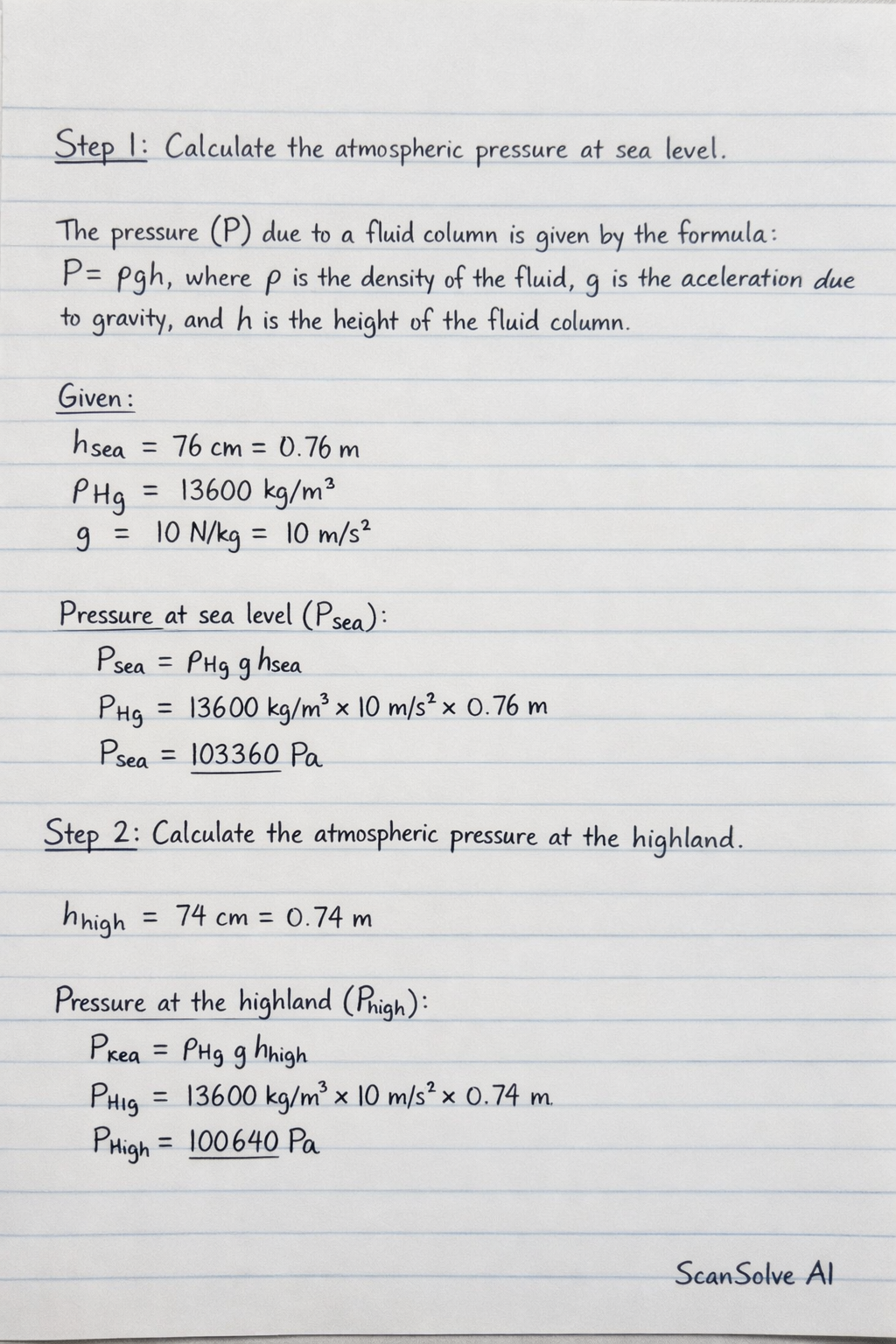
Step 1: Calculate the atmospheric pressure at sea level. The pressure (P) due to a fluid column is given by the formula P = g h, where is the density of the fluid, g is the acceleration due to gravity, and h is the height of the fluid column. Given: Barometric height at sea level (h_sea) = 76 cm = 0.76 m Density of mercury (_Hg) = 13600 kg/m^3 Acceleration due to gravity (g) = 10 N/kg = 10 m/s^2 Pressure at sea level (P_sea): P_sea = _Hg g h_sea P_sea = 13600 kg/m^3 × 10 m/s^2 × 0.76 m P_sea = 103360 Pa Step 2: Calculate the atmospheric pressure at the highland. Barometric height at the highland (h_high) = 74 cm = 0.74 m Pressure at the highland (P_high): P_high = _Hg g h_high P_high = 13600 kg/m^3 × 10 m/s^2 × 0.74 m P_high = 100640 Pa Step 3: Determine the pressure difference between sea level and the highland. The pressure difference ( P) is the difference between the pressure at sea level and the pressure at the highland. P = P_sea - P_high P = 103360 Pa - 100640 Pa P = 2720 Pa Step 4: Calculate the altitude of the point. The pressure difference is caused by the column of air between sea level and the highland. This pressure difference can also be expressed as P = _air g H, where _air is the density of air and H is the altitude. Given: Density of air (_air) = 1.25 kg/m^3 Rearrange the formula to solve for H: H = ( P)/(_air) g H = 2720 Pa1.25 kg/m^3 × 10 m/s^2 H = (2720)/(12.5) m H = 217.6 m The altitude of the point is: 217.6 m That's 2 down. 3 left today — send the next one.