
We read your photo as:
Explain four measures the Government of Kenya has taken to conserve energy.
ScanSolve AI Answer
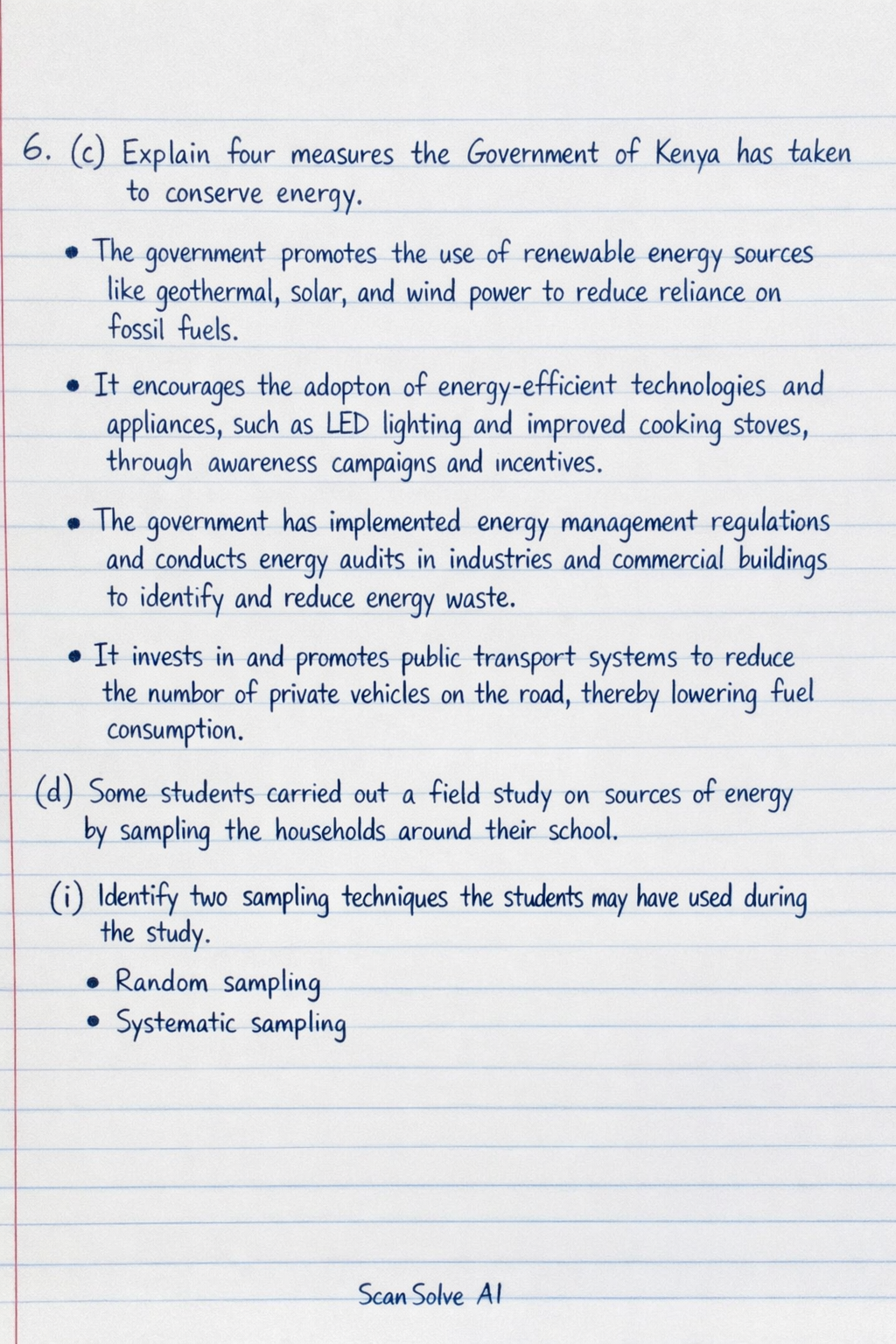
6. (c) Explain four measures the Government of Kenya has taken to conserve energy.
- The government promotes the use of renewable energy sources like geothermal, solar, and wind power to reduce reliance on fossil fuels.
- It encourages the adoption of energy-efficient technologies and appliances, such as LED lighting and improved cooking stoves, through awareness campaigns and incentives.
- The government has implemented energy management regulations and conducts energy audits in industries and commercial buildings to identify and reduce energy waste.
- It invests in and promotes public transport systems to reduce the number of private vehicles on the road, thereby lowering fuel consumption.
6. (d) Some students carried out a field study on sources of energy by sampling the households around their school.
(i) Identify two sampling techniques the students may have used during the study.
- Random sampling
- Systematic sampling
(ii) Give three advantages of sampling the households for the study.
- It saves time as fewer households need to be visited and data collected.
- It reduces the cost of the study since fewer resources (personnel, transport) are required.
- It makes the data more manageable to process, analyze, and interpret due to the smaller volume.
11. (a) Differentiate manufacturing industries from tertiary industries.
Manufacturing industries are involved in processing raw materials into finished or semi-finished goods, creating tangible products. Tertiary industries, also known as service industries, provide services to individuals and businesses rather than producing physical goods.
11. (b) Explain why the Government of Kenya encourages the setting up of industries in rural areas.
- To create employment opportunities for the rural population, reducing unemployment rates.
- To reduce rural-urban migration by providing economic opportunities closer to people's homes.
- To promote balanced regional development by distributing economic activities across the country, rather than concentrating them in urban centers.
- To utilize local raw materials and labor available in rural areas, fostering local economic growth.
- To diversify the rural economy beyond agriculture, making it more resilient.
- To improve the living standards of rural residents through increased income and access to goods and services.
11. (c) Explain four factors that have contributed to the development of electronics industry in Japan.
- Japan has a highly skilled and disciplined labor force with a strong work ethic and high levels of technical education.
- There is a significant emphasis on research and development (R&D), leading to continuous innovation and technological advancements.
- The government provides strong support and favorable policies, including subsidies and protection for domestic industries, fostering growth.
- Japan has a well-developed infrastructure, including efficient transport, communication networks, and reliable energy supply, which supports industrial operations.
11. (d) You intend to carry out a field study in a nearby post office.
(i) Identify two characteristics of a good hypothesis for the study.
- It must be testable or verifiable through data collection.
- It should be specific and clearly state the expected relationship or outcome.
(ii) State three advantages of using the interview method to collect data during the study.
- It allows for in-depth and detailed information to be gathered, as the interviewer can ask follow-up questions.
- It often results in a higher response rate compared to other methods, as direct interaction encourages participation.
- The interviewer can clarify questions and rephrase them if the respondent does not understand, ensuring accurate responses.
(iii) Give two challenges facing postal services that you are likely to find out during the study.
- Competition from digital communication methods like email, social media, and instant messaging, which have reduced the volume of traditional mail.
- High operational costs associated with maintaining a vast network of post offices, staff, and transportation for mail delivery.
Still stuck on this one?
Ask a follow-up, and the answer starts from this question.
More Physics Questions
Handwritten Step-by-Step Solution
Get this as a handwritten image on WhatsApp — like a tutor wrote it for you.
Try on WhatsApp