
We read your photo as:
Explain the distinction between joints and faults, and discuss the importance of joints in economic geology. Describe constructive plate margins.
ScanSolve AI Answer
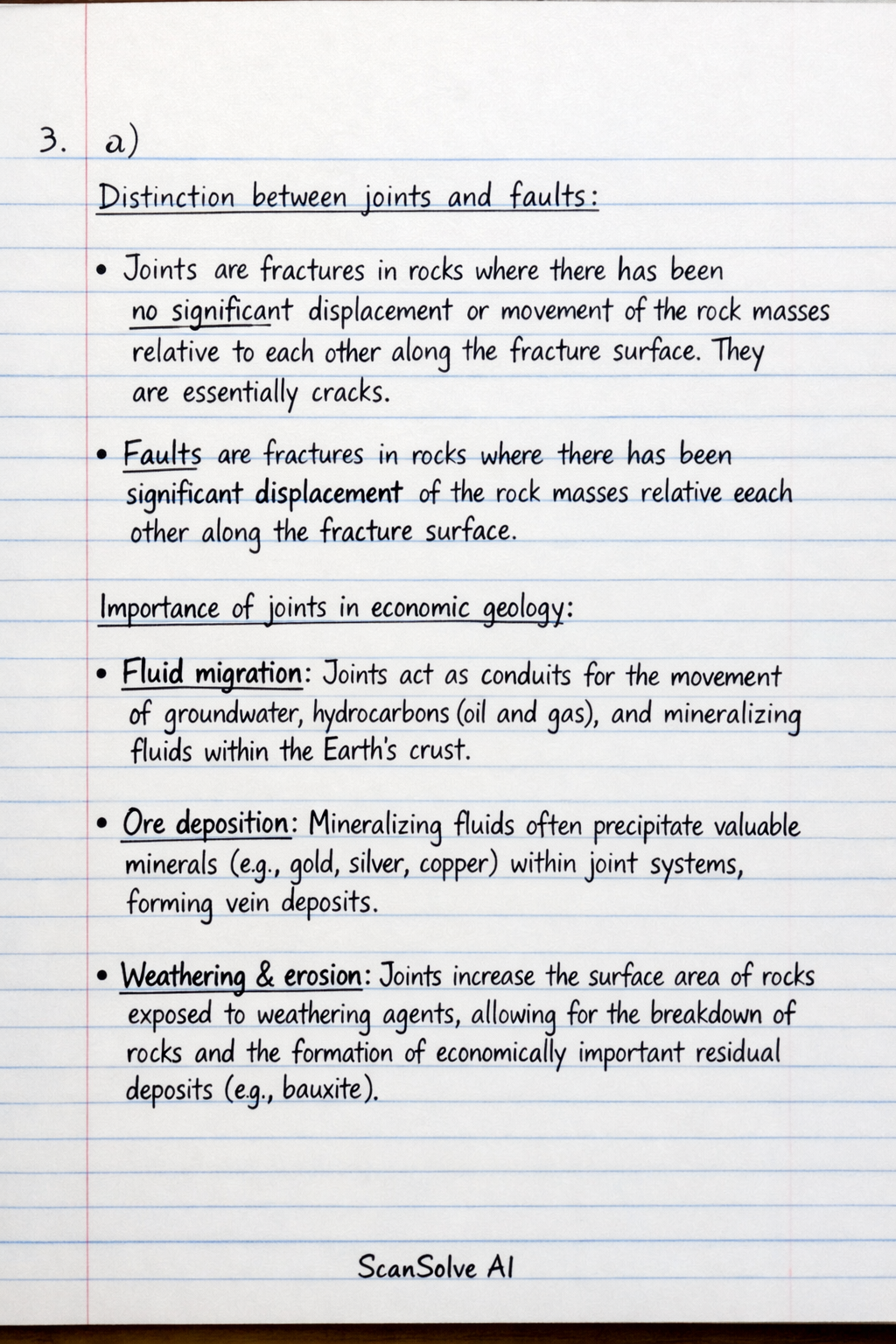
3.
a)
Distinction between joints and faults:
- Joints are fractures in rocks where there has been no significant displacement or movement of the rock masses relative to each other along the fracture surface. They are essentially cracks.
- Faults are fractures in rocks where there has been significant displacement (movement) of the rock masses relative to each other along the fracture surface.
Importance of joints in economic geology:
- Fluid migration: Joints act as conduits for the movement of groundwater, hydrocarbons (oil and gas), and mineralizing fluids within the Earth's crust.
- Ore deposition: Mineralizing fluids often precipitate valuable minerals (e.g., gold, silver, copper) within joint systems, forming vein deposits.
- Weathering and erosion: Joints increase the surface area of rocks exposed to weathering agents, facilitating the breakdown of rocks and the formation of economically important residual deposits (e.g., bauxite).
- Mining stability: The orientation and density of joints significantly influence the stability of rock masses in mining operations, affecting tunnel design and slope stability in open-pit mines.
b)
i) Constructive plate margins (Divergent plate boundaries):
- Description: These are zones where two tectonic plates move away from each other. Magma from the mantle rises to fill the gap, creating new crustal material.
- Features formed:
- Mid-ocean ridges: Underwater mountain ranges where new oceanic crust is generated (e.g., Mid-Atlantic Ridge).
- Rift valleys: Linear depressions formed where continental crust is pulling apart (e.g., East African Rift Valley).
- Volcanism: Effusive basaltic volcanism, often forming pillow lavas.
- Shallow earthquakes: Occur due to the tensional stresses as plates pull apart.
ii) Transform plate margins (Conservative plate boundaries):
- Description: These are zones where two tectonic plates slide horizontally past each other. Crust is neither created nor destroyed.
- Features formed:
- Transform faults: Large strike-slip faults that accommodate the lateral movement (e.g., San Andreas Fault in California).
- Frequent earthquakes: Often shallow and powerful, resulting from the friction and sudden release of stress as plates grind past each other.
- Offset features: Geological features like rivers or ridges may be abruptly offset along the fault line.
- Absence of volcanism: Generally no volcanic activity as there is no significant magma generation.
iii) Destructive plate margins (Convergent plate boundaries):
- Description: These are zones where two tectonic plates move towards each other. One plate is typically forced beneath the other (subduction), or both plates collide.
- Features formed (Oceanic-Continental or Oceanic-Oceanic convergence):
- Oceanic trenches: Deep, narrow depressions where the oceanic plate subducts (e.g., Mariana Trench).
- Volcanic arcs: Chains of volcanoes formed on the overriding plate (continental volcanic arcs like the Andes, or island arcs like Japan) due to melting of the subducting plate.
- Deep earthquakes: Occur along the subduction zone (Benioff zone) as the subducting plate descends.
- Fold mountains: Formation of mountain ranges (e.g., Andes) or island chains.
- Features formed (Continental-Continental collision):
- Large mountain ranges: Formation of very high fold mountains (e.g., Himalayas) as neither continental plate subducts significantly.
- Extensive faulting and folding: Due to intense compressional forces.
- Broad zone of earthquakes: Shallow to intermediate-depth earthquakes.
- Limited volcanism: Generally little to no volcanic activity.
4.
a)
Characteristics of source rocks and primary materials of crude oil:
- Source rocks are typically fine-grained sedimentary rocks, such as shales or limestones, rich in organic matter.
- Characteristics:
- High organic content: They contain a significant amount of kerogen, which is disseminated organic matter derived from dead marine organisms (phytoplankton, zooplankton) or terrestrial plants.
- Fine-grained texture: This allows for good preservation of organic matter by limiting oxygen exposure and microbial degradation.
- Anoxic depositional environment: The sediments are deposited in oxygen-deficient conditions (e.g., deep marine basins, stagnant lakes) to prevent the oxidation and decomposition of organic matter.
- Thermal maturity: The source rock must be buried to sufficient depths (typically 2-4 km) where temperatures (60-150 °C) are high enough to convert kerogen into liquid hydrocarbons (oil) and natural gas through a process called catagenesis.
- Presence of hydrogen-rich organic matter: The primary materials for crude oil are typically Type I (algal) and Type II (mixed marine) kerogens, which are rich in hydrogen and yield liquid hydrocarbons upon maturation.
b)
Various sedimentary basins in Cameroon where petroleum exploration is currently going on:
- Douala Basin
- Kribi-Campo Basin
- Rio del Rey Basin
- Mamfe Basin
- Logone-Birni Basin
c)
Three different petroleum traps:
-
Structural traps: These are formed by deformation of the rock layers, such as folding or faulting, which creates a configuration that prevents hydrocarbons from migrating further.
- Anticlinal trap: Formed by an upward fold (anticline) in rock layers. Oil and gas accumulate at the crest of the fold beneath an impermeable cap rock.
- Fault trap: Formed when a fault displaces permeable reservoir rock against an impermeable rock layer, creating a barrier to hydrocarbon migration.
- Salt dome trap: Formed when a diapiric intrusion of salt pierces and deforms overlying sedimentary layers, creating structural closures and sealing off reservoir rocks.
-
Stratigraphic traps: These are formed by variations in the rock type or pinch-outs of permeable reservoir beds, rather than by structural deformation.
- Pinch-out trap: Occurs where a permeable reservoir rock thins out and disappears laterally into an impermeable rock layer, trapping hydrocarbons.
- Unconformity trap: Formed where an erosional surface (unconformity) truncates permeable reservoir beds, which are then sealed by an overlying impermeable layer.
- Reef trap: Formed by porous ancient coral reefs or carbonate buildups that are surrounded and sealed by impermeable shales or limestones.
-
Combination traps: These traps involve a combination of both structural and stratigraphic features to create the hydrocarbon accumulation. For example, a fault might cut across a pinch-out, or an anticline might be associated with a facies change.
5.
a)
Physical conditions which determine the preservation of fossils:
- Rapid burial: Organisms must be buried quickly after death to protect them from scavengers, decomposition, and physical destruction (e.g., by currents or waves). This limits exposure to oxygen and bacteria.
- Anoxic environment: Burial in oxygen-deficient (anoxic) environments significantly slows down or prevents aerobic decomposition by bacteria and fungi, which are the primary agents of decay.
- Fine-grained sediments: Burial in fine-grained sediments (e.g., mud, silt, clay) provides a tight seal around the organism, further limiting oxygen penetration and microbial activity. It also helps preserve delicate structures.
- Presence of hard parts: Organisms with hard parts (shells, bones, teeth, woody stems) are much more likely to be preserved than those composed entirely of soft tissues, as hard parts are more resistant to decay and physical destruction.
- Lack of metamorphism or intense deformation: The rocks containing the fossils must not undergo significant metamorphism or intense deformation, as these processes can destroy or distort the fossil remains.
- Stable tectonic environment: Areas with minimal tectonic activity are more conducive to long-term preservation, as uplift, erosion, or intense faulting can expose or destroy fossil-bearing strata.
b)
Various modes of preservation of fossils that result in changes in the mineral substance of the hard parts:
- Permineralization (Petrification): This occurs when mineral-rich groundwater seeps into the porous spaces (e.g., bone cells, wood pores) of an organism's hard parts. Minerals (commonly silica, calcite, or pyrite) precipitate within these spaces, hardening and preserving the original structure. The original organic material may or may not remain.
- Replacement: In this mode, the original hard parts of an organism are completely dissolved and replaced, molecule by molecule, by new minerals. The new mineral takes on the exact shape and fine details of the original structure. Common replacing minerals include silica (silicification), pyrite (pyritization), or calcite (calcification).
- Recrystallization: This process involves the conversion of the original mineral substance of a hard part into a more stable or larger crystal form of the same mineral. For example, aragonite shells (a less stable form of calcium carbonate) may recrystallize into calcite (a more stable form), often destroying fine internal details.
- Carbonization (Carbon film): While primarily preserving soft parts, carbonization can also affect hard parts. It involves the removal of volatile elements (hydrogen, oxygen, nitrogen) from organic matter under pressure and heat, leaving behind a thin film of carbon that preserves the outline and some surface details of the organism. This is common for plants and graptolites.
c)
Textures as used in igneous petrology:
- Texture in igneous petrology refers to the size, shape, and arrangement of mineral grains within an igneous rock. It provides clues about the cooling history and formation environment of the magma or lava.
d)
Differentiation between porphyritic and amygdaloidal texture:
- Porphyritic texture: This texture is characterized by two distinct crystal sizes: large, well-formed crystals (phenocrysts) embedded in a groundmass of much finer-grained crystals or glass. It indicates a two-stage cooling history, with initial slow cooling at depth allowing large crystals to grow, followed by rapid cooling at or near the surface.
- Amygdaloidal texture: This texture is found in volcanic rocks (extrusive igneous rocks) and is characterized by the presence of infillings of secondary minerals (e.g., quartz, calcite, zeolites) within former gas bubbles or vesicles. These filled vesicles are called amygdales. It indicates that the lava contained gas bubbles that were later filled by minerals from circulating fluids.
Still stuck on this one?
Ask a follow-up, and the answer starts from this question.
More Geography Questions
Handwritten Step-by-Step Solution
Get this as a handwritten image on WhatsApp — like a tutor wrote it for you.
Try on WhatsApp