
We read your photo as:
Describe orogenic and epeirogenic movements, identify features S, T, and U on a diagram, explain folding and faulting, and discuss two ways faulting influences transport.
ScanSolve AI Answer
Step-by-step solution
3 stepsHere are the answers to the questions:
-
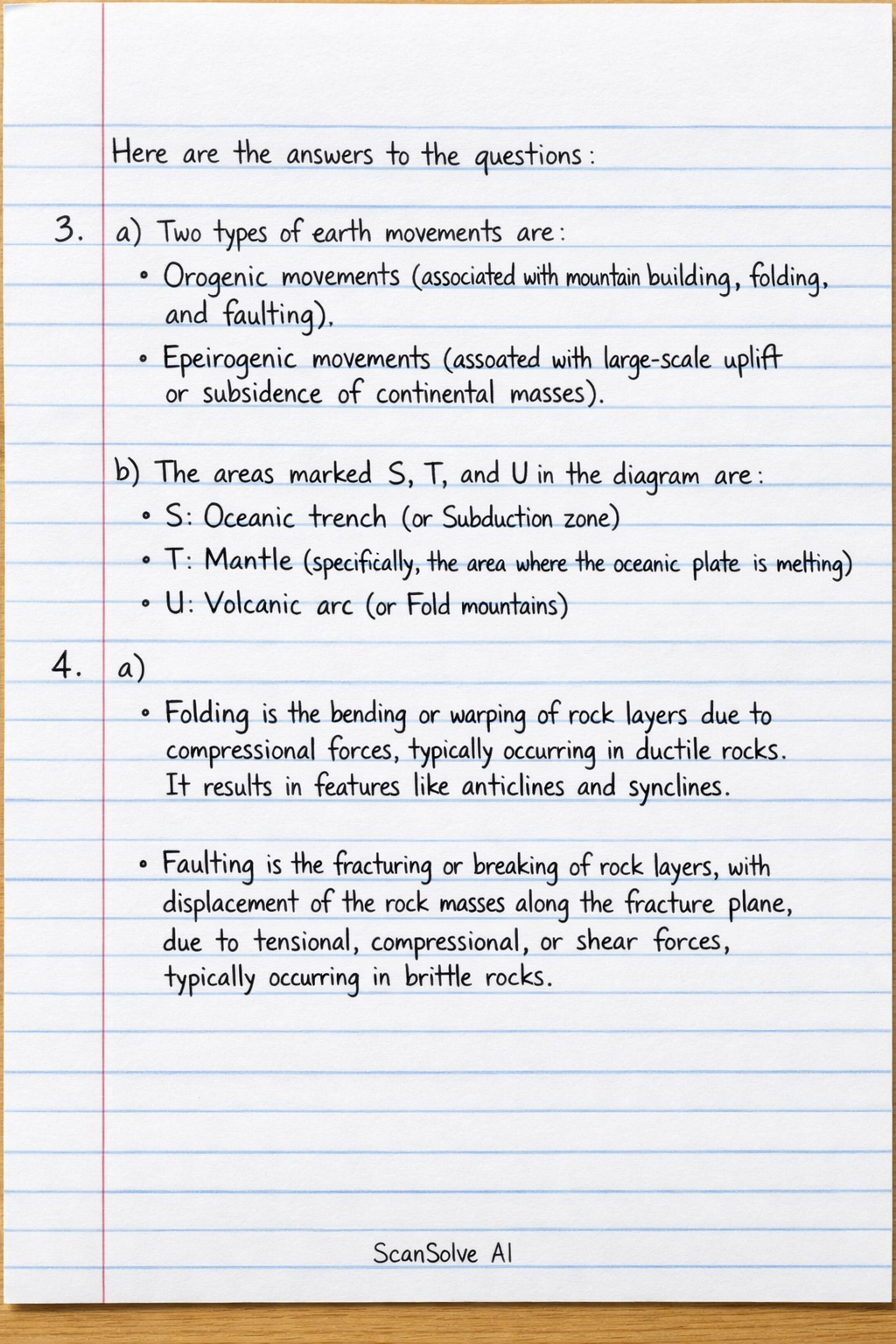
a) Two types of earth movements are:
- Orogenic movements (associated with mountain building, folding, and faulting).
- Epeirogenic movements (associated with large-scale uplift or subsidence of continental masses).
b) The areas marked S, T, and U in the diagram are:
- S: Oceanic trench (or Subduction zone)
- T: Mantle (specifically, the area where the oceanic plate is melting)
- U: Volcanic arc (or Fold mountains)
-
a)
- Folding is the bending or warping of rock layers due to compressional forces, typically occurring in ductile rocks. It results in features like anticlines and synclines.
- Faulting is the fracturing or breaking of rock layers, with displacement of the rock masses along the fracture plane, due to tensional, compressional, or shear forces, typically occurring in brittle rocks.
b) Two ways in which faulting influences transport are:
- Fault scarps and rift valleys can create steep slopes and obstacles, making the construction of roads and railways difficult and expensive, often requiring detours or extensive engineering.
- Fault lines can create linear depressions or valleys that provide natural routes for the construction of transport networks, such as roads, railways, or canals.
-
Anabatic winds are local winds that blow up a valley or mountain slope during the day. They occur as the sun heats the slopes, causing the air above them to warm, become less dense, and rise. Katabatic winds are local winds that blow down a valley or mountain slope during the night. They occur as the slopes cool rapidly, causing the air above them to become dense and cold, and then sink down the slope due to gravity.
-
a) i) Two pieces of information that can be obtained from the sheet title of the map "KIPKABUS 1:50,000 (sheet 104/1)" are:
- The name of the area covered by the map (KIPKABUS).
- The scale of the map (1:50,000).
ii) To convert the ratio scale of 1:50,000 into a statement scale:
Understand the ratio scale.
$$ 1:50,000 \text{ means } 1 \text{ unit on the map represents } 50,000 \text{ of the same units on the ground.} $$Convert ground units to a more practical measurement (e.g., kilometers).
$$ 50,000 \text{ cm} = \frac{50,000}{100} \text{ m} = 500 \text{ m} $$ $$ 500 \text{ m} = \frac{500}{1000} \text{ km} = 0.5 \text{ km} $$Formulate the statement scale.
$$
\text{Therefore, } 1 \text{ cm on the map represents } 0.5 \text{ km on the ground.}
$$
The statement scale is: $\boxed{\text{1 cm represents 0.5 km}}$

**iii)** The magnetic variation of the area when the map was drawn is typically found in the **marginal information or legend of the map itself**. Without the actual map of KIPKABUS 1:50,000 (sheet 104/1), this specific information cannot be determined.
Still stuck on this one?
Ask a follow-up, and the answer starts from this question.
More Geography Questions
Handwritten Step-by-Step Solution
Get this as a handwritten image on WhatsApp — like a tutor wrote it for you.
Try on WhatsApp