
We read your photo as:
Explain Earth movements, orogenic and epeirogenic movements, isostatic adjustment, and factors determining features formed by earth movements.
ScanSolve AI Answer
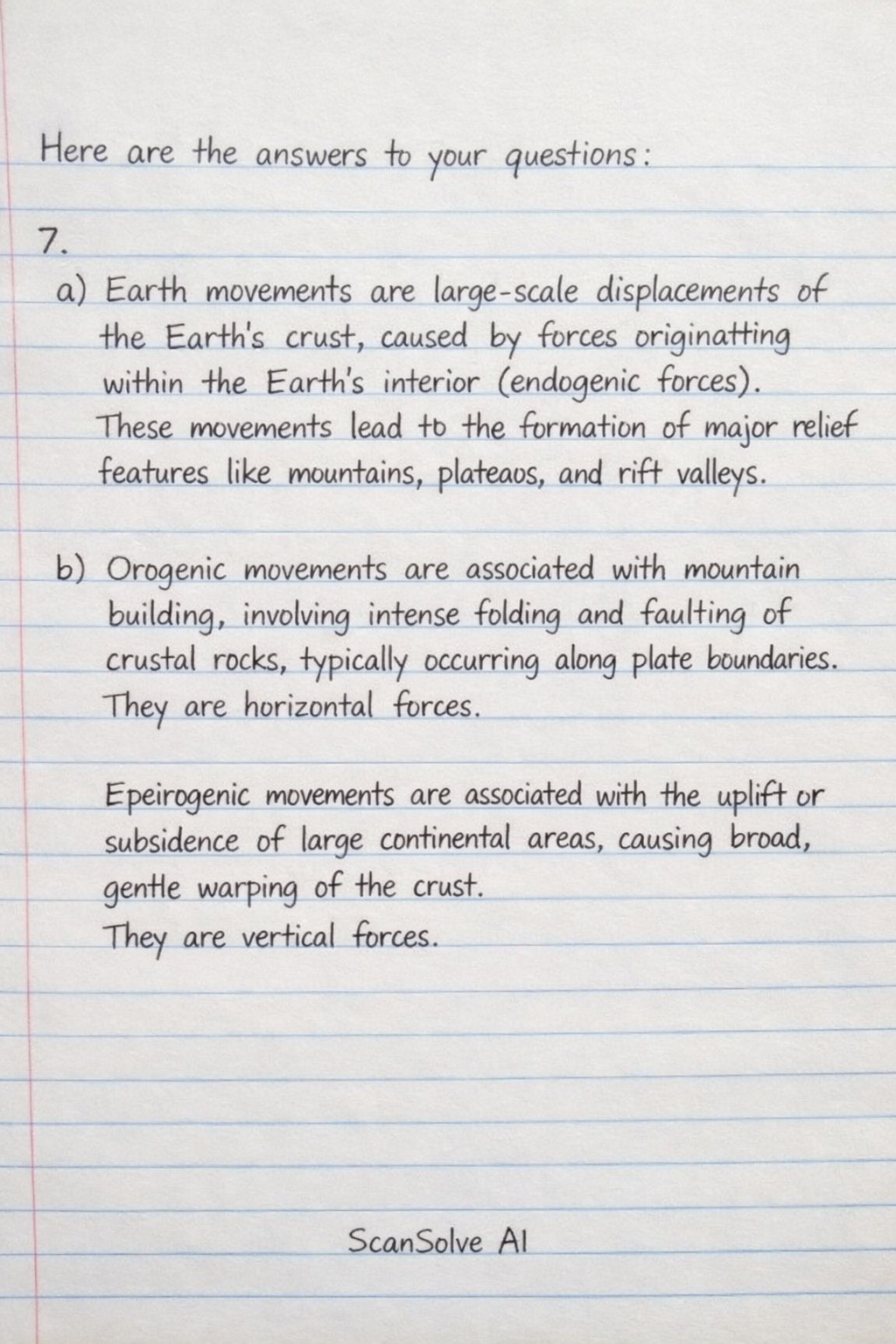
Here are the answers to your questions:
-
a) Earth movements are large-scale displacements of the Earth's crust, caused by forces originating within the Earth's interior (endogenic forces). These movements lead to the formation of major relief features like mountains, plateaus, and rift valleys.
b) Orogenic movements are associated with mountain building, involving intense folding and faulting of crustal rocks, typically occurring along plate boundaries. They are horizontal forces. Epeirogenic movements are associated with the uplift or subsidence of large continental areas, causing broad, gentle warping of the crust. They are vertical forces.
c) Isostatic adjustment causes earth movement when there is an imbalance in the Earth's crust due to changes in load. For example, when glaciers melt, the removal of ice weight causes the land to slowly rise (isostatic rebound). Conversely, the accumulation of sediments or ice can cause the crust to subside. This vertical movement occurs as the lithosphere "floats" on the denser, more fluid asthenosphere, seeking equilibrium.
d) Three factors that determine the type of features formed as a result of earth movement are:
- The type of rock (e.g., brittle rocks tend to fault, ductile rocks tend to fold).
- The magnitude and direction of the forces involved (e.g., compression, tension, shear).
- The rate at which the forces are applied (slow deformation allows for folding, rapid deformation can cause faulting).
Subduction zones are areas where one tectonic plate slides beneath another and sinks into the Earth's mantle. This typically occurs at convergent plate boundaries where an oceanic plate converges with another oceanic plate or a continental plate.
f) Three examples of transform faults are:
- San Andreas Fault (California, USA)
- North Anatolian Fault (Turkey)
- Alpine Fault (New Zealand)
g) Two oceanic plates are:
- Pacific Plate
- Nazca Plate
- (Other examples include the Cocos Plate, Philippine Sea Plate, Juan de Fuca Plate)
h) According to the plate tectonics theory, fold mountains are formed at convergent plate boundaries where two continental plates collide, or where an oceanic plate subducts beneath a continental plate. The immense compressional forces cause the sedimentary rocks accumulated in the geosynclines (depressions between the converging plates) to be intensely folded, faulted, and uplifted, creating mountain ranges.
Still stuck on this one?
Ask a follow-up, and the answer starts from this question.
More Geography Questions
Handwritten Step-by-Step Solution
Get this as a handwritten image on WhatsApp — like a tutor wrote it for you.
Try on WhatsApp