
We read your photo as:
ELEMENTS OF PRACTICAL AND PHYSICAL GEOGRAPHY Study the map extract IFO DISTRICT on a scale 1:50,000 and answer the questions that follow:
ScanSolve AI Answer
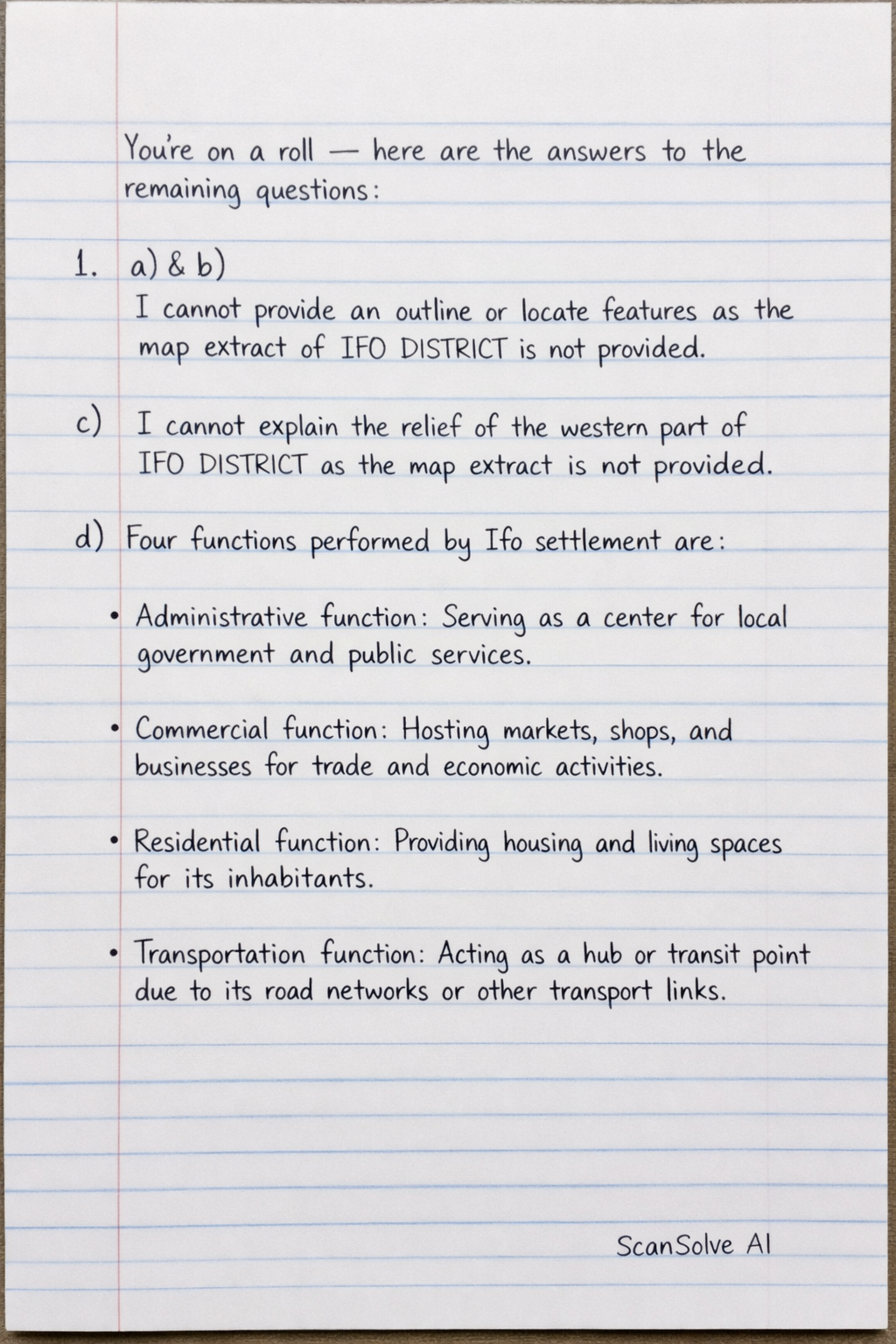
here are the answers to the remaining questions:
1.
a) & b) I cannot provide an outline or locate features as the map extract of IFO DISTRICT is not provided.
c) I cannot explain the relief of the western part of IFO DISTRICT as the map extract is not provided.
d) Four functions performed by Ifo settlement are:
- Administrative function: Serving as a center for local government and public services.
- Commercial function: Hosting markets, shops, and businesses for trade and economic activities.
- Residential function: Providing housing and living spaces for its inhabitants.
- Transportation function: Acting as a hub or transit point due to its road networks or other transport links.
2.
a) Two differences between lunar and solar eclipses:
- A lunar eclipse occurs when the Earth passes directly between the Sun and the Moon, casting a shadow on the Moon. A solar eclipse occurs when the Moon passes directly between the Sun and the Earth, casting a shadow on the Earth.
- A lunar eclipse can only happen during a full moon and is visible from any location on Earth where the Moon is above the horizon. A solar eclipse can only happen during a new moon and is visible only from a narrow path on Earth where the Moon's shadow falls. (I cannot provide diagrams in this format.)
b) Explanation of sunrise and sunset as proof of Earth's sphericity:
If the Earth were flat, the Sun would appear to rise and set simultaneously for everyone on its surface, or it would gradually dim and brighten across the entire flat plane. However, because the Earth is a sphere, as it rotates, the Sun appears to gradually emerge above the horizon (sunrise) or disappear below it (sunset) at different times for different locations. This gradual appearance and disappearance, and the fact that different places experience these events at different times, is direct evidence of the Earth's curved surface.
(I cannot provide diagrams in this format.)
3.
a) Three types of igneous rocks are:
- Intrusive (Plutonic) igneous rocks (e.g., granite)
- Extrusive (Volcanic) igneous rocks (e.g., basalt)
- Hypabyssal igneous rocks (e.g., dolerite)
b) Three characteristics of igneous rocks are:
- They are typically crystalline, composed of interlocking mineral crystals formed from the cooling and solidification of molten magma or lava.
- They generally lack fossils because the extreme heat of their formation destroys any organic remains.
- They are often hard and resistant to erosion due to their dense, crystalline structure.
c) Four economic importance of rocks are:
- Construction materials: Rocks like granite, limestone, and sandstone are used as building materials, aggregates for concrete, and in road construction.
- Source of minerals and ores: Rocks contain valuable metallic minerals (e.g., iron, gold, copper) and non-metallic minerals (e.g., salt, gypsum) that are mined for various industries.
- Energy resources: Sedimentary rocks are the primary source of fossil fuels such as coal, petroleum, and natural gas, which are crucial for global energy supply.
- Soil formation: The weathering and erosion of rocks contribute to the formation of soil, which is essential for agriculture and supporting plant life.
Still stuck on this one?
Ask a follow-up, and the answer starts from this question.
More Geography Questions
Handwritten Step-by-Step Solution
Get this as a handwritten image on WhatsApp — like a tutor wrote it for you.
Try on WhatsApp