
Example 1: A 5 kg block A rests on a frictionless table and is connected by a light string over a pulley to a 3 kg block B hanging vertically. Find the acceleration of the system and the tension in the string. Take g = 9.8 m/s². Solution: 1. Free body diagram + Law 1/3: For block A, normal force balances its weight. Tension T pulls it right. For block B, weight mB g pulls down, tension T pulls up. Action-reaction: the string has the same T on both sides. 2. Apply F = ma to each block: - Block A: T = mA a - Block B: mB g − T = mB a 3. Solve: Add both equations → mB g = (mA + mB)a a = (mB g)/(mA + mB) = (3 x 9.8)/(5 + 3) = (29.4)/(8) = 3.68 m/s² T = mA a = 5 x 3.68 = 18.4 N Insight: The 3kg block doesn’t fall at 9.8 m/s² because the 5kg block resists it via tension. Example 2: A 10 kg box slides down a 30° frictionless incline. Find its acceleration. Solution: 1. Resolve forces: Gravity mg acts vertically down. Resolve into components parallel and perpendicular to the plane: - Parallel: mg 30^ - Perpendicular: mg 30^ — balanced by normal force, so no motion here. 2. Apply F = ma along the plane using Law 2: mg 30^ = m a a = g 30^ = 9.8 x 0.5 = 4.9 m/s² Insight: Mass cancels out — all objects slide down a frictionless slope with the same acceleration. That’s Law 1: without friction, nothing else stops the motion. Example 3: A rocket ejects gas at 2000 m/s relative to the rocket at a rate of 50 kg/s. What is the thrust force on the rocket? Solution: 1. Law 3: The force on the gas = force on the rocket. This is called thrust. 2. Thrust = rate of change of momentum of ejected gas: F = ( p)/( t) = m v = 50 kg/s x 2000 m/s = 100,000 N Insight: No air is needed. The rocket pushes gas one way, gas pushes rocket the other way. Exercise a. A 2kg block is pushed across a rough floor with a 20N force. Friction is 8N. What is the acceleration Hint: Net force = Applied force - Friction = 20 - 8 = 12N. Then a = F/m = 12/2 = 6 m/s²._
Geography
ScanSolve AI Answer
Step-by-step solution
3 stepsHere's the solution to your exercise:
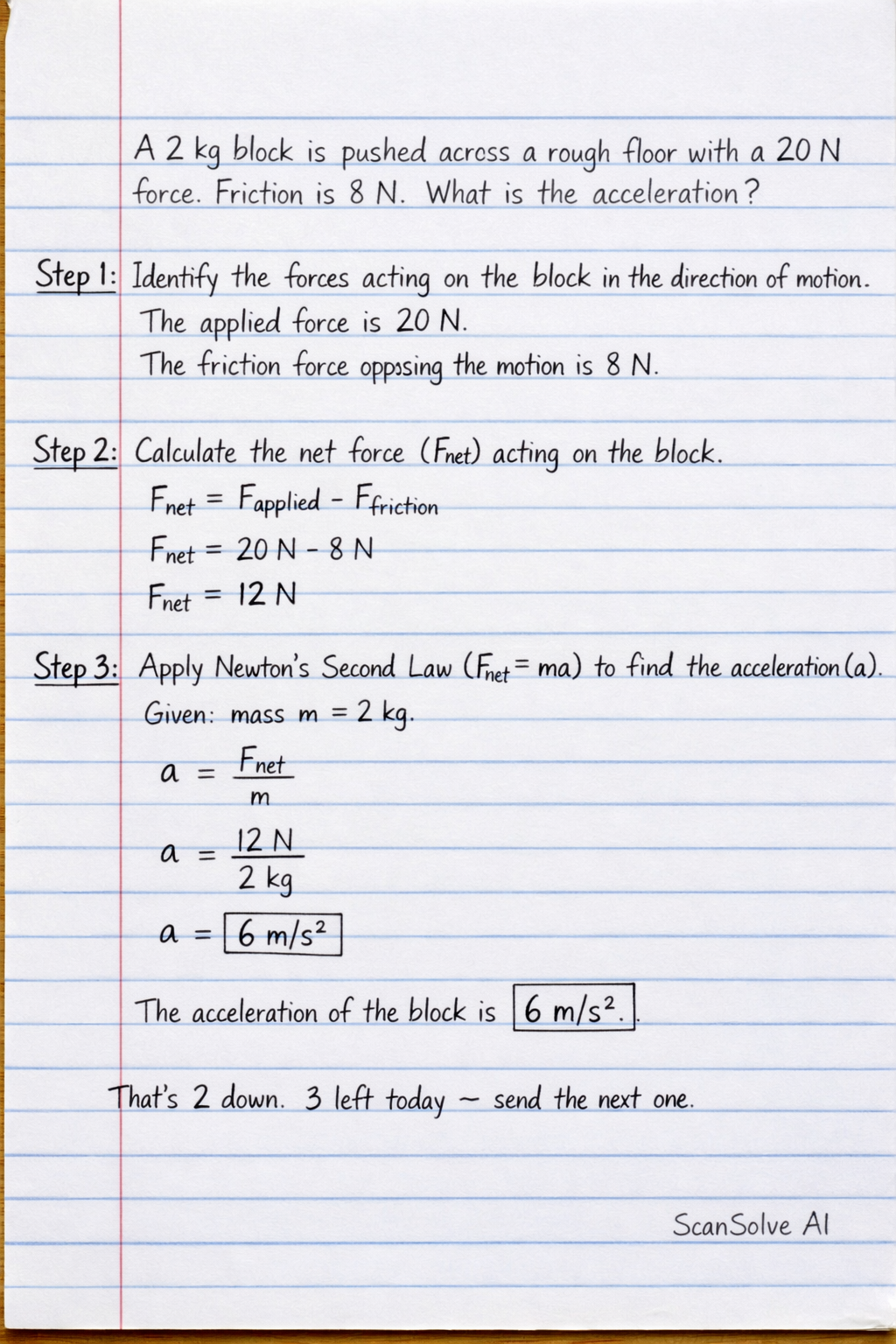
a) A 2kg block is pushed across a rough floor with a 20N force. Friction is 8N. What is the acceleration?
Identify the forces acting on the block in the direction of motion.
The applied force is .
The friction force opposing the motion is .Calculate the net force () acting on the block.
Apply Newton's Second Law () to find the acceleration ().
Given mass .
The acceleration of the block is .
Was this helpful?
Still stuck on this one?
Ask a follow-up, and the answer starts from this question.
Got a different question?Ask your own question
More Geography Questions
QMultiple Choice Quiz (Practice) Here are 10 multiple-choice questions covering all the concepts we…QA block of mass 200g rests on a rough horizontal table. A force of 0.6N pulls the block so that it…QTwo blocks, A and B, with masses 10 kg and 15 kg respectively, are placed side-by-side on a…QA horizontal force is applied to a system of two blocks (m1 = 300g, m2 = 500g) resting on a…QA mass of 4kg rests on a horizontal table(coefficient of friction 1/2) and is connected by a light…
Handwritten Step-by-Step Solution
Get this as a handwritten image on WhatsApp — like a tutor wrote it for you.
Try on WhatsApp