
We read your photo as:
What are four environmental and four social consequences of deforestation in your district?
Geography
ScanSolve AI Answer
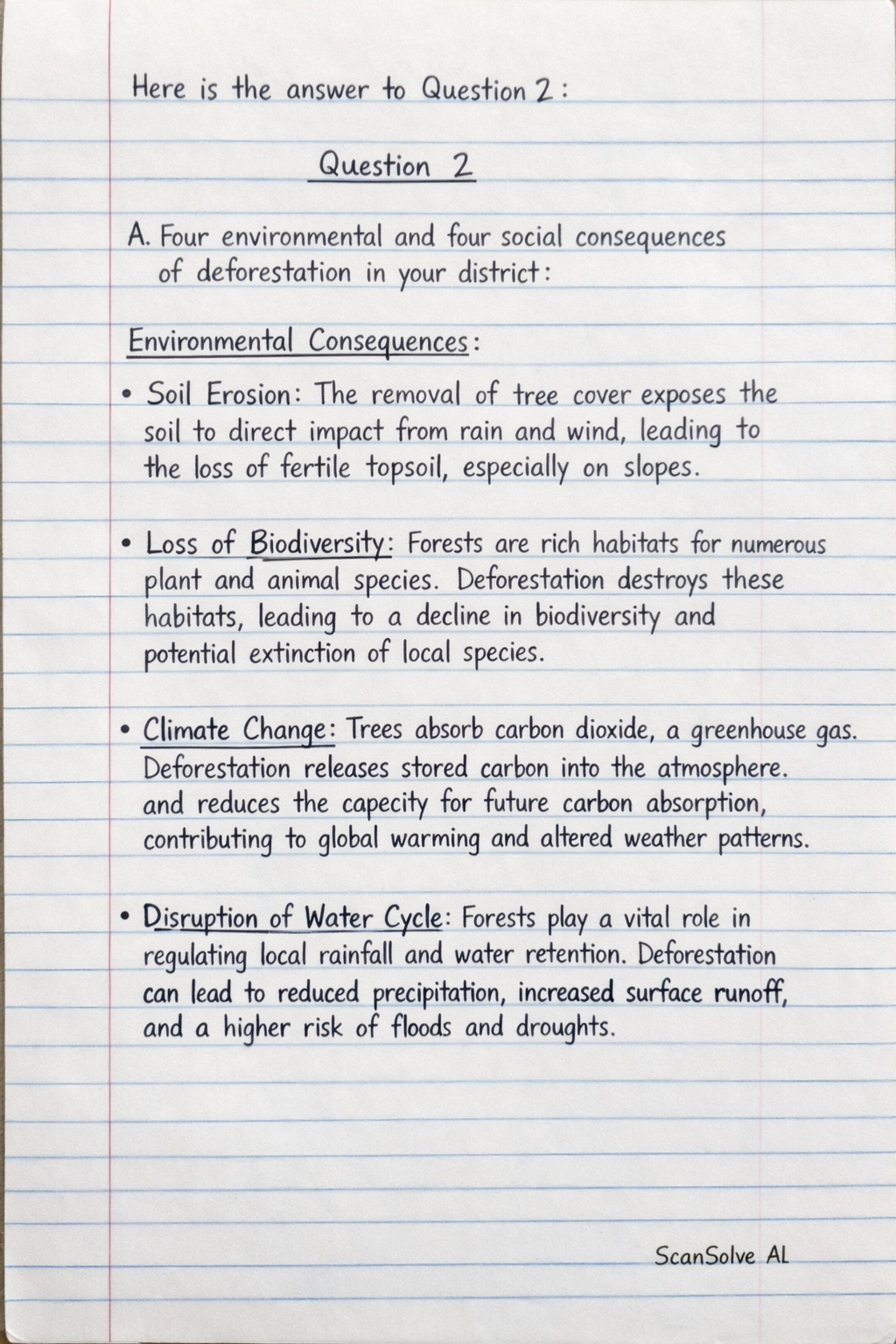
Here is the answer to Question 2:
Question 2
A. Four environmental and four social consequences of deforestation in your district:
Environmental Consequences:
- Soil Erosion: The removal of tree cover exposes the soil to direct impact from rain and wind, leading to the loss of fertile topsoil, especially on slopes.
- Loss of Biodiversity: Forests are rich habitats for numerous plant and animal species. Deforestation destroys these habitats, leading to a decline in biodiversity and potential extinction of local species.
- Climate Change: Trees absorb carbon dioxide, a greenhouse gas. Deforestation releases stored carbon into the atmosphere and reduces the capacity for future carbon absorption, contributing to global warming and altered weather patterns.
- Disruption of Water Cycle: Forests play a vital role in regulating local rainfall and water retention. Deforestation can lead to reduced precipitation, increased surface runoff, and a higher risk of floods and droughts.
Social Consequences:
- Loss of Livelihoods: Many local communities depend on forests for resources such as timber, fuelwood, medicinal plants, and non-timber forest products. Deforestation destroys these resources, impacting traditional livelihoods and economic stability.
- Displacement of Indigenous Communities: Forest-dwelling communities often have deep cultural and economic ties to the forest. Deforestation can force these communities to relocate, disrupting their way of life and cultural heritage.
- Increased Poverty: The loss of natural resources and traditional livelihoods due to deforestation can exacerbate poverty within affected communities, leading to food insecurity and reduced quality of life.
- Health Issues: Deforestation can alter ecosystems, potentially increasing the prevalence of certain diseases (e.g., vector-borne diseases) by changing habitats for disease carriers. It can also reduce access to traditional medicinal plants.
B. School-based environmental project to address deforestation:
Project Title: "Green Guardians: School Reforestation and Awareness Program"
i. The objectives:
- To educate students and the wider school community about the causes, impacts, and solutions to deforestation.
- To actively engage students in practical tree planting and forest restoration activities within the school and local community.
- To foster a sense of environmental stewardship and responsibility among students.
- To establish a sustainable school nursery for continuous seedling production.
ii. Key activities:
- Educational Workshops: Conduct regular workshops and seminars for students on topics such as the importance of forests, sustainable forestry, and the local impacts of deforestation.
- Tree Planting Drives: Organize scheduled tree planting events within the school grounds, along riverbanks, and in identified degraded areas in the local community, involving students, teachers, and parents.
- School Nursery Establishment: Set up and maintain a small tree nursery within the school premises where students learn to collect seeds, germinate them, and care for seedlings of native tree species.
- Community Outreach: Collaborate with local environmental groups and community leaders to extend awareness campaigns and planting efforts beyond the school, involving local residents.
iii. Expected outcomes of the project:
- Increased knowledge and awareness among students and the community regarding the importance of forests and the negative effects of deforestation.
- Successful reforestation of degraded areas, leading to improved local environmental conditions, such as reduced soil erosion and enhanced biodiversity.
- Development of practical skills in environmental conservation, horticulture, and project management among participating students.
- A more environmentally conscious school culture that promotes sustainable practices and active participation in conservation efforts.
- A self-sustaining source of native tree seedlings for future reforestation initiatives through the school nursery.
Was this helpful?
Still stuck on this one?
Ask a follow-up, and the answer starts from this question.
Got a different question?Ask your own question
More Geography Questions
QHighlight four adverse effects of production activities on the environment and community.QIs clearing of tropical rainforest a good practice in ecological studies? Advance four reasons for…QIdentify the environmental issue, list two of its effects, and suggest one solution.QOutline TWO causes of each of the following environmental hazards common in MEDCs: i) Floods ii)…QImpact of environmental awareness on cubbing deforestation and promoting biodiversity conservation…
Handwritten Step-by-Step Solution
Get this as a handwritten image on WhatsApp — like a tutor wrote it for you.
Try on WhatsApp