
We read your photo as:
Define geography and explain its relationship with biology. Describe land breezes and adiabatic cooling. Define folding and list four types of folds.
ScanSolve AI Answer
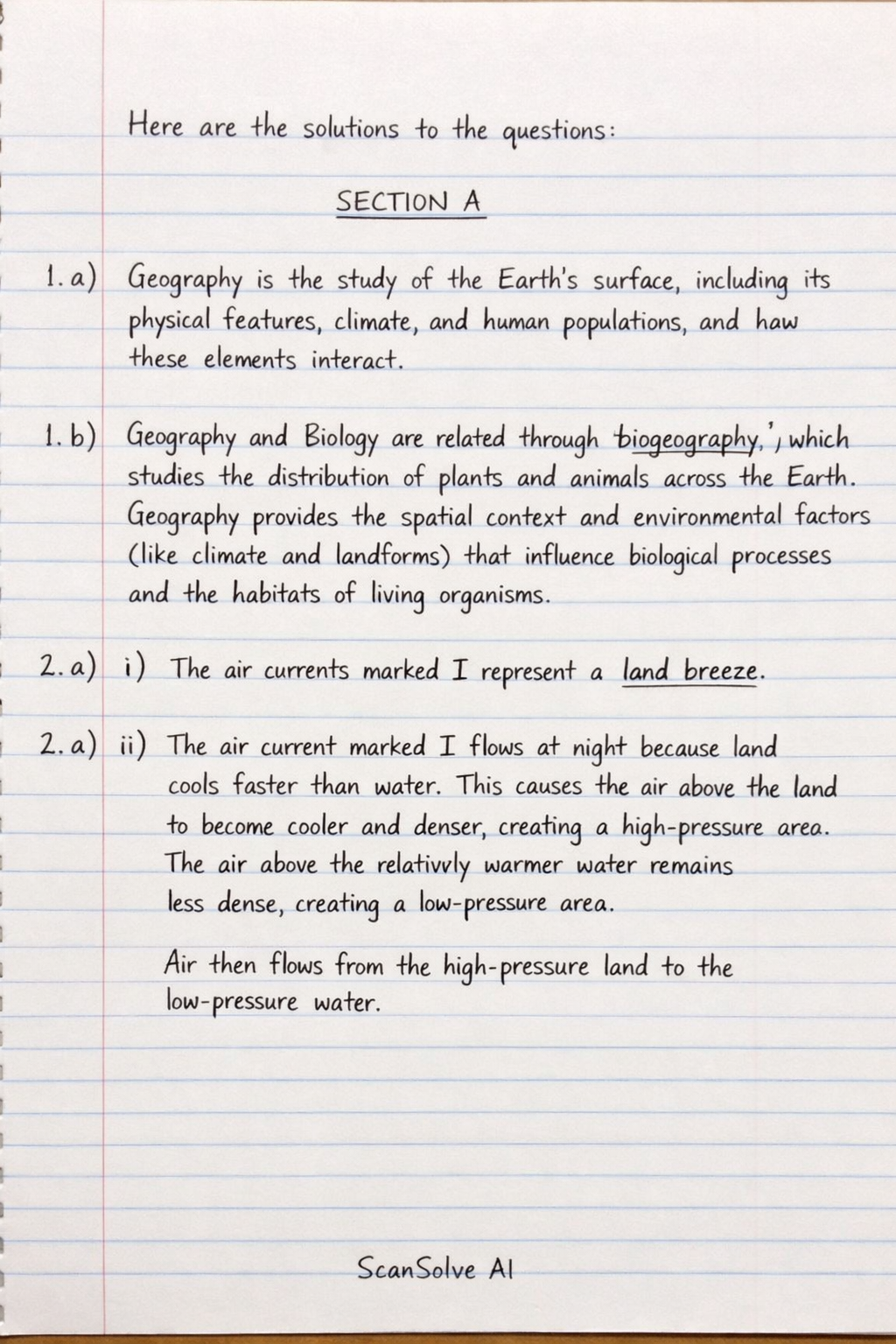
Here are the solutions to the questions:
SECTION A
1. a) Geography is the study of the Earth's surface, including its physical features, climate, and human populations, and how these elements interact.
1. b) Geography and Biology are related through biogeography, which studies the distribution of plants and animals across the Earth. Geography provides the spatial context and environmental factors (like climate and landforms) that influence biological processes and the habitats of living organisms.
2. a) i) The air currents marked I represent a land breeze.
2. a) ii) The air current marked I flows at night because land cools faster than water. This causes the air above the land to become cooler and denser, creating a high-pressure area. The air above the relatively warmer water remains less dense, creating a low-pressure area. Air then flows from the high-pressure land to the low-pressure water.
2. b) Air cools as it rises due to adiabatic expansion. As air ascends, the atmospheric pressure decreases, causing the air to expand. This expansion requires energy, which is drawn from the internal energy of the air molecules, leading to a decrease in temperature.
3. a) Folding is a geological process where layers of rock are bent or curved due to compressional forces acting on the Earth's crust.
3. b) Four types of folds are:
- Anticline
- Syncline
- Monocline
- Recumbent fold
4. a) The process illustrated in the diagram is soil creep.
4. b) Soil creep occurs as a slow, continuous downslope movement of soil and loose rock. It is primarily caused by repeated expansion and contraction of soil particles due to processes like freezing and thawing, wetting and drying, or heating and cooling. With each cycle, gravity pulls the particles slightly downhill, resulting in a gradual net movement.
5. a) A river profile, also known as a longitudinal profile, is a cross-section of a river from its source to its mouth, illustrating the gradient or slope of the river bed along its entire course.
5. b) The three stages of a river profile are:
- Upper course (or youthful stage)
- Middle course (or mature stage)
- Lower course (or old stage)
Still stuck on this one?
Ask a follow-up, and the answer starts from this question.
More Geography Questions
Handwritten Step-by-Step Solution
Get this as a handwritten image on WhatsApp — like a tutor wrote it for you.
Try on WhatsApp