
We read your photo as:
Describe the layers of the Earth, including their composition, density, and physical state.
ScanSolve AI Answer
Step-by-step solution
4 stepsHere's the solution for question 1(a):
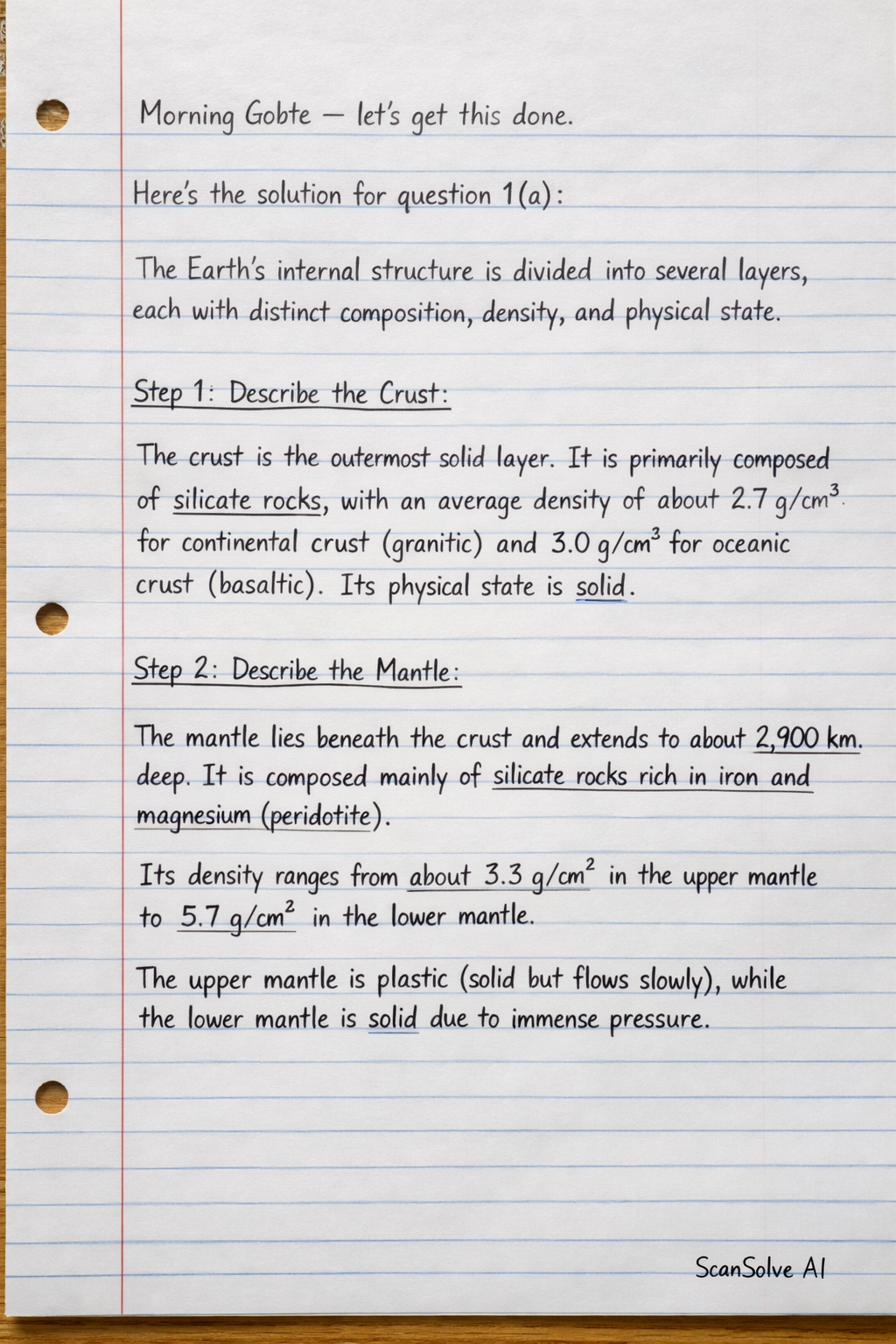
a) The Earth's internal structure is divided into several layers, each with distinct composition, density, and physical state.
Describe the Crust.
The crust is the outermost solid layer. It is primarily composed of silicate rocks, with an average density of about for continental crust (granitic) and for oceanic crust (basaltic). Its physical state is solid.
Describe the Mantle.
The mantle lies beneath the crust and extends to about deep. It is composed mainly of silicate rocks rich in iron and magnesium (peridotite). Its density ranges from about in the upper mantle to in the lower mantle. The upper mantle is plastic (solid but flows slowly), while the lower mantle is solid due to immense pressure.
Describe the Outer Core.
The outer core is a liquid layer extending from to deep. It is primarily composed of molten iron and nickel, with some lighter elements. Its density ranges from about to . Its physical state is liquid, responsible for generating Earth's magnetic field.
Describe the Inner Core.
The inner core is the Earth's innermost layer, a solid sphere from to the center at . It is composed mainly of solid iron and nickel. Its density is the highest, estimated to be around to . Despite extreme temperatures, the immense pressure keeps it in a solid state.
Still stuck on this one?
Ask a follow-up, and the answer starts from this question.
More Geography Questions
Handwritten Step-by-Step Solution
Get this as a handwritten image on WhatsApp — like a tutor wrote it for you.
Try on WhatsApp