
We read your photo as:
Describe the layers of the Earth, including their state (solid/liquid) and thickness. What parts of the Earth are solid? What is the part of Earth's structure under the oceans? Use a peach as an analo
ScanSolve AI Answer
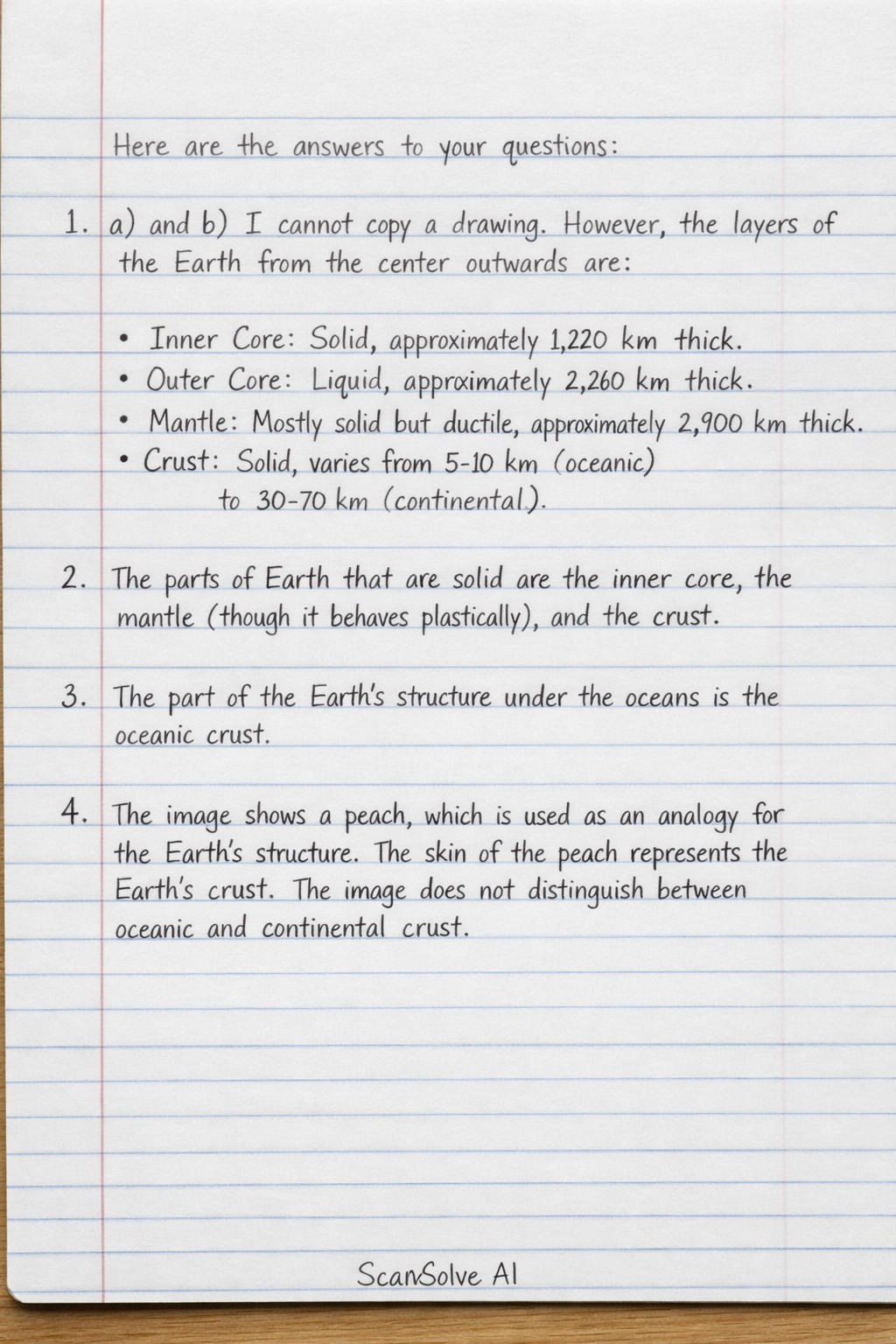
Here are the answers to your questions:
-
a) and b) I cannot copy a drawing. However, the layers of the Earth from the center outwards are:
- Inner Core: Solid, approximately thick.
- Outer Core: Liquid, approximately thick.
- Mantle: Mostly solid but ductile, approximately thick.
- Crust: Solid, varies from (oceanic) to (continental).
-
The parts of Earth that are solid are the inner core, the mantle (though it behaves plastically), and the crust.
-
The part of the Earth's structure under the oceans is the oceanic crust.
-
The image shows a peach, which is used as an analogy for the Earth's structure. The skin of the peach represents the Earth's crust. The image does not distinguish between oceanic and continental crust.
-
Here are the corrected statements: a) Earth has two types of crust: continental and oceanic. b) The thickest parts of Earth's crust are under the continents. c) New crust is continually formed at mid-ocean ridges. d) Basalt is a rock that occurs in the ocean floor.
Still stuck on this one?
Ask a follow-up, and the answer starts from this question.
More Geography Questions
Handwritten Step-by-Step Solution
Get this as a handwritten image on WhatsApp — like a tutor wrote it for you.
Try on WhatsApp