
We read your photo as:
Mapping in a Geography research task involves creating a map or maps that visually represent the study area and relevant geographical features or data. This helps to orient the reader and provide spat
Geography
ScanSolve AI Answer
Step 2: Mapping
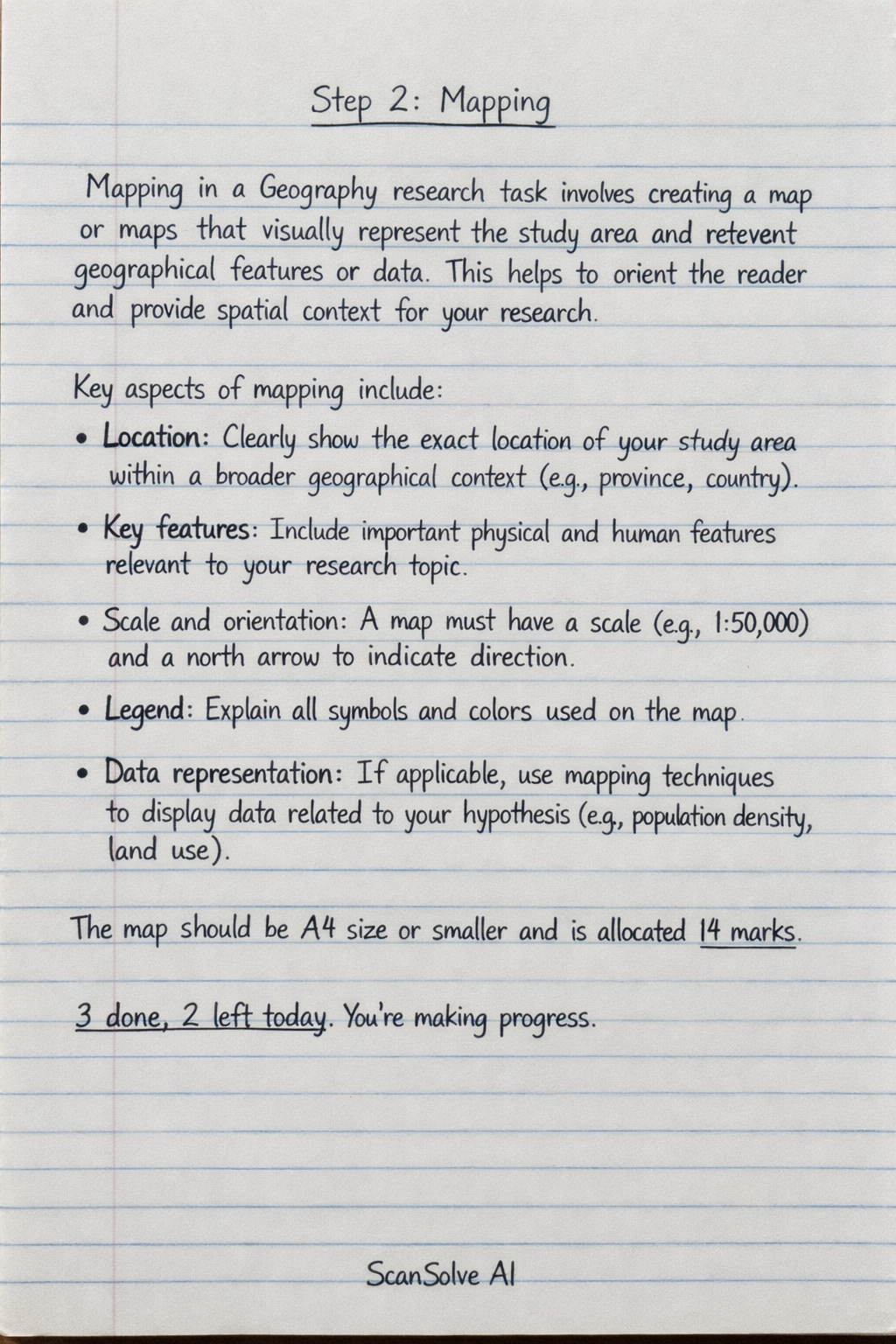
Mapping in a Geography research task involves creating a map or maps that visually represent the study area and relevant geographical features or data. This helps to orient the reader and provide spatial context for your research.
Key aspects of mapping include:
- Location: Clearly show the exact location of your study area within a broader geographical context (e.g., province, country).
- Key features: Include important physical and human features relevant to your research topic.
- Scale and orientation: A map must have a scale (e.g., 1:50,000) and a north arrow to indicate direction.
- Legend: Explain all symbols and colors used on the map.
- Data representation: If applicable, use mapping techniques to display data related to your hypothesis (e.g., population density, land use).
The map should be A4 size or smaller and is allocated 14 marks.
Was this helpful?
Still stuck on this one?
Ask a follow-up, and the answer starts from this question.
Got a different question?Ask your own question
More Geography Questions
QSummarize the details of the Geography Research Assignment.QOutline the steps for a geographical study, including hypothesis, mapping, data collection…QOf the Geography Research Task involves formulating a hypothesis or a geographical problem…QProvide background information, analyze data, and discuss implications for a geographical study.QGuidelines of map reading in geography
Handwritten Step-by-Step Solution
Get this as a handwritten image on WhatsApp — like a tutor wrote it for you.
Try on WhatsApp