
We read your photo as:
Match the questions in COLUMN A with the options in COLUMN B. Write down the question numbers (2.1.1 to 2.1.8) in the ANSWER BOOK.
Geography
ScanSolve AI Answer
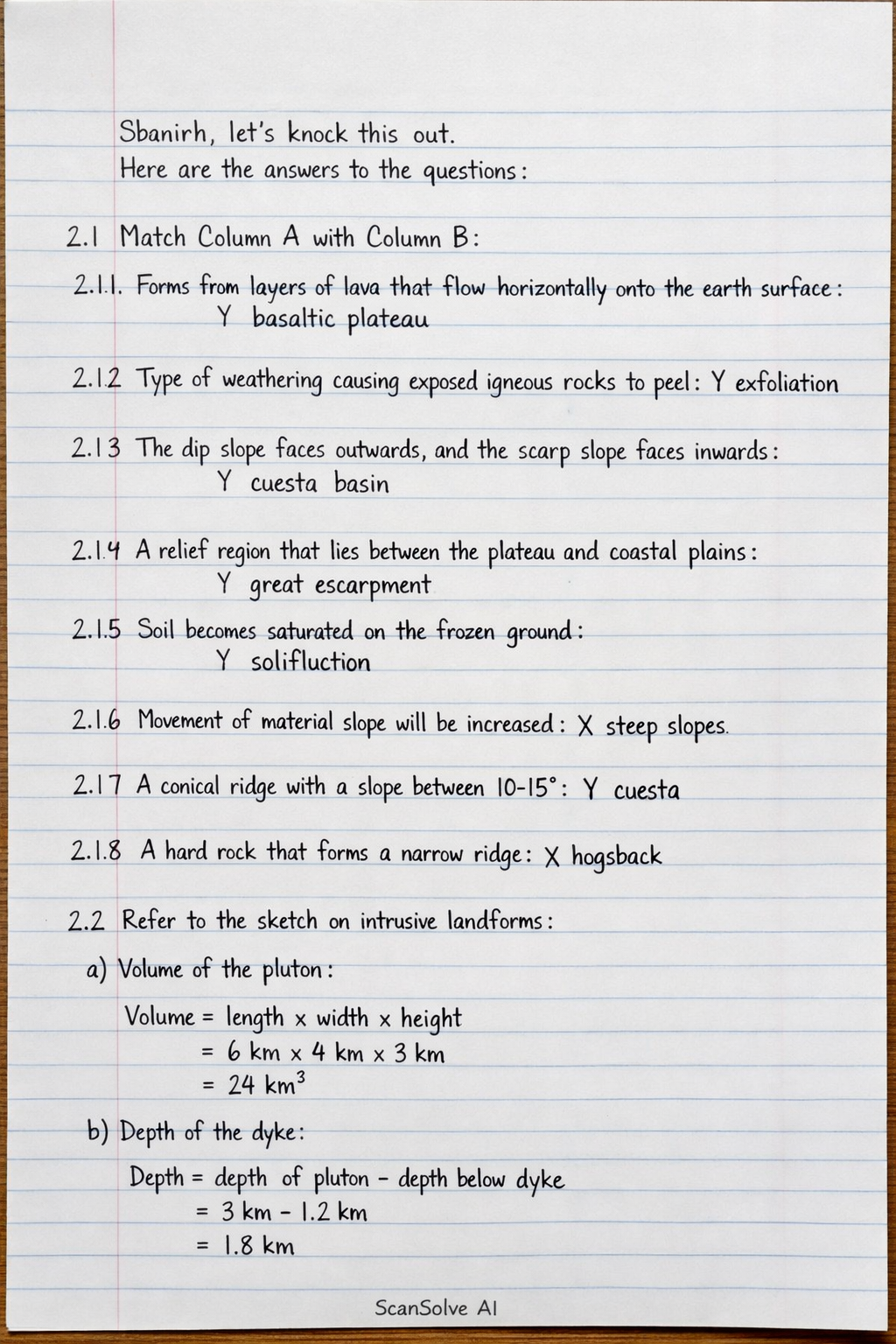
Here are the answers to the questions:
2.1 Match Column A with Column B:
- 2.1.1 Forms from layers of lava that flow horizontally onto the earth surface: Y basaltic plateau
- 2.1.2 Type of weathering causing exposed igneous rocks to peel: Y exfoliation
- 2.1.3 The dip slope faces outwards, and the scarp slope faces inwards: Y cuesta basin
- 2.1.4 A relief region that lies between the plateau and coastal plains: Y great escarpment
- 2.1.5 Soil becomes saturated and on the frozen ground: Y solifluction
- 2.1.6 Movement of material slope will be increased: X steep slopes
- 2.1.7 A conical ridge with a slope between 10-15: Y cuesta
- 2.1.8 A hard rock that... (incomplete, but likely refers to a ridge formed by resistant rock): X hogsback
2.2 Refer to the sketch on intrusive landforms:
- 2.2.1 The largest of all intrusive forms: Batholith
- 2.2.2 A vertical intrusion of igneous rock that forms a wall: Dike
- 2.2.3 When magma is exposed on the earth's surface: Not an intrusive form shown in the sketch
- 2.2.4 Igneous intrusion that forms when strata is forced up: Laccolith
- 2.2.5 A horizontal intrusion of igneous rock that forms a sheet: Sill
- 2.2.6 Igneous intrusion that forms when sedimentary strata sags downwards: Lopolith
- 2.2.7 A triangle-shaped hill formed from material of erosion: Not an intrusive form shown in the sketch
Was this helpful?
Still stuck on this one?
Ask a follow-up, and the answer starts from this question.
Got a different question?Ask your own question
More Geography Questions
QComplete the statements in COLUMN A with the options in COLUMN B. Write only A or B next to the…QChoose a word from COLUMN B that matches a description in COLUMN A. Write only the letter (A − J)…QChoose a description from COLUMN B that matches a term in COLUMN A. Write only the letter (A-G) next…QChoose a description from the column B that matches the item in column A. Write only the letter to…
Handwritten Step-by-Step Solution
Get this as a handwritten image on WhatsApp — like a tutor wrote it for you.
Try on WhatsApp