
My own contributions Aqua regia is a mixture of concentrated hydrochloric acid and concentrated trioxonitrate(V) acid in the ratio of: A) 1:1 B) 1:2 C) 3:1 D) 1:3 Vector of cholera is: A) Housefly B) Mosquito C) Cockroach D) Tsetse fly Product of decarboxylation of phenylmethanoic acid is: A) Benzene B) Toluene C) Phenol D) Benzoic acid Soft solder alloy is made of lead and: A) Tin B) Copper C) Zinc D) Aluminium Excretory product of earthworm is: A) Urea B) Ammonia C) Uric acid D) Nephridia The concentration of salt in brackish water is: A) High B) Low C) Moderate D) Very high Secondary succession can be caused by: A) Afforestation B) Deforestation C) Volcanic eruption D) Flood The apex predator in an aquatic habitat is: A) Catfish B) Crocodile C) Shark D) Kingfisher The middle ear consists of: A) Pinna, ear canal, cochlea B) Hammer, anvil, stirrup C) Semicircular canals D) Eustachian tube only The Sahel savannah is located in which state in Nigeria: A) Kaduna B) Kwara C) Borno D) Lagos Which of the following has only one body opening: A) Euglena B) Amoeba C) Paramecium D) Hydra The non-volatile residue from destructive distillation of coal is: A) Coke B) Tar C) Coal gas D) Carbon dioxide A substance with lesser permeability than free space is: A) Ferromagnetic B) Diamagnetic C) Paramagnetic D) Superconductive Detergents are manufactured with long hydrocarbon chains so as to make them: A) Soluble in water B) Hydrophobic C) Non-polar D) Neutral The alkaline derivative used as disinfectant is: A) Sodium hydroxide B) Calcium oxide C) Ammonium hydroxide D) Sodium carbonate Secondary growth in older dicot roots occurs in: A) Cambium B) Phloem C) Xylem D) Cortex How is silicon(IV) oxide removed from haematite? A) Roasting with carbon B) Leaching with NaOH C) Electrolysis D) Fractional distillation
ScanSolve AI Answer
Answer
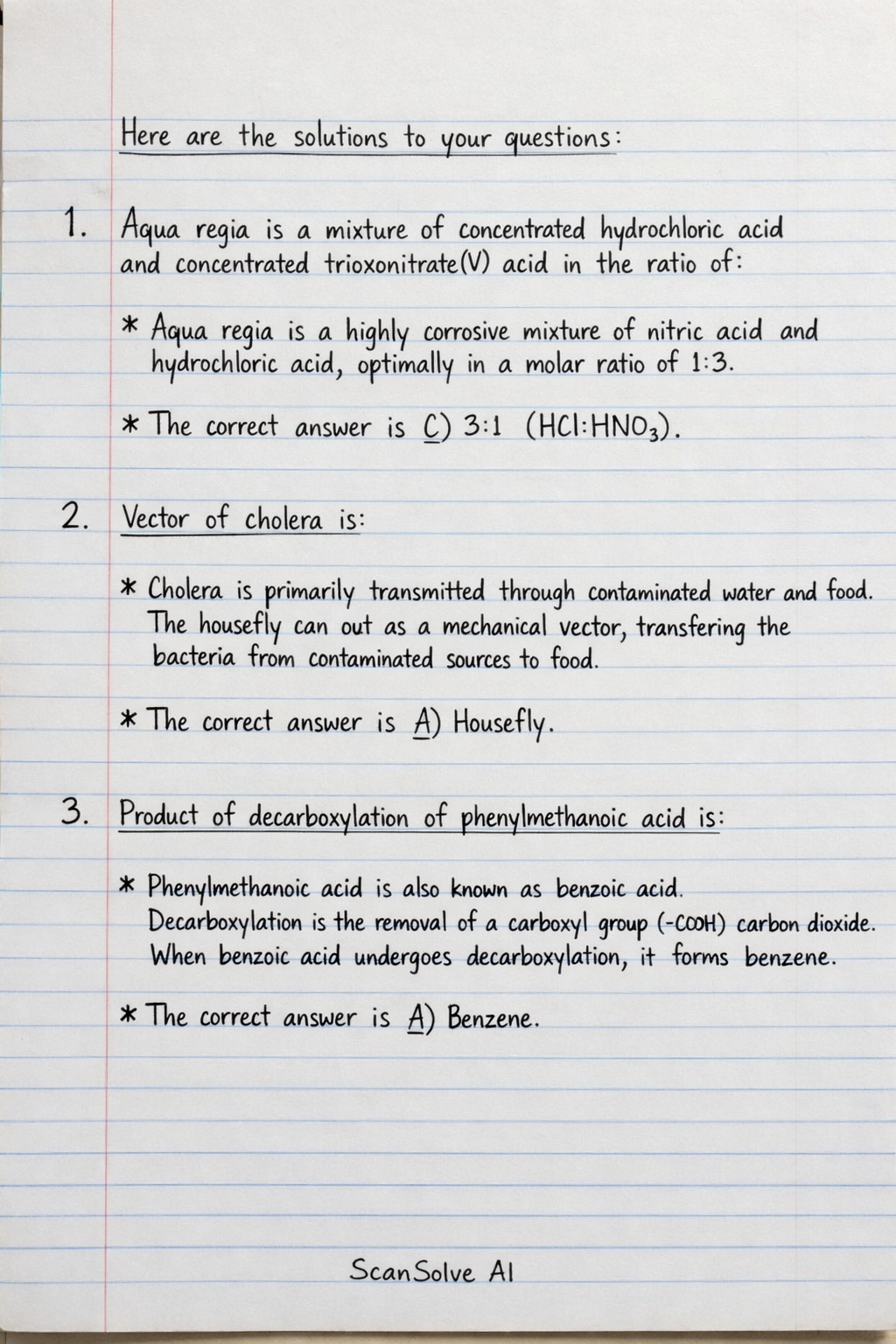
Here are the solutions to your questions:
-
Aqua regia is a mixture of concentrated hydrochloric acid and concentrated trioxonitrate(V) acid in the ratio of:
- Aqua regia is a highly corrosive mixture of nitric acid and hydrochloric acid, optimally in a molar ratio of 1:3.
- The correct answer is C) 3:1 (HCl:HNO₃).
-
Vector of cholera is:
- Cholera is primarily transmitted through contaminated water and food. The housefly can act as a mechanical vector, transferring the bacteria from contaminated sources to food.
- The correct answer is A) Housefly.
-
Product of decarboxylation of phenylmethanoic acid is:
- Phenylmethanoic acid is also known as benzoic acid. Decarboxylation is the removal of a carboxyl group (-COOH) as carbon dioxide. When benzoic acid undergoes decarboxylation, it forms benzene.
- The correct answer is A) Benzene.
-
Soft solder alloy is made of lead and:
- Soft solder is a fusible metal alloy used to create a permanent bond between metal workpieces. It is typically composed of tin and lead.
- The correct answer is A) Tin.
-
Excretory product of earthworm is:
- Earthworms are annelids that excrete nitrogenous waste primarily in the form of urea.
- The correct answer is A) Urea.
-
The concentration of salt in brackish water is:
- Brackish water has a salinity level that is higher than freshwater but lower than seawater.
- The correct answer is C) Moderate.
-
Secondary succession can be caused by:
- Secondary succession occurs in areas where a community that previously existed has been removed by a disturbance, but the soil or substrate remains intact. Deforestation is an example of such a disturbance.
- The correct answer is B) Deforestation.
-
The apex predator in an aquatic habitat is:
- An apex predator is at the top of the food chain, with no natural predators. Among the given options, sharks are widely recognized as apex predators in many marine aquatic habitats.
- The correct answer is C) Shark.
-
The middle ear consists of:
- The middle ear contains three small bones called ossicles: the malleus (hammer), incus (anvil), and stapes (stirrup).
- The correct answer is B) Hammer, anvil, stirrup.
-
The Sahel savannah is located in which state in Nigeria:
- The Sahel savannah zone in Nigeria is located in the far northern parts of the country, which includes Borno State.
- The correct answer is C) Borno.
-
Which of the following has only one body opening:
- Hydra, a freshwater cnidarian, has a sac-like body plan with a single opening that functions as both mouth and anus.
- The correct answer is D) Hydra.
-
The non-volatile residue from destructive distillation of coal is:
- Destructive distillation of coal involves heating coal in the absence of air. The solid, non-volatile residue left behind is coke.
- The correct answer is A) Coke.
-
A substance with lesser permeability than free space is:
- Diamagnetic materials have a relative permeability slightly less than 1, meaning they are weakly repelled by magnetic fields and have lesser permeability than free space.
- The correct answer is B) Diamagnetic.
-
Detergents are manufactured with long hydrocarbon chains so as to make them:
- The long hydrocarbon chain in a detergent molecule is non-polar and hydrophobic (water-hating), which allows it to interact with and dissolve grease and oil.
- The correct answer is B) Hydrophobic.
-
The alkaline derivative used as disinfectant is:
- Ammonium hydroxide (ammonia water) is an alkaline solution that is commonly used as a disinfectant and cleaning agent.
- The correct answer is C) Ammonium hydroxide.
-
Secondary growth in older dicot roots occurs in:
- Secondary growth in dicot roots, which leads to an increase in girth, is primarily due to the activity of the vascular cambium.
- The correct answer is A) Cambium.
-
How is silicon(IV) oxide removed from haematite?
- In the industrial extraction of iron from haematite in a blast furnace, silicon(IV) oxide (silica) acts as an acidic impurity. It is removed by reacting with a basic flux, typically calcium oxide (from limestone), to form calcium silicate slag. Among the given options, leaching with NaOH is a chemical method used to remove acidic oxides like silica from certain ores (e.g., in the Bayer process for bauxite).
- The correct answer is B) Leaching with NaOH.
Try one yourself
A new problem that tests the same skill.
Still stuck on this one?
Ask a follow-up, and the answer starts from this question.
More Geography Questions
Handwritten Step-by-Step Solution
Get this as a handwritten image on WhatsApp — like a tutor wrote it for you.
Try on WhatsApp