
We read your photo as:
Which of the following are components of a map: a) Title, b) Scale, c) Legend, d) All of the above
ScanSolve AI Answer
-
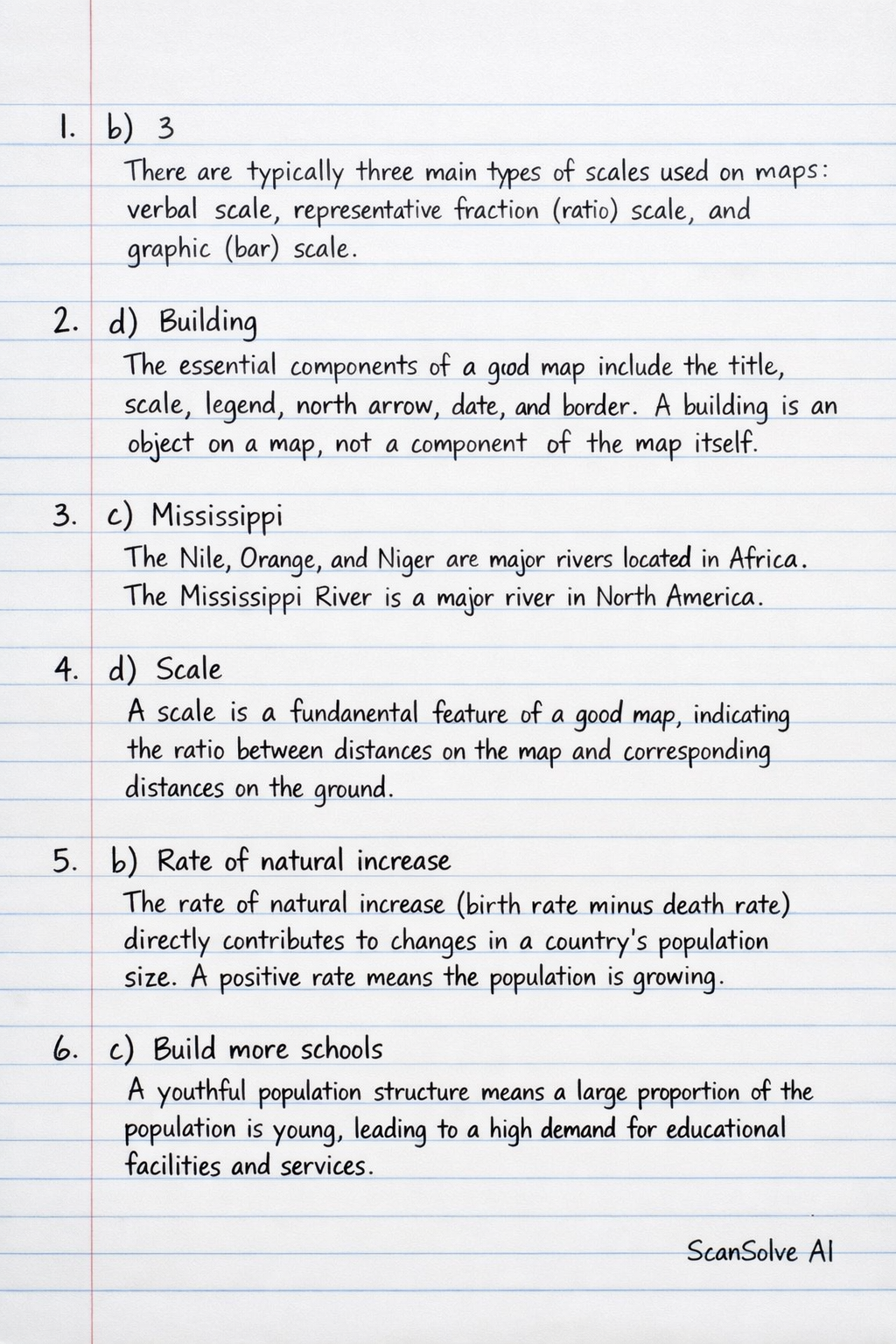
b) 3 There are typically three main types of scales used on maps: verbal scale, representative fraction (ratio) scale, and graphic (bar) scale.
-
d) Building The essential components of a good map include the title, scale, legend, north arrow, date, and border. A building is an object on a map, not a component of the map itself.
-
c) Mississippi The Nile, Orange, and Niger are major rivers located in Africa. The Mississippi River is a major river in North America.
-
d) Scale A scale is a fundamental feature of a good map, indicating the ratio between distances on the map and corresponding distances on the ground.
-
b) Rate of natural increase The rate of natural increase (birth rate minus death rate) directly contributes to changes in a country's population size. A positive rate means the population is growing.
-
c) Build more schools A youthful population structure means a large proportion of the population is young, leading to a high demand for educational facilities and services.
-
b) Fall below 26 years of age A population is described as youthful when a significant majority of its members are in the younger age brackets, typically below 25 or 26 years of age.
-
c) High dependency burden A youthful population implies a large number of young dependents (children) relative to the working-age population, which creates a high dependency burden on the productive members of society.
-
c) Voting While foreigners in a country typically enjoy rights such as freedom of expression, worship, and association, the right to vote is generally reserved for citizens of that country.
-
b) Fair trial If a person suspected of a crime is beaten by a mob, they are denied the fundamental right to a fair trial and due process under the law, which ensures justice is administered by legal institutions.
-
A) Court When an individual's rights have been infringed upon, the court system is the primary institution responsible for providing justice and legal remedies.
-
B) Birth Citizenship by birth (either by being born within the country's territory, jus soli, or by being born to citizens of the country, jus sanguinis) is the most common way for individuals to acquire citizenship.
-
B) Common color Communities are typically characterized by a common territory, shared values, and often a common language or culture. Common color (referring to race or ethnicity) is not a universal characteristic of all communities.
-
D) Find out the types of services the community offers Community development involves active processes like collecting views, planning for welfare, and members working together to solve problems. Finding out existing services is part of needs assessment but does not describe the development process itself.
-
C) Control anger and friendship Citizen participation aims to improve decision-making, leverage collective knowledge, and encourage resource contribution. Controlling anger and friendship is not a direct purpose or outcome of citizen participation in community or governance matters.
-
B) Fund raising and payments Main steps in planning community activities typically include problem identification, resource mobilization (including people and funds), and implementation. While fundraising is part of resource mobilization, "payments" is a financial transaction rather than a main planning step itself.
-
C) Rural-urban migration Rural-urban migration leads to a rapid increase in the population of urban areas, which places significant pressure on existing social facilities such as housing, sanitation, healthcare, and education.
Still stuck on this one?
Ask a follow-up, and the answer starts from this question.
More Geography Questions
Handwritten Step-by-Step Solution
Get this as a handwritten image on WhatsApp — like a tutor wrote it for you.
Try on WhatsApp