
We read your photo as:
Outline TWO causes of each of the following environmental hazards common in MEDCs: i) Floods ii) Drought iii) Pollution iv) Traffic congestion v) Deforestation. Then, give THREE solutions for THREE of
Geography
ScanSolve AI Answer
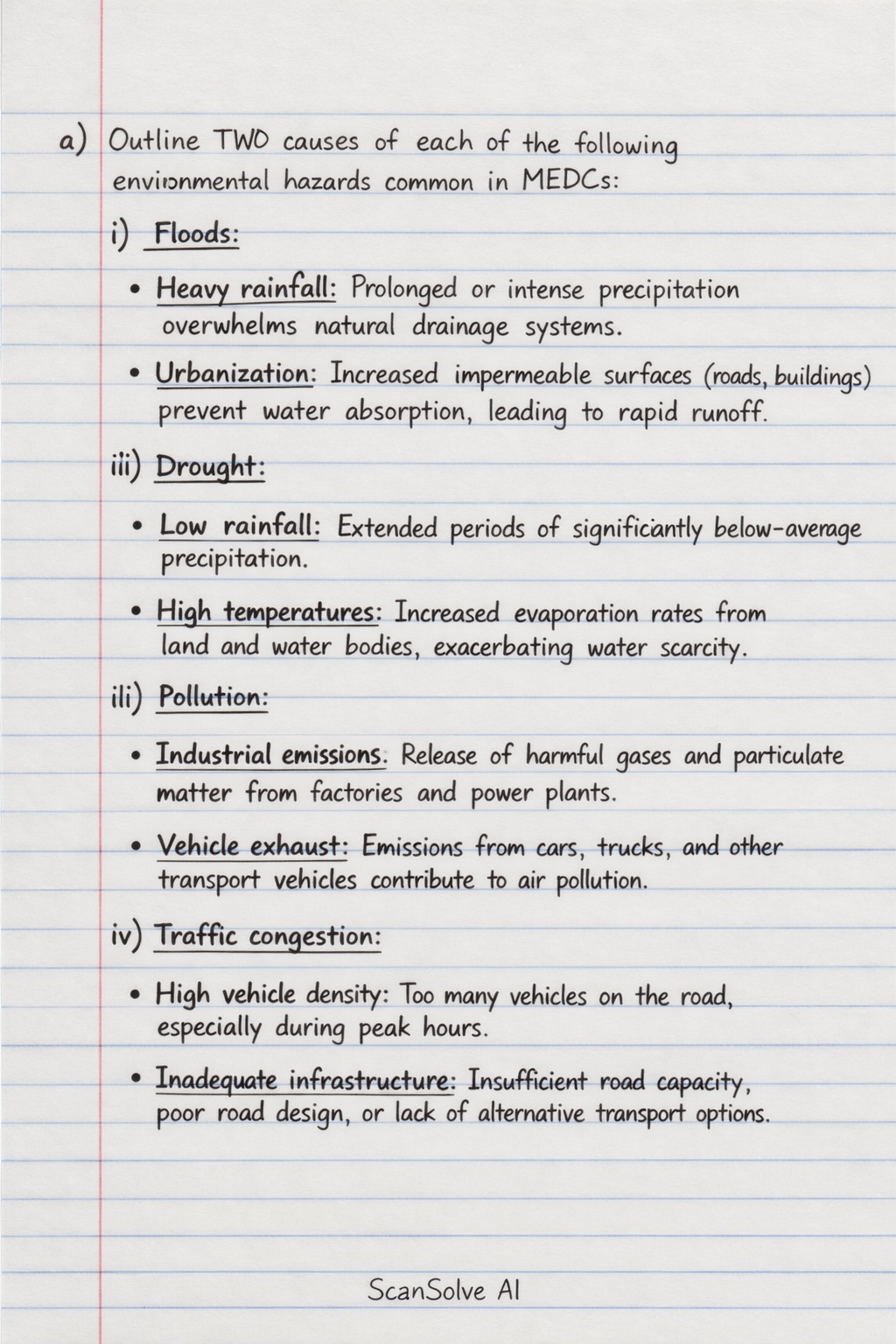
a) Outline TWO causes of each of the following environmental hazards common in MEDCs:
-
i) Floods:
- Heavy rainfall: Prolonged or intense precipitation overwhelms natural drainage systems.
- Urbanization: Increased impermeable surfaces (roads, buildings) prevent water absorption, leading to rapid runoff.
-
ii) Drought:
- Low rainfall: Extended periods of significantly below-average precipitation.
- High temperatures: Increased evaporation rates from land and water bodies, exacerbating water scarcity.
-
iii) Pollution:
- Industrial emissions: Release of harmful gases and particulate matter from factories and power plants.
- Vehicle exhaust: Emissions from cars, trucks, and other transport vehicles contribute to air pollution.
-
iv) Traffic congestion:
- High vehicle density: Too many vehicles on the road, especially during peak hours.
- Inadequate infrastructure: Insufficient road capacity, poor road design, or lack of alternative transport options.
-
v) Deforestation:
- Agricultural expansion: Clearing forests for farmland to grow crops or raise livestock.
- Logging: Commercial harvesting of timber for wood products and paper.
b) Select any THREE of the hazards in (a) above and give THREE solutions for each hazard:
-
i) Floods:
- Constructing flood defenses: Building dams, levees, and embankments to contain water.
- Improving drainage systems: Widening rivers, clearing culverts, and creating permeable urban surfaces.
- Afforestation: Planting trees in catchment areas to increase water absorption and reduce runoff.
-
iii) Pollution:
- Stricter emission standards: Implementing and enforcing laws for industrial and vehicle emissions.
- Promoting renewable energy: Shifting from fossil fuels to sources like solar, wind, and hydroelectric power.
- Waste management: Encouraging recycling, proper waste disposal, and reducing single-use plastics.
-
v) Deforestation:
- Sustainable forestry: Practicing selective logging and replanting trees to ensure forest regeneration.
- Establishing protected areas: Creating national parks and reserves to conserve forests.
- Promoting agroforestry: Integrating trees into farming systems to provide economic benefits while maintaining tree cover.
Was this helpful?
Still stuck on this one?
Ask a follow-up, and the answer starts from this question.
Got a different question?Ask your own question
More Geography Questions
QIdentify the environmental issue, list two of its effects, and suggest one solution.QWrite a geographical essay on this three as follows " Pollution, Air Transport , and Migration…QWhat are environmental hazards? Provide three examples and five effects on mankind.QState THREE problems faced by natural vegetation across the world today.Q11.a) Outline any 5 effects of Environmental degradation. 11.b) Evaluate the possible measures to…
Handwritten Step-by-Step Solution
Get this as a handwritten image on WhatsApp — like a tutor wrote it for you.
Try on WhatsApp