
We read your photo as:
SECTION E: CLIMATE, VEGETATION AND FIELD WORK.
ScanSolve AI Answer
SECTION E: CLIMATE, VEGETATION AND FIELD WORK.
-
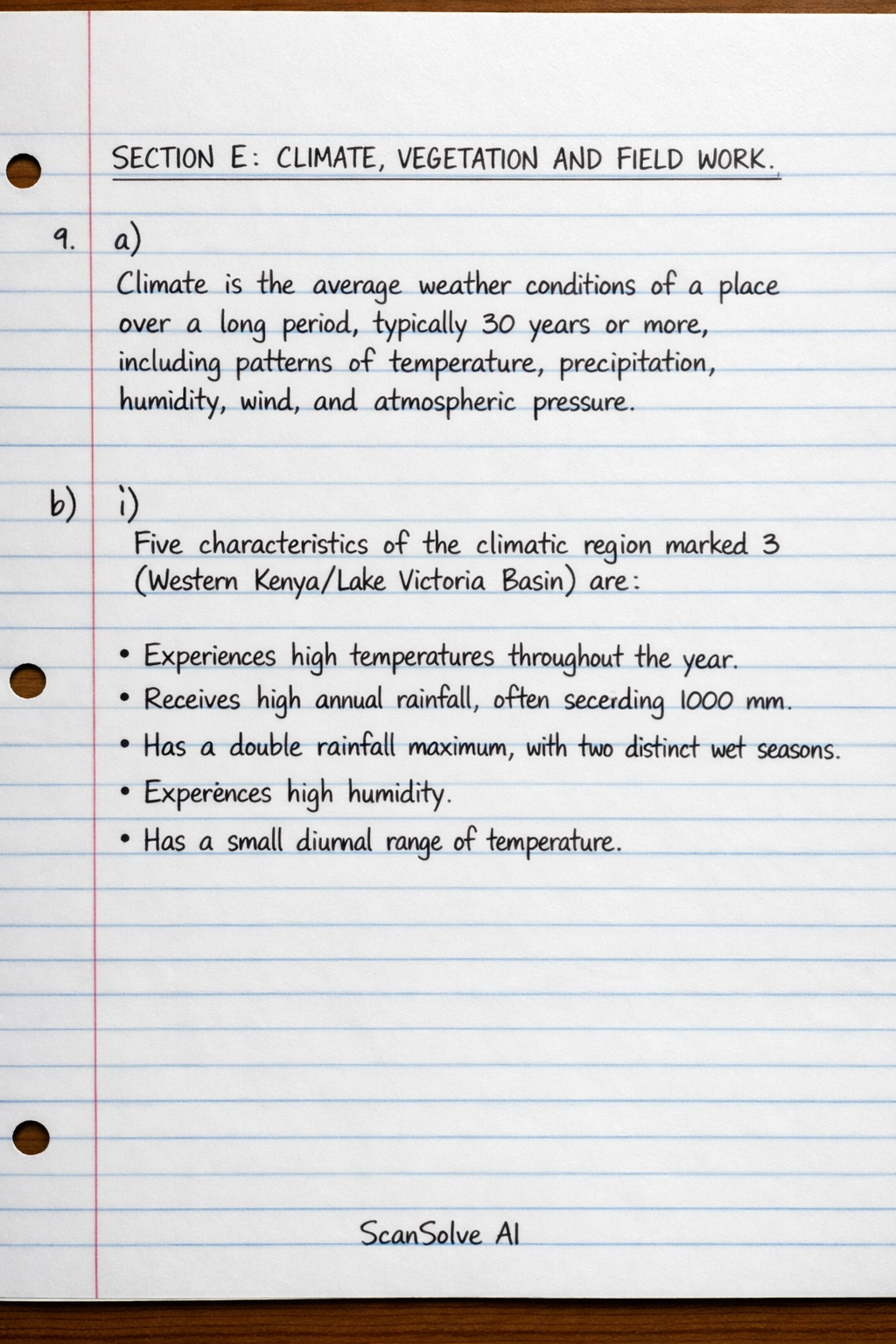
a) Climate is the average weather conditions of a place over a long period, typically 30 years or more, including patterns of temperature, precipitation, humidity, wind, and atmospheric pressure.
b)
i) Five characteristics of the climatic region marked 3 (Western Kenya/Lake Victoria Basin) are:- Experiences high temperatures throughout the year.
- Receives high annual rainfall, often exceeding 1000 mm.
- Has a double rainfall maximum, with two distinct wet seasons.
- Experiences high humidity.
- Has a small diurnal range of temperature.
ii) The vegetation found in the area marked 7 (Northern Kenya, arid/semi-arid region) is adapted to the dry climatic conditions in several ways:
- Small, waxy leaves or spines: These reduce the surface area for transpiration, minimizing water loss. The waxy cuticle further prevents evaporation.
- Deep root systems: Plants develop long roots to reach underground water sources, allowing them to access moisture deep in the soil.
- Succulent stems: Some plants, like cacti, store water in their fleshy stems, enabling them to survive long periods without rainfall.
- Short life cycles (ephemerals): Some plants grow, flower, and produce seeds very quickly after rainfall, completing their life cycle before the dry conditions return.
- Drought deciduousness: Some trees and shrubs shed their leaves during prolonged dry periods to conserve water.
c)
i) Two objectives for the study on desert encroachment could be:- To identify the main human activities contributing to desert encroachment in the marginal area.
- To assess the socio-economic impacts of desert encroachment on the local community.
ii) Three findings on the cause of the encroachment could be:
- Overgrazing: Excessive livestock numbers deplete vegetation cover, exposing soil to erosion by wind and water, leading to land degradation.
- Deforestation: Cutting down trees for fuel, timber, or clearing land for agriculture removes protective vegetation, increasing soil erosion and reducing moisture retention.
- Unsustainable farming practices: Practices like continuous cropping without fallow periods or proper soil conservation measures deplete soil nutrients and structure, making the land vulnerable to desertification.
Still stuck on this one?
Ask a follow-up, and the answer starts from this question.
More Geography Questions
Handwritten Step-by-Step Solution
Get this as a handwritten image on WhatsApp — like a tutor wrote it for you.
Try on WhatsApp