We read your photo as:

Calculate the shortest distance between two points on Earth using their latitude and longitude coordinates.

Geography

ScanSolve AI Answer

Answer

a

10010 km10010 \text{ km}

Step-by-step solution

7 steps

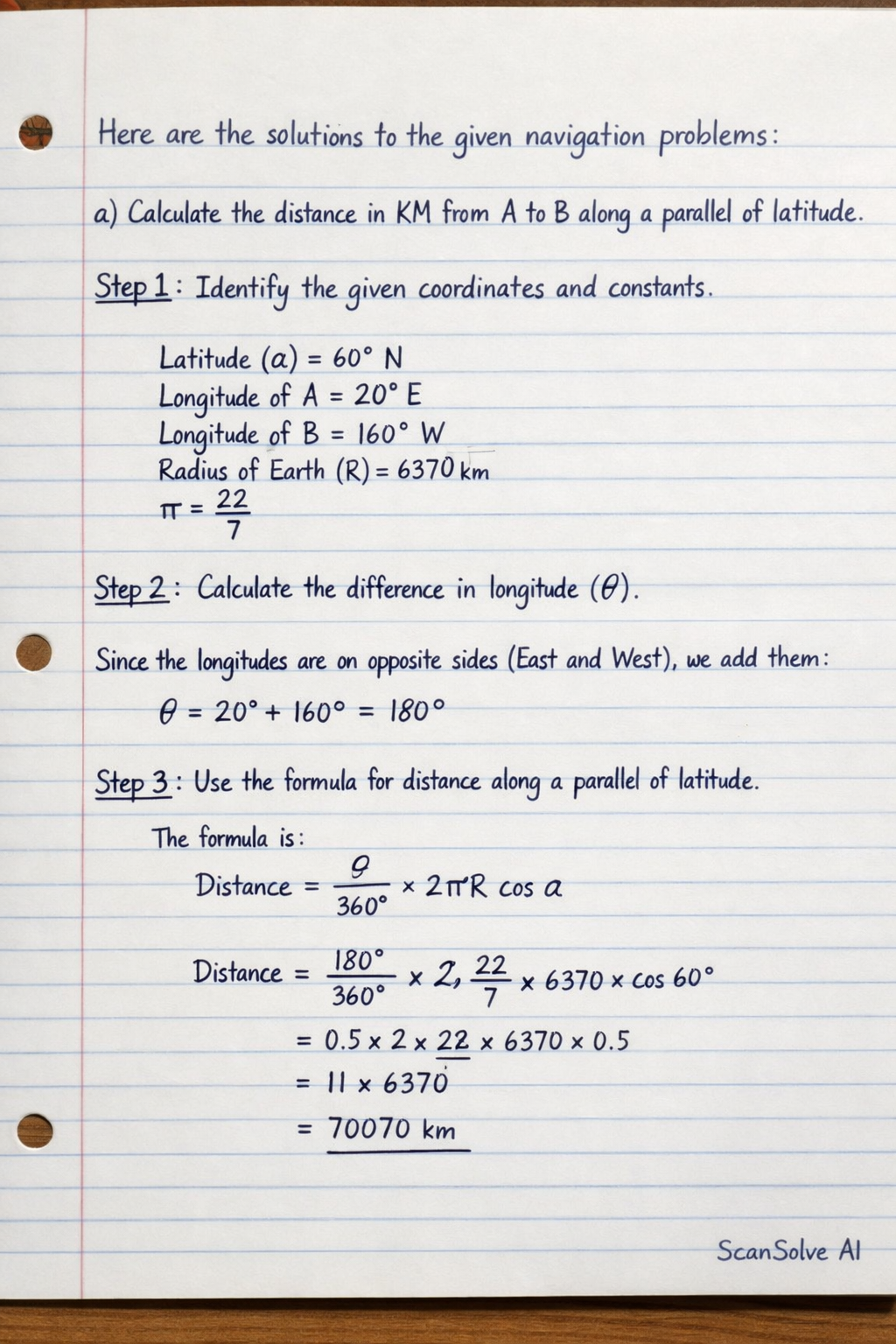
Here are the solutions to the given navigation problems:

Part a· 4 steps

Calculate the distance in KM from A to B along a parallel of latitude.

  1. Identify the given coordinates and constants.

    Latitude (α\alpha) = 60∘N60^\circ N
    Longitude of A = 20∘E20^\circ E
    Longitude of B = 160∘W160^\circ W
    Radius of Earth (RR) = 6370 km
    π=227\pi = \frac{22}{7}

  2. Calculate the difference in longitude (θ\theta).

    Since the longitudes are on opposite sides (East and West), we add them:

    θ=20∘+160∘=180∘\theta = 20^\circ + 160^\circ = 180^\circ
  3. Use the formula for distance along a parallel of latitude.

    The formula is:

    Distance=θ360∘×2πRcos⁡α\text{Distance} = \frac{\theta}{360^\circ} \times 2\pi R \cos \alpha
  4. Substitute the values into the formula and calculate.

    Distance=180360×2×227×6370×cos⁡60∘\text{Distance} = \frac{180}{360} \times 2 \times \frac{22}{7} \times 6370 \times \cos 60^\circ Distance=12×2×227×6370×0.5\text{Distance} = \frac{1}{2} \times 2 \times \frac{22}{7} \times 6370 \times 0.5 Distance=227×6370×0.5\text{Distance} = \frac{22}{7} \times 6370 \times 0.5 Distance=22×910×0.5\text{Distance} = 22 \times 910 \times 0.5 Distance=10010 km\text{Distance} = 10010 \text{ km}

    The distance from A to B along a parallel of latitude is 10010 km\boxed{10010 \text{ km}}.

Part b· 3 steps

Shortest distance from A to B along a great circle in nautical miles.

  1. Identify the coordinates.

    Point A: (60∘N,20∘E60^\circ N, 20^\circ E)
    Point B: (60∘N,160∘W60^\circ N, 160^\circ W)

  2. Calculate the angular distance (DD) along the great circle.

    The formula for the angular distance between two points (L1,λ1L_1, \lambda_1) and (L2,λ2L_2, \lambda_2) is:

    cos⁡D=sin⁡L1sin⁡L2+cos⁡L1cos⁡L2cos⁡(λ2−λ1)\cos D = \sin L_1 \sin L_2 + \cos L_1 \cos L_2 \cos(\lambda_2 - \lambda_1)

    Here, L1=L2=60∘L_1 = L_2 = 60^\circ and the difference in longitude (λ2−λ1)=180∘(\lambda_2 - \lambda_1) = 180^\circ.

    cos⁡D=sin⁡60∘sin⁡60∘+cos⁡60∘cos⁡60∘cos⁡180∘\cos D = \sin 60^\circ \sin 60^\circ + \cos 60^\circ \cos 60^\circ \cos 180^\circ cos⁡D=(32)2+(12)2(−1)\cos D = \left(\frac{\sqrt{3}}{2}\right)^2 + \left(\frac{1}{2}\right)^2 (-1) cos⁡D=34−14\cos D = \frac{3}{4} - \frac{1}{4} cos⁡D=24=12\cos D = \frac{2}{4} = \frac{1}{2}

    Therefore, D=cos⁡−1(12)=60∘D = \cos^{-1}\left(\frac{1}{2}\right) = 60^\circ.

  3. Convert the angular distance to nautical miles.

    One degree of a great circle

Was this helpful?

Try one yourself

A new problem that tests the same skill.

Still stuck on this one?

Ask a follow-up, and the answer starts from this question.

Got a different question?Ask your own question
Handwritten step-by-step solution preview

Handwritten Step-by-Step Solution

Get this as a handwritten image on WhatsApp — like a tutor wrote it for you.

Try on WhatsApp