We read your photo as:

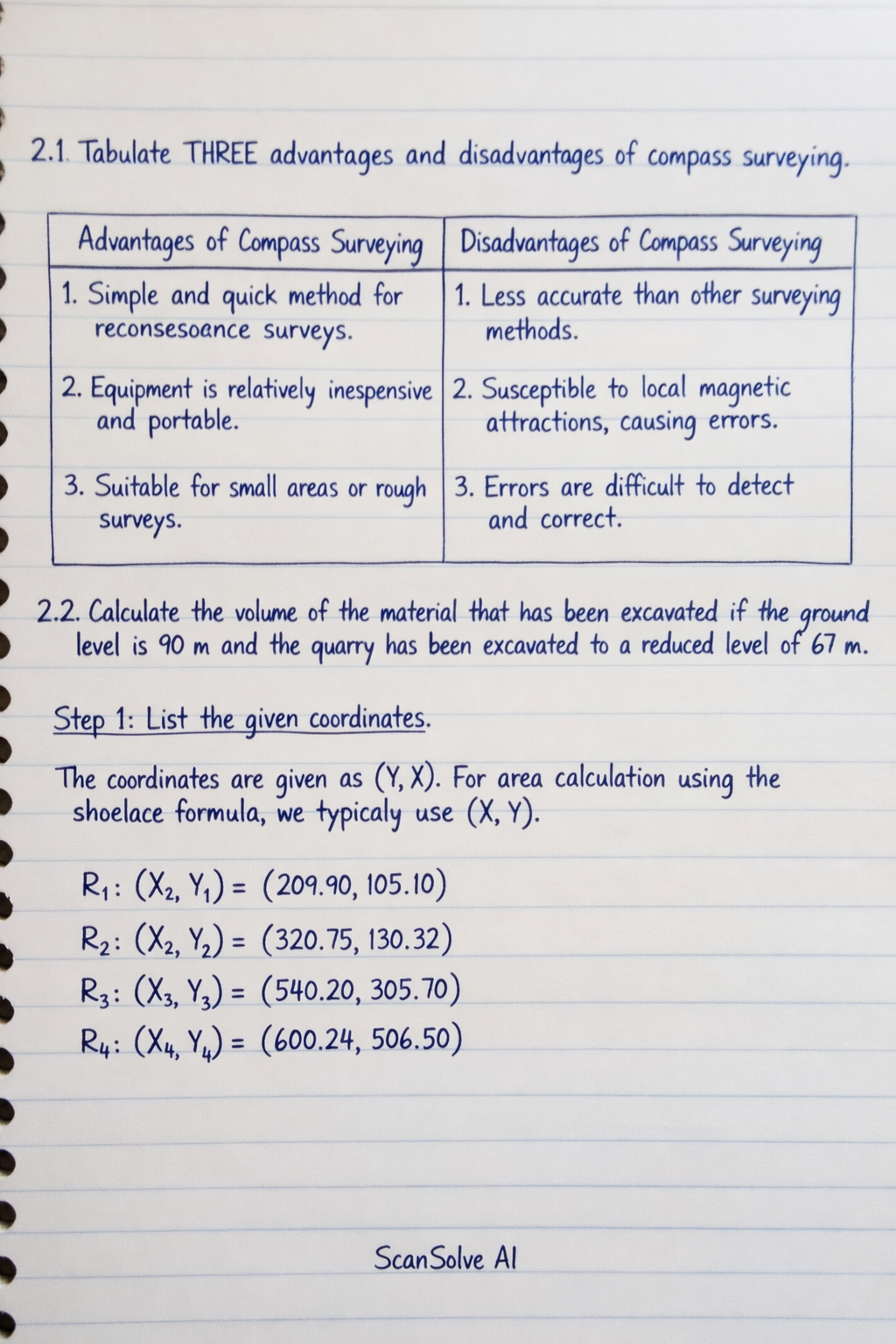
Tabulate THREE advantages and disadvantages of compass surveying and calculate the volume of excavated material.

Geography

ScanSolve AI Answer

Answer

2.2

782337.18 m3\text{782337.18 m}^3

Step-by-step solution

4 steps

Part 2.1

Tabulate THREE advantages and disadvantages of compass surveying.

Advantages of Compass SurveyingDisadvantages of Compass Surveying
1. Simple and quick method for reconnaissance surveys.1. Less accurate than other surveying methods.
2. Equipment is relatively inexpensive and portable.2. Susceptible to local magnetic attractions, causing errors.
3. Suitable for small areas or rough surveys.3. Errors are difficult to detect and correct.

Part 2.2

782337.18 m3\text{782337.18 m}^3

Calculate the volume of the material that has been excavated if the ground level is 90 m and the quarry has been excavated to a reduced level of 67 m.

  1. List the given coordinates.

    The coordinates are given as (Y, X). For area calculation using the shoelace formula, we typically use (X, Y).
    R1: (X1,Y1)=(209.90,105.10)(X_1, Y_1) = (209.90, 105.10)
    R2: (X2,Y2)=(320.75,130.32)(X_2, Y_2) = (320.75, 130.32)
    R3: (X3,Y3)=(540.20,305.70)(X_3, Y_3) = (540.20, 305.70)
    R4: (X4,Y4)=(600.24,506.50)(X_4, Y_4) = (600.24, 506.50)

  2. Calculate the area of the closed traverse using the coordinate method (shoelace formula).

    The formula for the area AA of a polygon with nn vertices is:

    A=12∣∑i=1n(XiYi+1−Xi+1Yi)∣A = \frac{1}{2} \left| \sum_{i=1}^{n} (X_i Y_{i+1} - X_{i+1} Y_i) \right|

    where (Xn+1,Yn+1)=(X1,Y1)(X_{n+1}, Y_{n+1}) = (X_1, Y_1).

    Calculate the sum of (XiYi+1)(X_i Y_{i+1}) terms:
    X1Y2=209.90×130.32=27351.468X_1 Y_2 = 209.90 \times 130.32 = 27351.468
    X2Y3=320.75×305.70=98040.075X_2 Y_3 = 320.75 \times 305.70 = 98040.075
    X3Y4=540.20×506.50=273491.300X_3 Y_4 = 540.20 \times 506.50 = 273491.300
    X4Y1=600.24×105.10=63085.224X_4 Y_1 = 600.24 \times 105.10 = 63085.224
    Sum (XiYi+1)=27351.468+98040.075+273491.300+63085.224=461968.067(X_i Y_{i+1}) = 27351.468 + 98040.075 + 273491.300 + 63085.224 = 461968.067

    Calculate the sum of (Xi+1Yi)(X_{i+1} Y_i) terms:
    X2Y1=320.75×105.10=33711.325X_2 Y_1 = 320.75 \times 105.10 = 33711.325
    X3Y2=540.20×130.32=70409.864X_3 Y_2 = 540.20 \times 130.32 = 70409.864
    X4Y3=600.24×305.70=183503.208X_4 Y_3 = 600.24 \times 305.70 = 183503.208
    X1Y4=209.90×506.50=106314.350X_1 Y_4 = 209.90 \times 506.50 = 106314.350
    Sum (Xi+1Yi)=33711.325+70409.864+183503.208+106314.350=393938.747(X_{i+1} Y_i) = 33711.325 + 70409.864 + 183503.208 + 106314.350 = 393938.747

    Now, calculate the area AA:

    A=12∣461968.067−393938.747∣A = \frac{1}{2} | 461968.067 - 393938.747 | A=12∣68029.32∣A = \frac{1}{2} | 68029.32 | A=34014.66 m2A = 34014.66 \text{ m}^2
  3. Calculate the depth of excavation.

    Ground level =90 m= 90 \text{ m}
    Reduced level (excavated) =67 m= 67 \text{ m}
    Depth D=Ground level−Reduced levelD = \text{Ground level} - \text{Reduced level}

    D=90 m−67 m=23 mD = 90 \text{ m} - 67 \text{ m} = 23 \text{ m}
  4. Calculate the volume of the excavated material.

    Volume V=Area×DepthV = \text{Area} \times \text{Depth}

    V=34014.66 m2×23 mV = 34014.66 \text{ m}^2 \times 23 \text{ m} V=782337.18 m3V = 782337.18 \text{ m}^3

    The volume of the material that has been excavated is 782337.18 m3\boxed{\text{782337.18 m}^3}.

Was this helpful?

Try one yourself

A new problem that tests the same skill.

Still stuck on this one?

Ask a follow-up, and the answer starts from this question.

Got a different question?Ask your own question
Handwritten step-by-step solution preview

Handwritten Step-by-Step Solution

Get this as a handwritten image on WhatsApp — like a tutor wrote it for you.

Try on WhatsApp