
We read your photo as:
Define tacheometry, explain its purpose, and state the formulas for calculating horizontal distance and vertical height using stadia measurements, given a multiplying constant k=100 and additive const
ScanSolve AI Answer
Here are the solutions to questions 3.1, 3.2, and 3.3.
3.1 Tacheometry is an angular surveying method where horizontal and vertical distances are obtained through optical means, typically using a staff and a theodolite or total station.
3.2 The primary purpose of tacheometry is to prepare topographic maps where both horizontal and vertical distances are required, often for contouring and detailed mapping of terrain.
3.3 To complete the table, we will use the following tacheometry formulas, assuming a multiplying constant and an additive constant . The "Vert" angle is assumed to be the zenith angle . The "Stadia" column provides the upper and lower stadia
Still stuck on this one?
Ask a follow-up, and the answer starts from this question.
More Geography Questions
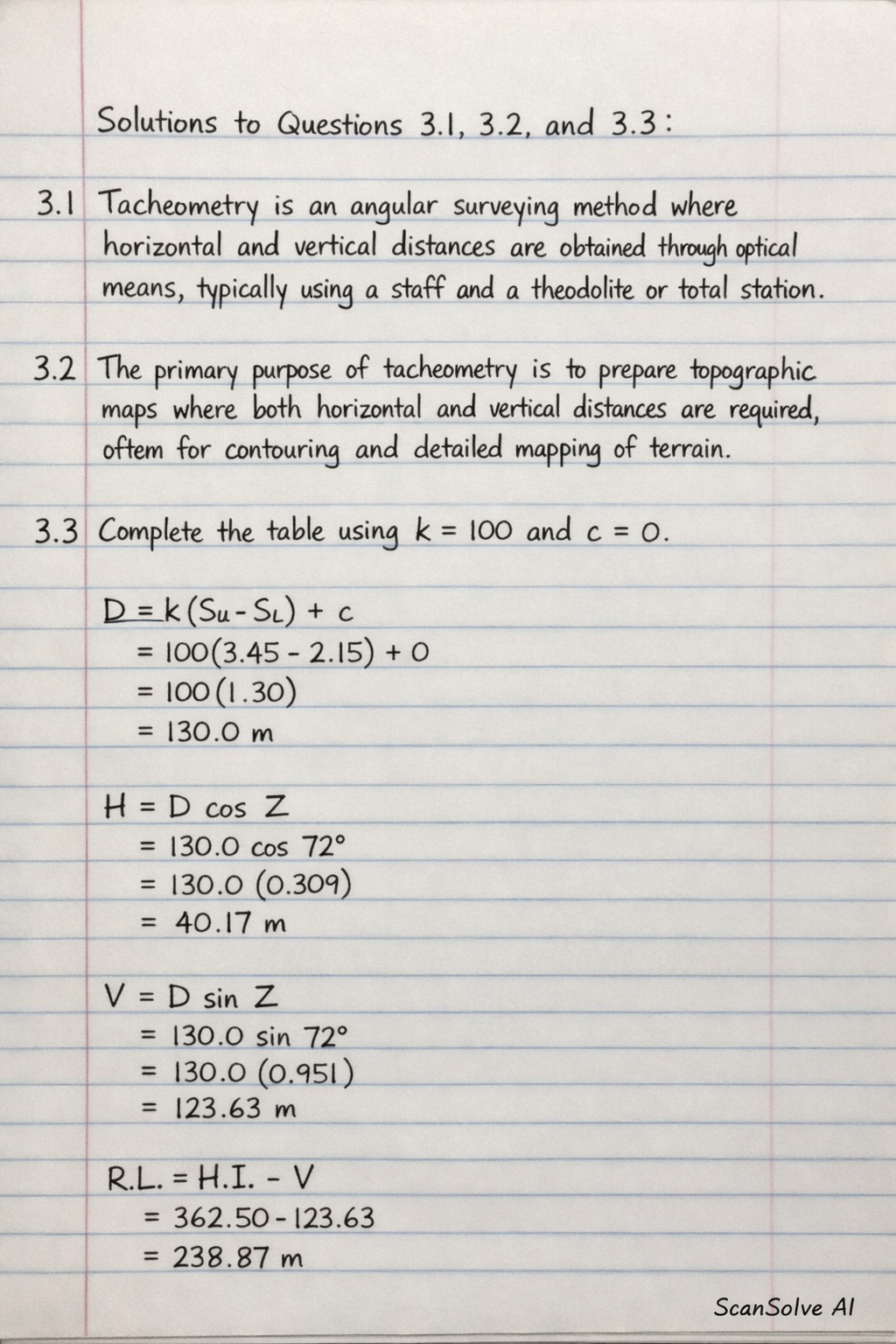
Handwritten Step-by-Step Solution
Get this as a handwritten image on WhatsApp — like a tutor wrote it for you.
Try on WhatsApp