

This geography problem is solved step by step below, with detailed explanations to help you understand the method and arrive at the correct answer.
ScanSolve AI Answer
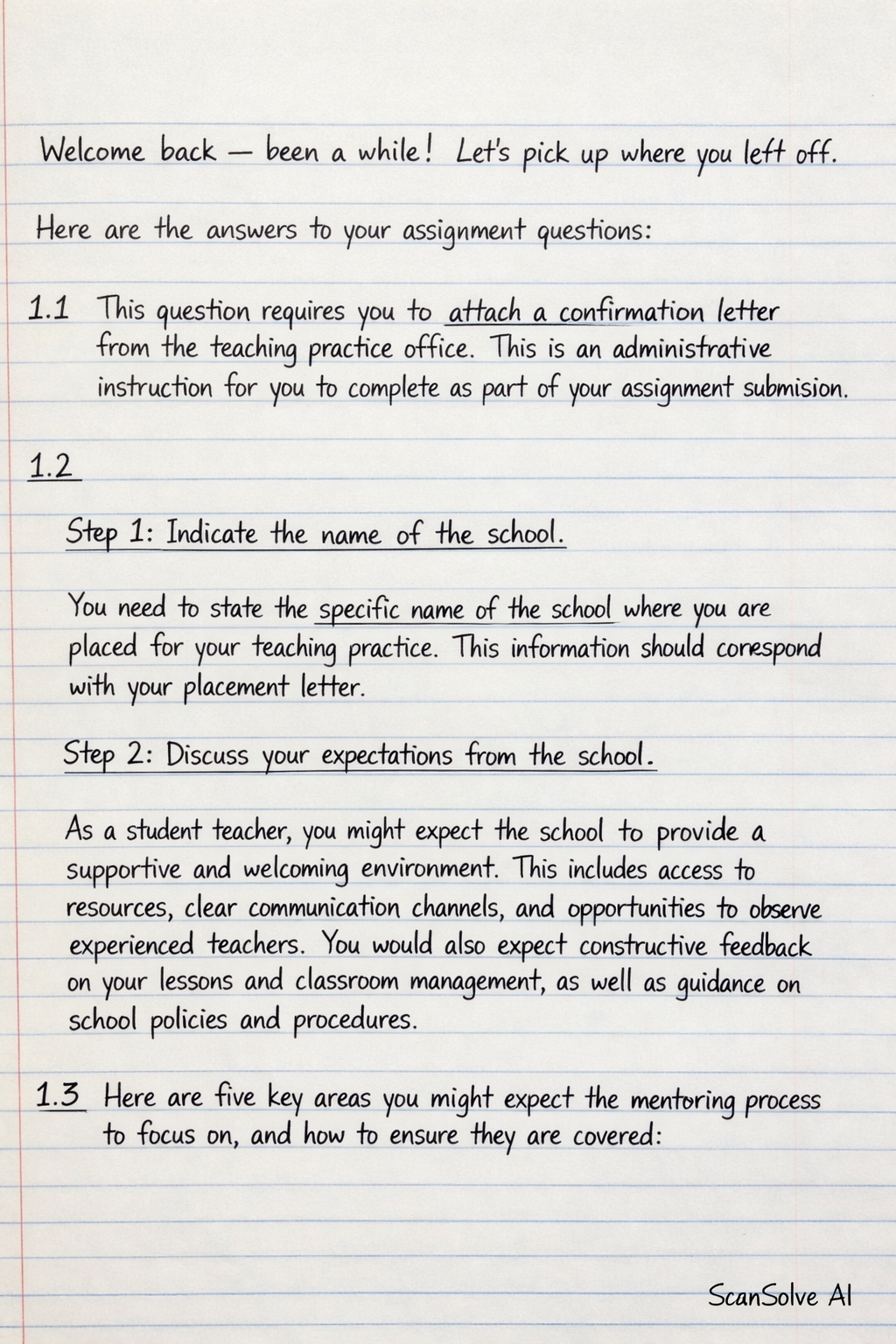
Welcome back — been a while! Let's pick up where you left off. Here are the answers to your assignment questions: 1.1 This question requires you to attach a confirmation letter from the teaching practice office. This is an administrative instruction for you to complete as part of your assignment submission. 1.2 Step 1: Indicate the name of the school. You need to state the specific name of the school where you are placed for your teaching practice. This information should correspond with your placement letter. Step 2: Discuss your expectations from the school. As a student teacher, you might expect the school to provide a supportive and welcoming environment. This includes access to resources, clear communication channels, and opportunities to observe experienced teachers. You would also expect constructive feedback on your lessons and classroom management, as well as guidance on school policies and procedures. 1.3 Here are five key areas you might expect the mentoring process to focus on, and how to ensure they are covered: • Lesson Planning and Delivery: Your mentor should guide you in creating effective lesson plans, aligning them with curriculum objectives, and delivering them engagingly. To ensure this is covered, regularly share your lesson plans with your mentor for feedback and ask for opportunities to co-plan or observe their lessons. • Classroom Management: Mentoring should address strategies for maintaining discipline, fostering a positive learning environment, and managing student behavior. Actively seek advice on specific classroom challenges, observe your mentor's techniques, and discuss different approaches to behavior management. • Assessment and Feedback: Guidance on designing assessments, marking student work, and providing constructive feedback is crucial. Discuss various assessment methods with your mentor, ask them to review your marking, and seek advice on how to communicate feedback effectively to students. • Curriculum Knowledge and Pedagogy: Your mentor should help deepen your understanding of the Grade 10 Geography curriculum and effective teaching methods for the subject. Regularly discuss content areas, ask for clarification on complex topics, and explore different pedagogical approaches with your mentor. • Professionalism and Ethics: Mentoring should cover professional conduct, ethical responsibilities, and communication with colleagues, parents, and students. Observe your mentor's professional interactions, ask for advice on navigating school dynamics, and discuss ethical dilemmas that may arise. 1.4 Step 1: Indicate the subject and grade. You will be teaching Geography to Grade 10 students. Step 2: Discuss the teaching approach. For Grade 10 Geography, a learner-centred approach is highly effective, often combined with elements of a teacher-centred approach. A learner-centred approach encourages students to actively participate in their learning through inquiry-based activities, discussions, and problem-solving. This is particularly suitable for Geography as it allows students to explore real-world issues, analyze data, and develop critical thinking skills. While the teacher will still provide foundational knowledge and guidance (teacher-centred elements), the emphasis will be on student engagement and discovery. This approach fosters deeper understanding, promotes independent learning, and makes the subject more relevant and engaging for students. 1.5 Here are two teaching methods suitable for Grade 10 Geography and how to implement them: • Case Study Method: This method involves presenting students with a real-world geographical scenario or problem to analyze. For example, students could study a case of drought in a specific region, examining its causes, impacts, and potential solutions. To implement this, provide students with relevant data, maps, articles, and questions. Students work individually or in groups to research, discuss, and present their findings, developing analytical and problem-solving skills. • Fieldwork/Excursion Method: This involves taking students outside the classroom to observe geographical phenomena firsthand. While a full excursion might be challenging, even local fieldwork (e.g., observing land use patterns around the school, analyzing local weather data) can be effective. To implement this, clearly define learning objectives, provide observation sheets or tasks, and ensure safety protocols. After the fieldwork, conduct follow-up discussions and activities to consolidate learning and connect observations to theoretical concepts. 1.6 Here are three classroom management strategies and how to implement each in an actual classroom: • Establishing Clear Routines and Expectations: This involves setting consistent procedures for daily activities, such as entering the classroom, submitting assignments, group work, and transitions. To implement this, explicitly teach and practice routines at the beginning of the term. Display classroom rules and expectations prominently, and consistently reinforce them through positive feedback and gentle reminders. This creates a predictable and organized learning environment, reducing disruptions. • Positive Reinforcement: This strategy focuses on acknowledging and rewarding desired behaviors to encourage their repetition. To implement this, verbally praise students for participation, effort, and good conduct. Use non-verbal cues like a nod or a smile. You can also implement a token system or award small privileges for consistent positive behavior. This builds student confidence and motivates them to maintain appropriate behavior. • Proximity Control and Non-Verbal Cues: This involves using your physical presence and subtle gestures to manage minor misbehaviors without interrupting the lesson. To implement this, move around the classroom frequently, standing near students who are off-task. Make eye contact, use a hand gesture, or a slight shake of the head to signal disapproval. This allows you to address disruptions discreetly and prevent them from escalating, maintaining the flow of instruction. Got more? Send 'em 📸