
We read your photo as:
Explain ten (10) effects of rapid population growth on the environment. Briefly define Production.
Geography
ScanSolve AI Answer
here are the answers to the questions from the image:
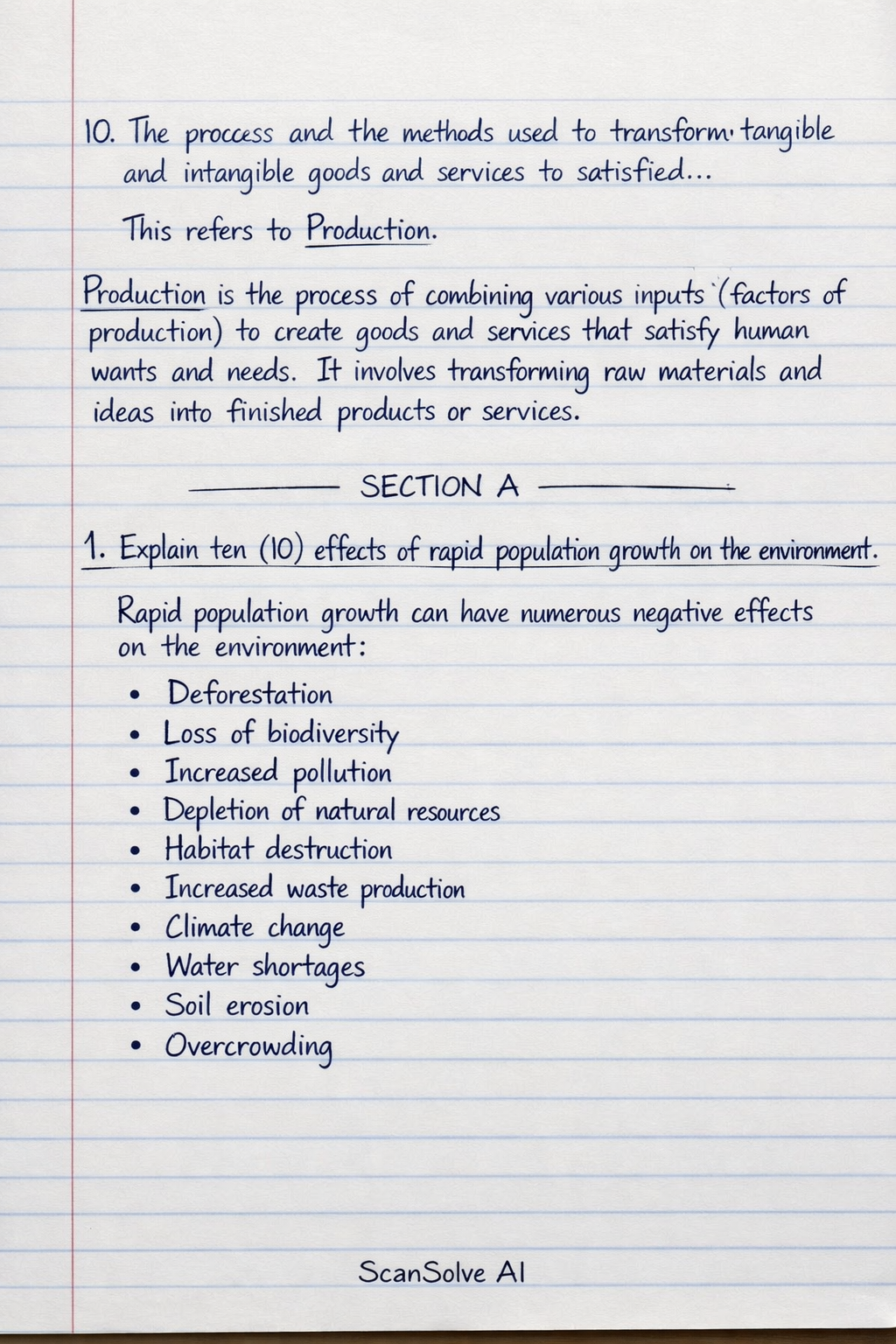
10. The process and the methods used to transform tangible and intangible goods and services to satisfied...
This refers to Production.
- Production is the process of combining various inputs (factors of production) to create goods and services that satisfy human wants and needs. It involves transforming raw materials and ideas into finished products or services.
SECTION A
1. Explain ten (10) effects of rapid population growth on the environment.
Rapid population growth can have numerous negative effects on the environment:
- Deforestation: Increased demand for agricultural land, timber, and fuel wood leads to the clearing of forests, resulting in habitat loss and reduced carbon sequestration.
- Loss of Biodiversity: As natural habitats are destroyed for human settlement and resource extraction, many plant and animal species face extinction, reducing ecological diversity.
- Water Scarcity and Pollution: A larger population requires more water for domestic, agricultural, and industrial use, leading to depletion of freshwater sources and increased pollution from waste discharge.
- Air Pollution: More people mean increased energy consumption, industrial activity, and vehicle emissions, contributing to higher levels of air pollutants and smog.
- Land Degradation and Soil Erosion: Intensive farming practices, overgrazing, and deforestation to feed a growing population deplete soil nutrients and increase susceptibility to erosion.
- Increased Waste Generation: A larger population produces more domestic, industrial, and hazardous waste, overwhelming waste management systems and leading to pollution of land and water bodies.
- Climate Change: Increased consumption and industrial activity by a growing population lead to higher greenhouse gas emissions, exacerbating global warming and climate change.
- Resource Depletion: Rapid population growth accelerates the consumption of non-renewable resources such as fossil fuels, minerals, and precious metals, leading to their faster depletion.
- Habitat Destruction: Expansion of human settlements, infrastructure, and agriculture encroaches upon natural ecosystems, destroying critical habitats for wildlife.
- Urban Sprawl: Growing urban populations lead to the expansion of cities into surrounding natural and agricultural lands, reducing green spaces and increasing impervious surfaces.
2. A. What is migration?
- Migration is the movement of people from one place to another with the intention of settling, permanently or temporarily, in a new location. This movement can occur within a country (internal migration) or across international borders (international migration).
2. B. Discuss ten causes of rural-urban migration.
Rural-urban migration is influenced by a combination of "push" factors (driving people out of rural areas) and "pull" factors (attracting them to urban areas):
- Limited Employment Opportunities in Rural Areas: Rural areas often lack diverse job markets, with employment primarily concentrated in subsistence agriculture, which can be seasonal and offer low wages.
- Better Employment Opportunities in Urban Areas: Cities offer a wider range of jobs in various sectors (manufacturing, services, commerce), often with higher wages and more stable income prospects.
- Poor Social Amenities and Services in Rural Areas: Rural regions frequently suffer from inadequate access to quality education, advanced healthcare facilities, reliable electricity, and piped water.
- Improved Social Amenities and Services in Urban Areas: Urban centers boast superior infrastructure and social services, including better schools, hospitals, recreational facilities, and entertainment options.
- Perceived Higher Standard of Living and Modernity: Cities are often viewed as centers of modernity, offering a more sophisticated lifestyle, greater social freedom, and diverse consumer goods, attracting those seeking an improved way of life.
- Lack of Access to Quality Education in Rural Areas: Limited availability of good schools and higher education institutions in rural areas pushes young people to urban centers for better educational opportunities.
- Natural Disasters and Environmental Degradation: Rural areas can be more susceptible to environmental challenges like droughts, floods, or land degradation, which can destroy livelihoods and force people to relocate.
- Influence of Friends and Family: The presence of relatives or friends who have already migrated to urban areas can act as a strong pull factor, providing social networks and support for new migrants.
- Lack of Access to Credit and Markets in Rural Areas: Farmers and small business owners in rural areas often struggle to access credit or efficient markets for their products, limiting their economic growth.
- Security Concerns and Conflict: In some cases, rural areas may experience higher levels of insecurity, communal conflicts, or banditry, prompting residents to seek safer environments in urban centers.
3. Discuss ten good work ethics that produce productivity in Ghana.
Good work ethics are crucial for enhancing individual and organizational productivity:
- Punctuality and Attendance: Consistently arriving on time and being present for work demonstrates reliability and commitment, ensuring tasks are started and completed as scheduled.
- Honesty and Integrity: Upholding truthfulness and strong moral principles builds trust among colleagues and clients, fostering a transparent and efficient work environment.
- Diligence and Commitment: Being hardworking, dedicated, and committed to performing duties effectively and efficiently ensures high-quality output and timely completion of tasks.
- Responsibility and Accountability: Taking ownership of one's tasks and being answerable for actions and results promotes reliability and reduces errors.
- Teamwork and Collaboration: Working effectively with others, sharing ideas, and supporting colleagues fosters a cooperative environment, leading to better problem-solving and collective achievement.
- Respect for Colleagues and Superiors: Treating everyone with courtesy and professionalism creates a positive work atmosphere, reducing conflicts and improving communication.
- Initiative and Proactiveness: Taking the lead, identifying problems, and proposing solutions without being prompted demonstrates engagement and contributes to innovation and efficiency.
- Continuous Learning and Self-Improvement: A willingness to acquire new skills and knowledge, and to adapt to new technologies, keeps employees relevant and enhances their contribution to the organization.
- Effective Time Management: Prioritizing tasks, organizing work, and meeting deadlines ensures that work is completed efficiently and productivity is maximized.
- Professionalism: Maintaining a professional demeanor, appearance, and communication style reflects positively on the individual and the organization, enhancing credibility and trust.
Was this helpful?
Still stuck on this one?
Ask a follow-up, and the answer starts from this question.
Got a different question?Ask your own question
More Geography Questions
QPositive and negative effect of population growth 10 pointsQName two challenges faced by cities with very high population density and briefly explain each…QQ5 is asking what is production? List and explain three factors of productionQDescribe one environmental impact of rapid urbanization and explain why it occurs.QA. With the aid of a diagram show the effect of an increase in the supply of a commodity while…
Handwritten Step-by-Step Solution
Get this as a handwritten image on WhatsApp — like a tutor wrote it for you.
Try on WhatsApp