
We read your photo as:
What are the answers to questions 3.1.1-3.1.6 and 3.2.1-3.2.3 regarding continental drift and tectonic plates?
Geography
ScanSolve AI Answer
Answer
My apologies, it looks like you've sent a new image with questions numbered 3.1 and 3.2. I'll answer those for you.
Step-by-step solution
3 stepsAnswer questions 3.1.1 to 3.1.6.
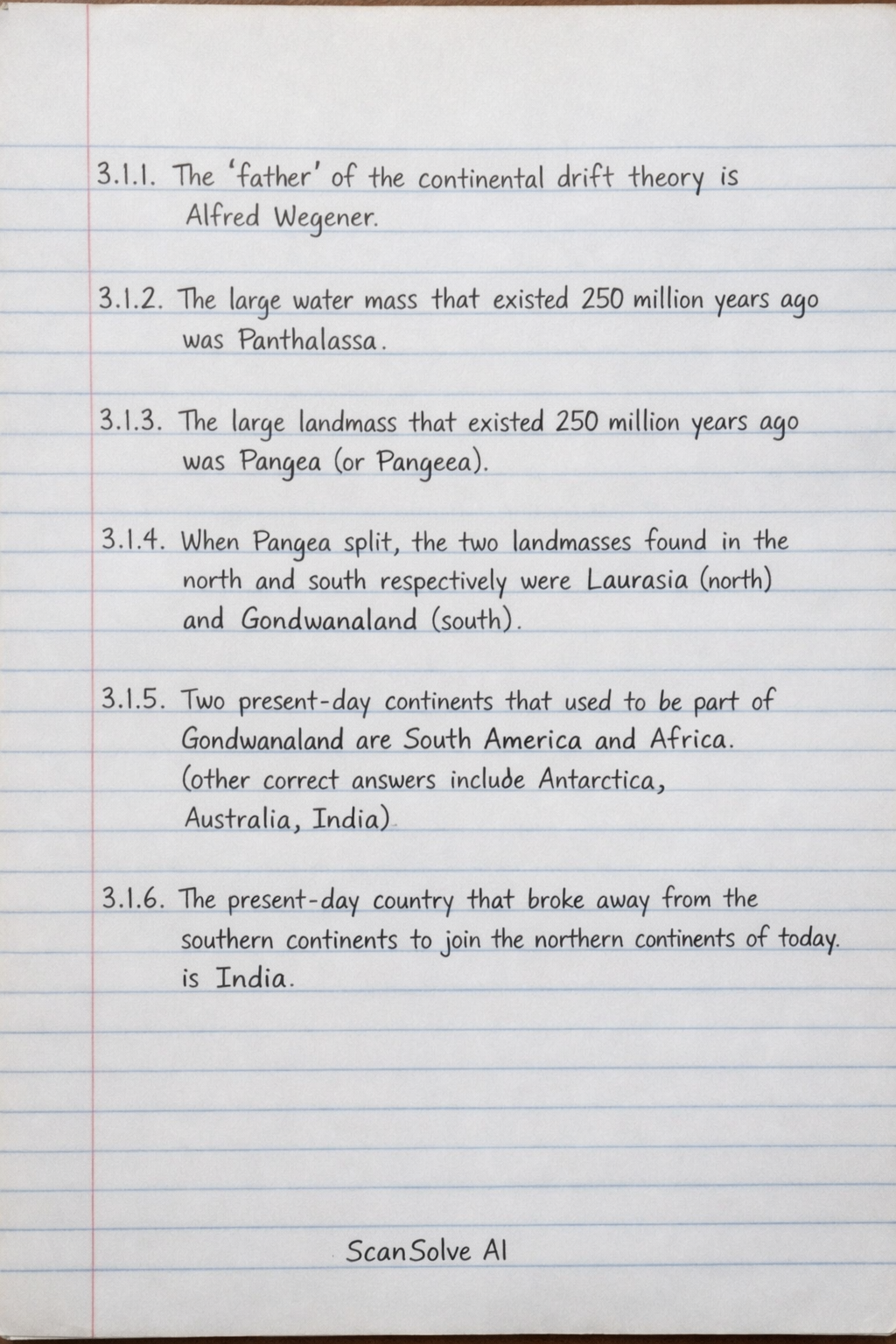
- 3.1.1: The "father" of the continental drift theory is Alfred Wegener.
- 3.1.2: The large water mass that existed 250 million years ago was Panthalassa.
- 3.1.3: The large landmass that existed 250 million years ago was Pangea (or Pangaea).
- 3.1.4: When Pangea split, the two landmasses found in the north and south respectively were Laurasia (north) and Gondwanaland (south).
- 3.1.5: Two present-day continents that used to be part of Gondwanaland are South America and Africa. (Other correct answers include Antarctica, Australia, India).
- 3.1.6: The present-day country that broke away from the southern continents to join the northern continents of today is India.
Answer questions 3.2.1 to 3.2.5.
- 3.2.1: Alfred Wegener gave the name Pangea (or Pangaea) to the one large supercontinent.
- 3.2.2: A tectonic plate is a large, rigid slab of solid rock, generally irregular in shape, composed of both continental and oceanic lithosphere, that moves slowly over the Earth's mantle.
- 3.2.3: The plates found on either side of the plate boundary on the west coast of South America are the Nazca Plate (oceanic) and the South American Plate (continental).
- 3.2.4: This type of plate boundary is a convergent plate boundary.
- 3.2.5: Continents move because they are part of larger tectonic plates that float on the semi-fluid asthenosphere (upper mantle). These plates are driven by convection currents within the mantle, where hot, less dense material rises, spreads laterally, and then cools and sinks, dragging the plates along.
Answer question 3.2.6.
- 3.2.6: Scientists use several lines of evidence to prove that the continents of Africa, Antarctica, and South America were once joined. Firstly, the fit of the continents is striking, particularly the coastlines of South America and Africa, which appear to fit together like puzzle pieces. Secondly, fossil evidence shows identical species of ancient plants (like Glossopteris) and animals (like Mesosaurus and Lystrosaurus) found on these now widely separated continents, indicating they once shared a continuous habitat. Thirdly, geological evidence reveals similar rock formations, mountain ranges, and mineral deposits across these continents, suggesting they formed under the same conditions and were once connected. Lastly, paleoclimate evidence, such as glacial deposits (tillites) found in tropical regions of South America and Africa, indicates these landmasses were once located closer to the South Pole, consistent with their former position within a supercontinent.
Was this helpful?
Still stuck on this one?
Ask a follow-up, and the answer starts from this question.
Got a different question?Ask your own question
More Geography Questions
QInvestigate evidence for continental drift and explain how plate tectonics provides the mechanism…QWhat is the continental driftQIn the context of plate tectonic theory, exaplain the three major plate boundaries.QWhat are the answers to the following questions: 1.1.10, 1.2.1-1.2.5, 1.3.1-1.3.5?QWhat continents must have looked like according to the continental drift theory. Show through the…
Browse by topic:Earth Science
Handwritten Step-by-Step Solution
Get this as a handwritten image on WhatsApp — like a tutor wrote it for you.
Try on WhatsApp