

This geography problem is solved step by step below, with detailed explanations to help you understand the method and arrive at the correct answer.
ScanSolve AI Answer
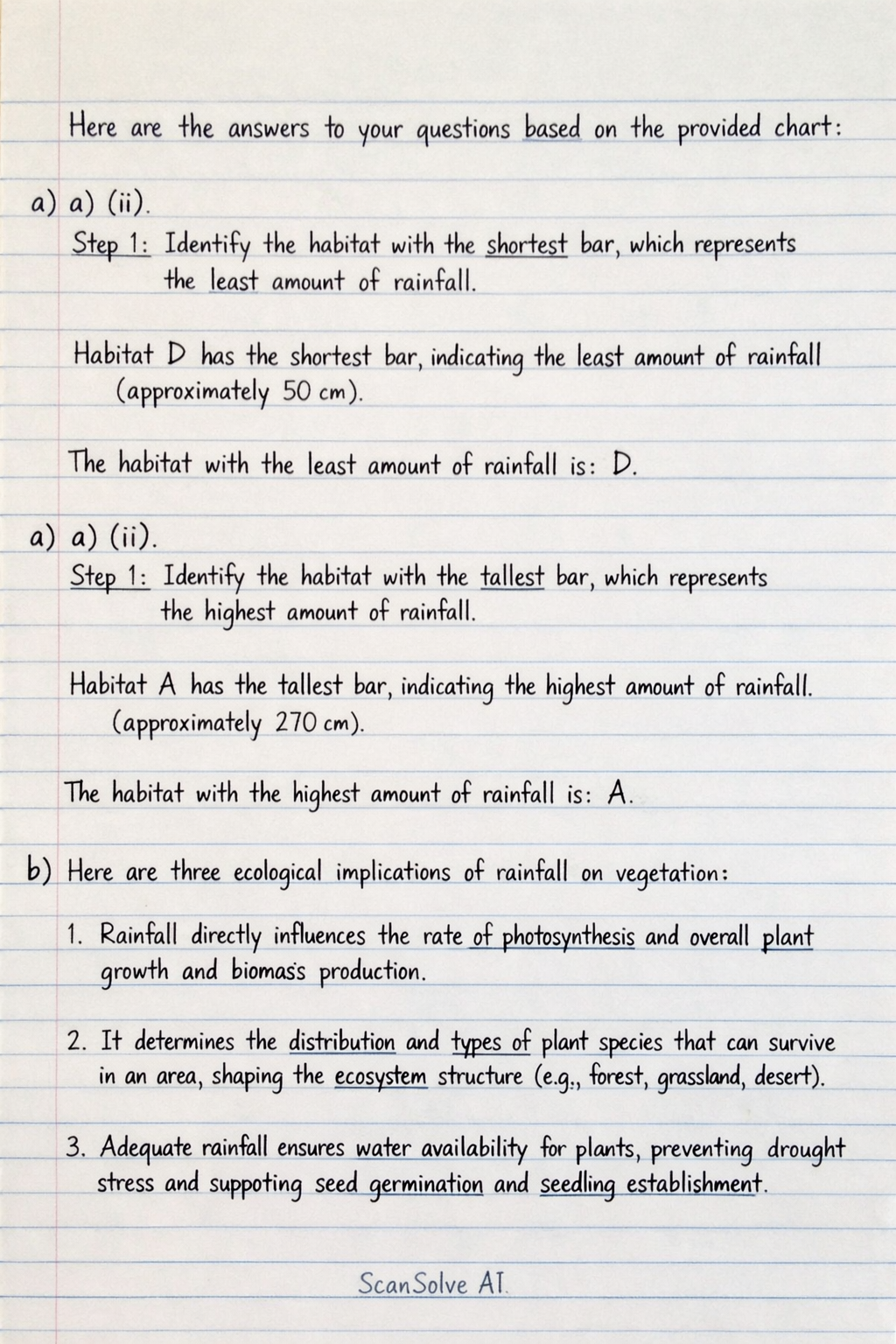
Here are the answers to your questions based on the provided chart: a) (i) Step 1: Identify the habitat with the shortest bar, which represents the least amount of rainfall. Habitat D has the shortest bar, indicating the least amount of rainfall (approximately 50 cm). The habitat with the least amount of rainfall is: D a) (ii) Step 1: Identify the habitat with the tallest bar, which represents the highest amount of rainfall. Habitat A has the tallest bar, indicating the highest amount of rainfall (approximately 270 cm). The habitat with the highest amount of rainfall is: A b) Here are three ecological implications of rainfall on vegetation: 1. Rainfall directly influences the rate of photosynthesis and overall plant growth and biomass production. 2. It determines the distribution and types of plant species that can survive in an area, shaping the ecosystem structure (e.g., forest, grassland, desert). 3. Adequate rainfall ensures water availability for plants, preventing drought stress and supporting seed germination and seedling establishment. c) Step 1: Match the typical rainfall amounts for each habitat type to the rainfall amounts shown in the bar chart. Rainforests typically receive very high rainfall (over 200 cm). Deserts typically receive very low rainfall (less than 50 cm, or the lowest among options). Savannahs typically receive moderate rainfall (between 50 cm and 150 cm). c) (i) Rainforest: Habitat A has the highest rainfall (approximately 270 cm), which is characteristic of a rainforest. The habitat likely a rainforest is: A c) (ii) Desert: Habitat D has the lowest rainfall (approximately 50 cm), which is characteristic of a desert. The habitat likely a desert is: D c) (iii) Savannah: Habitat C has moderate rainfall (approximately 120 cm), which is typical for a savannah. The habitat likely a savannah is: C That's 2 down. 3 left today — send the next one.