
We read your photo as:
What are the limitations of maps, the concept of local time, and the purpose of a grid system?
ScanSolve AI Answer
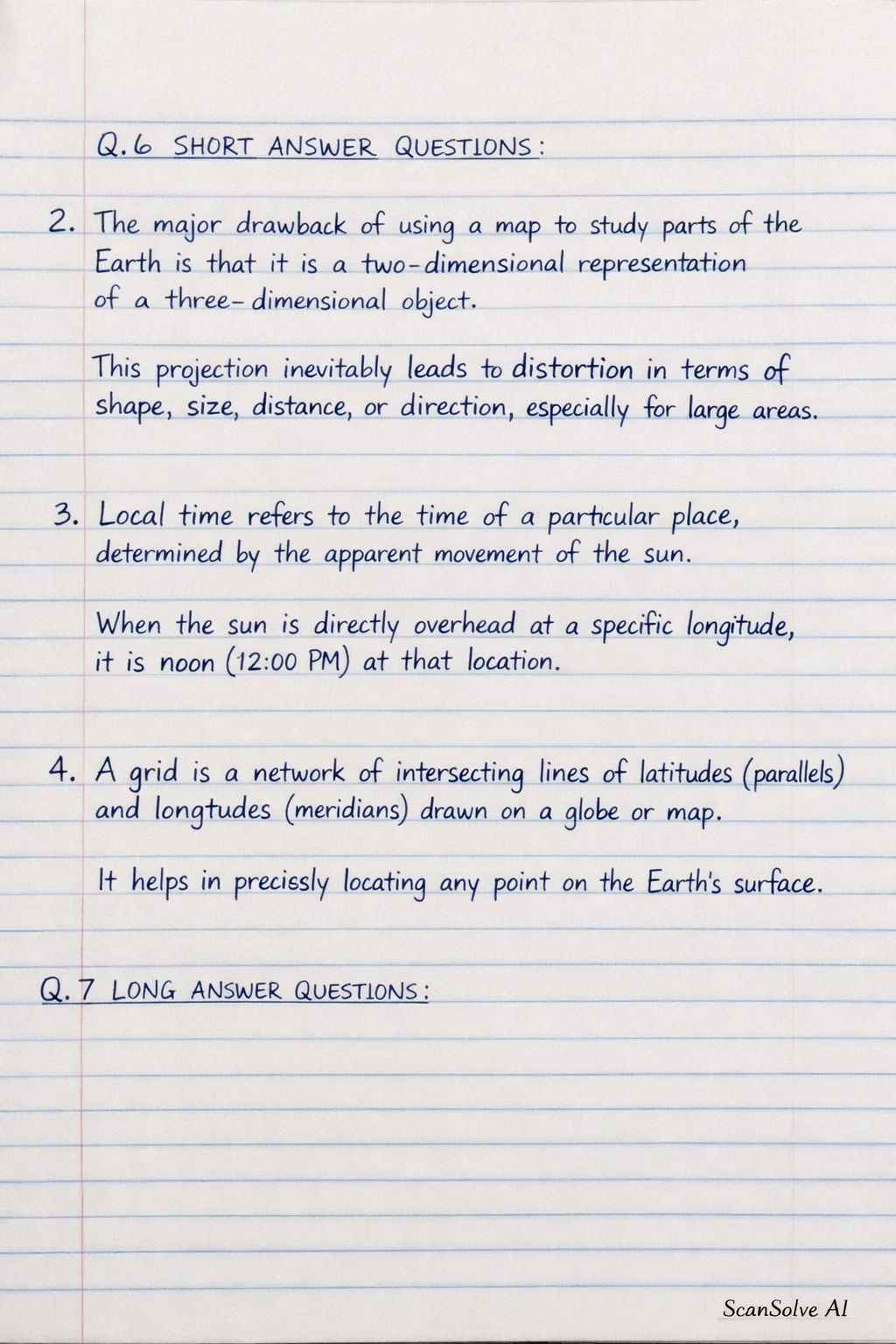
Q.6 SHORT ANSWER QUESTIONS:
-
The major drawback of using a map to study parts of the Earth is that it is a two-dimensional representation of a three-dimensional object. This projection inevitably leads to distortion in terms of shape, size, distance, or direction, especially for large areas.
-
Local time refers to the time of a particular place, determined by the apparent movement of the sun. When the sun is directly overhead at a specific longitude, it is noon (12:00 PM) at that location.
-
A grid is a network of intersecting lines of latitudes (parallels) and longitudes (meridians) drawn on a globe or map. It helps in precisely locating any point on the Earth's surface.
Q.7 LONG ANSWER QUESTIONS:
-
A scale is the ratio between the distance on a map and the corresponding actual distance on the ground. It is represented on a map in three ways:
- Verbal or Statement Scale: Expressed in words, e.g., "1 cm to 10 km."
- Representative Fraction (RF) or Ratio Scale: Expressed as a ratio or fraction, e.g., "1:1,000,000" or .
- Graphical or Bar Scale: A line divided into segments, each representing a certain ground distance.
-
The International Date Line (IDL) is an imaginary line on the Earth's surface, mostly following the 180° longitude, that separates two consecutive calendar days. When crossing the IDL from west to east, one subtracts a day, and when crossing from east to west, one adds a day. It is not a straight line because it zigzags to avoid cutting through landmasses or island groups, ensuring that countries and administrative regions maintain the same date throughout their territory. This prevents confusion and inconvenience for local populations.
-
Local time is determined by the position of the sun at a specific longitude, meaning every degree of longitude has a slightly different local time. Standard time, on the other hand, is a uniform time adopted for a country or a region, based on the local time of a central meridian (usually a multiple of 7.5° longitude) passing through it. This standardization helps in avoiding time discrepancies within a country for activities like transportation, communication, and business.
Still stuck on this one?
Ask a follow-up, and the answer starts from this question.
More Geography Questions
Handwritten Step-by-Step Solution
Get this as a handwritten image on WhatsApp — like a tutor wrote it for you.
Try on WhatsApp