
We read your photo as:
What is the name of the municipality that Mr Mabuza belongs to? Name the type of graph that could be used to represent the tariff system in the table above. Calculate how much money Mr Mabuza will pay
ScanSolve AI Answer
Step-by-step solution
4 stepsHere are the solutions to the questions:
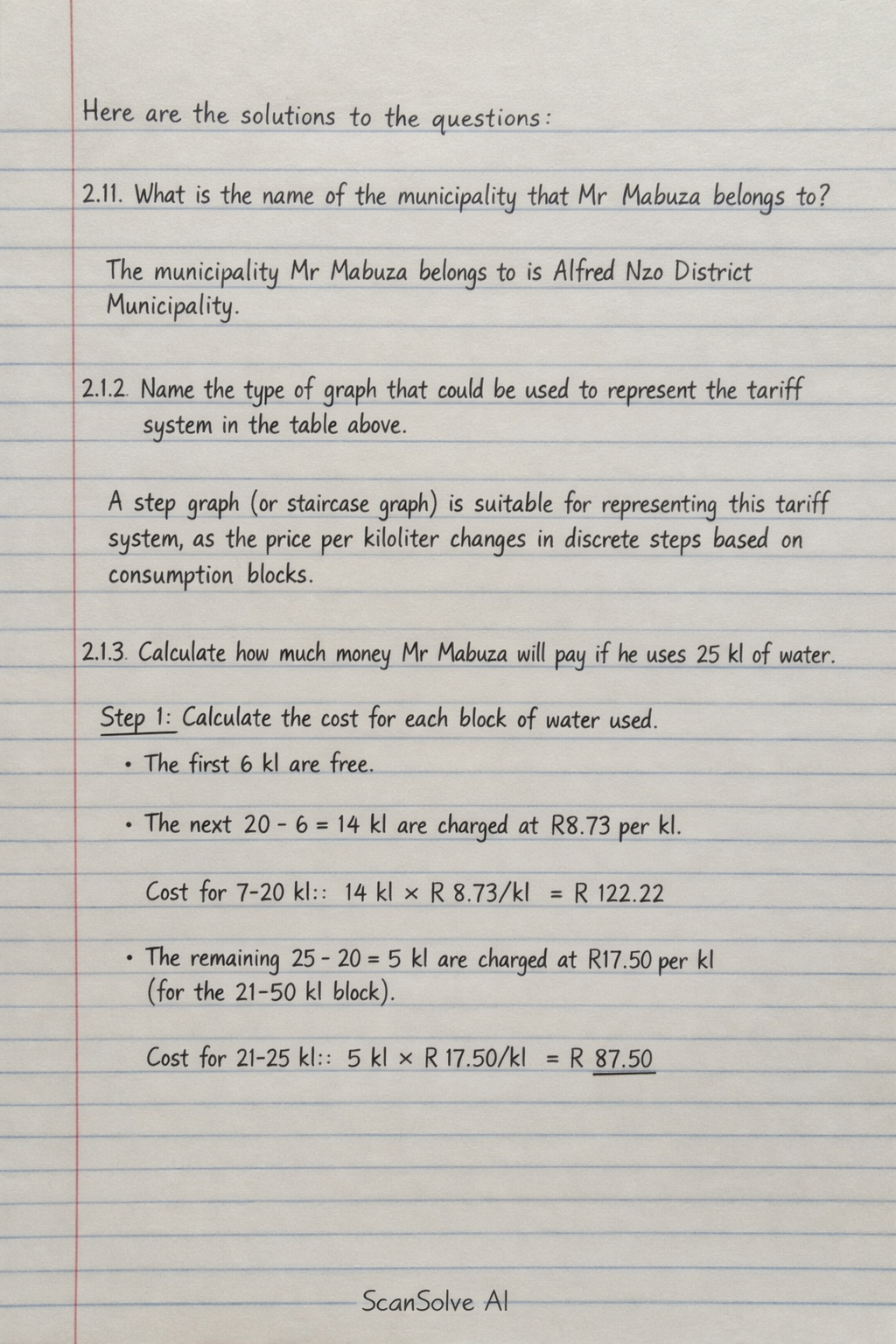
2.1.1 What is the name of the municipality that Mr Mabuza belongs to?
The municipality Mr Mabuza belongs to is Alfred Nzo District Municipality.
2.1.2 Name the type of graph that could be used to represent the tariff system in the table above.
A step graph (or staircase graph) is suitable for representing this tariff system, as the price per kiloliter changes in discrete steps based on consumption blocks.
2.1.3 Calculate how much money Mr Mabuza will pay if he uses 25 kl of water.
Calculate the cost for each block of water used.
- The first 6 kl are free.
- The next kl are charged at R8.73 per kl.
- The remaining kl are charged at R17.50 per kl (for the 21-50 kl block).
Calculate the total cost.
Mr Mabuza will pay R 209.72.
2.1.4 Explain why the first 6 kl is given for free?
The first 6 kl of water are given for free as part of a free basic services policy, which aims to ensure that all households, especially low-income ones, have access to a basic amount of essential resources.2.2.1 Calculate the new bus fare that Mr Mabuza pays for a single trip.
Calculate the increase in bus fare.
The original fare is R15.00, and it increased by 20%.
Calculate the new bus fare.
The new bus fare is R 18.00.
Still stuck on this one?
Ask a follow-up, and the answer starts from this question.
More Geography Questions
Handwritten Step-by-Step Solution
Get this as a handwritten image on WhatsApp — like a tutor wrote it for you.
Try on WhatsApp