
We read your photo as:
What are the primary drivers and consequences of population growth and urbanization, as detailed in the case study?
Geography
ScanSolve AI Answer
Step-by-step solution
2 stepsHere are the answers to your questions based on the provided text and the essay outline.
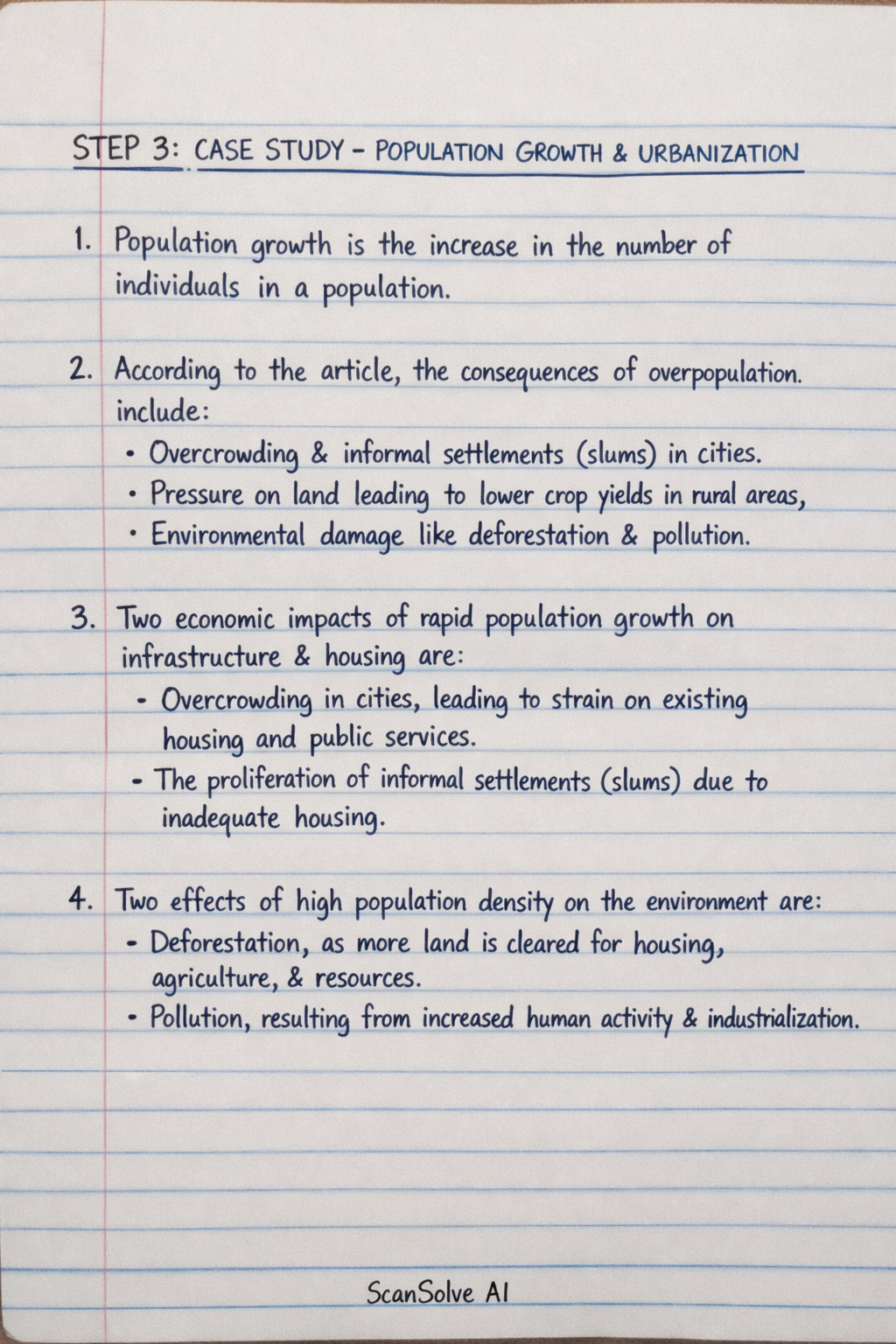
CASE STUDY – POPULATION GROWTH & URBANIZATION
- Population growth is the increase in the number of individuals in a population.
- According to the article, the consequences of overpopulation include overcrowding and informal settlements (slums) in cities, pressure on land leading to lower crop yields in rural areas, and environmental damage like deforestation and pollution.
- Two economic impacts of rapid population growth on infrastructure and housing are:
- Overcrowding in cities, leading to strain on existing housing and public services.
- The proliferation of informal settlements (slums) due to inadequate housing.
- Two effects of high population density on the environment are:
- Deforestation, as more land is cleared for housing, agriculture, and resources.
- Pollution, resulting from increased human activity and industrialization.
- Three negatives of an increase in birth rates in a developing country, inferred from the text's discussion of overpopulation consequences, are:
- Increased pressure on land, leading to lower crop yields and food insecurity.
- Greater demand for housing, resulting in overcrowding and the growth of informal settlements.
- Accelerated environmental degradation, such as deforestation and pollution, due to increased resource consumption and waste.
ARGUMENTATIVE ESSAY OUTLINE
-
Paragraph 1 (Introduction):
- Define population growth: The increase in the number of individuals in a population over time.
- Define overpopulation: A situation where the number of people exceeds the carrying capacity of the local environment, leading to resource scarcity and environmental degradation.
-
Paragraph 2 (Causes):
- Better healthcare leading to lower death rates: Advances in medicine, sanitation, and nutrition have significantly reduced mortality rates, especially infant mortality, allowing more people to live longer.
- Why birth rates remain high in some areas: Factors include lack of access to education and family planning resources, cultural or religious beliefs favoring large families, and economic reliance on children for labor or old-age support.
-
Paragraph 3 (Impacts):
- Leads to poverty (livelihood): Overpopulation intensifies competition for limited jobs and resources, driving down wages and making it harder for individuals to escape poverty.
- Leads to a strain on schools/hospitals (Economy): Rapid population growth overwhelms public services, leading to overcrowded schools, understaffed hospitals, and a decline in the quality of education and healthcare, placing a significant economic burden on governments.
- Leads to deforestation/pollution (Environment): Increased demand for food, housing, and resources results in extensive deforestation for agriculture and urban expansion, while increased consumption and industrial activity contribute to higher levels of pollution.
-
Paragraph 5 (Solutions):
- Promote education and awareness: Educating communities, especially women, about family planning, reproductive health, and the benefits of smaller families can lead to informed choices and lower birth rates.
- Improve access to contraception: Making a wide range of affordable and accessible contraceptive methods available empowers individuals to control their family size.
- Empower women: Investing in women's education and economic opportunities often correlates with delayed marriages and fewer children, as women gain more control over their lives and reproductive decisions.
- Foster economic development and poverty reduction: As living standards improve and poverty decreases, families often choose to have fewer children, as the economic necessity for child labor diminishes and children become less of an old-age security net.
- Implement supportive government policies: Governments can introduce policies such as incentives for smaller families, delayed marriage campaigns, and improved social security systems to reduce the perceived need for many children.
-
Was this helpful?
Still stuck on this one?
Ask a follow-up, and the answer starts from this question.
Got a different question?Ask your own question
More Geography Questions
QName two challenges faced by cities with very high population density and briefly explain each…QBased on the two documents and your knowledge, what are the factors contributing to urbanization in…QBy citing relevant examples, explain the effects of urbanization on society and environment.QWrite me a story of the effect of rapid population growth in world cities. In the story must include…QDescribe one environmental impact of rapid urbanization and explain why it occurs.
Handwritten Step-by-Step Solution
Get this as a handwritten image on WhatsApp — like a tutor wrote it for you.
Try on WhatsApp