
We read your photo as:
State three conditions that favour the development of karst topography. Describe the characteristics and mode of formation of a sinkhole.
ScanSolve AI Answer
Step-by-step solution
15 steps4. (a)
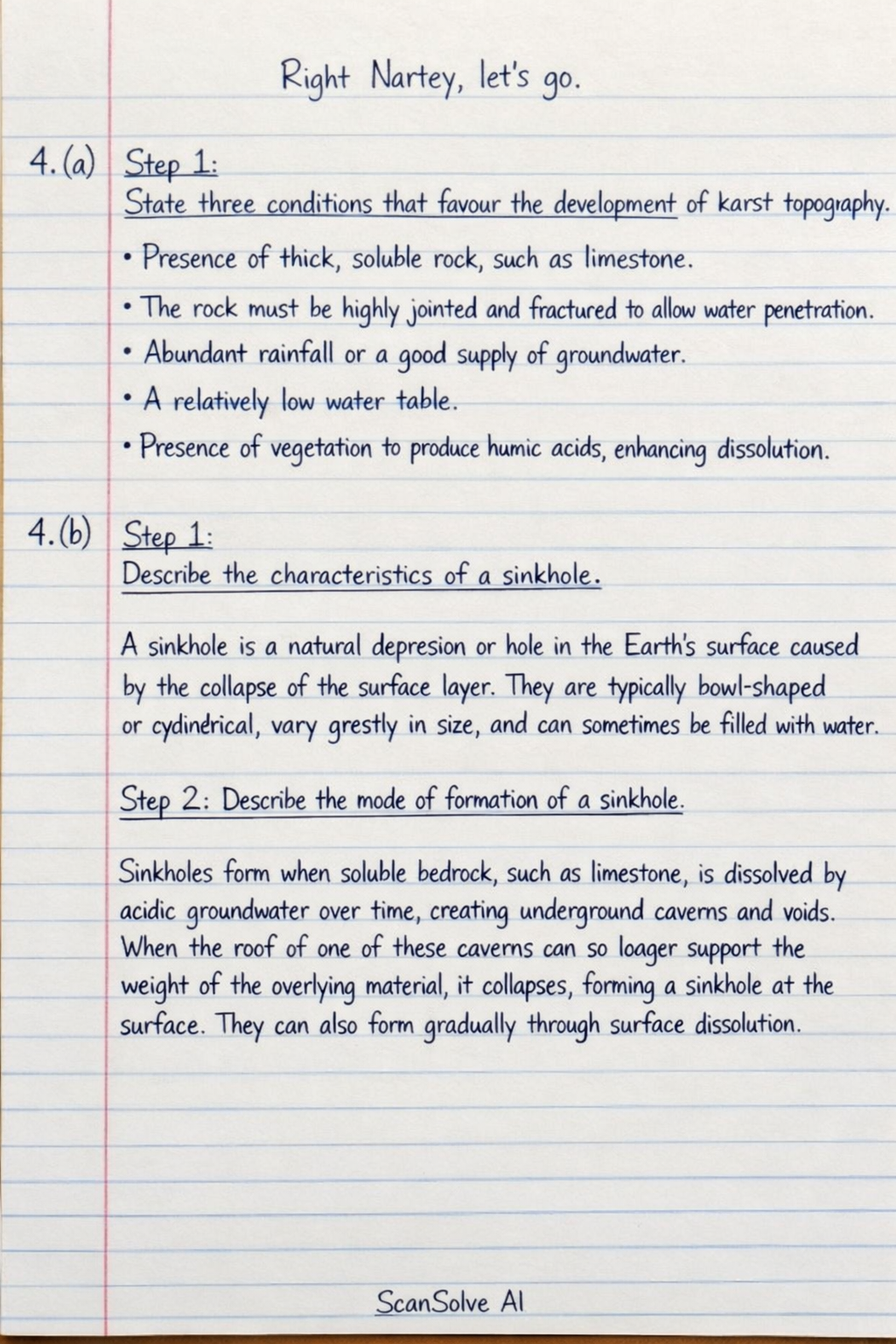
State three conditions that favour the development of karst topography.
- Presence of thick, soluble rock, such as limestone.
- The rock must be highly jointed and fractured to allow water penetration.
- Abundant rainfall or a good supply of groundwater.
- A relatively low water table.
- Presence of vegetation to produce humic acids, enhancing dissolution.
4. (b)
Describe the characteristics of a sinkhole.
A sinkhole is a natural depression or hole in the Earth's surface caused by the collapse of the surface layer. They are typically bowl-shaped or cylindrical, vary greatly in size, and can sometimes be filled with water.
Describe the mode of formation of a sinkhole.
Sinkholes form when soluble bedrock, such as limestone, is dissolved by acidic groundwater over time, creating underground caverns and voids. When the roof of one of these caverns can no longer support the weight of the overlying material, it collapses, forming a sinkhole at the surface. They can also form gradually through surface dissolution.
5. (a)
Define wind erosion.
Wind erosion is the process by which wind picks up, transports, and deposits loose surface material, primarily in arid and semi-arid regions where vegetation cover is sparse.
5. (b) (i)
List two processes of wind deposition.
- Loss of energy: As wind speed decreases, its carrying capacity diminishes, causing it to drop its sediment load.
- Obstruction: When wind encounters an obstacle like vegetation or rocks, its speed reduces, leading to the deposition of suspended and saltating particles.
5. (b) (ii)
List two landforms produced by wind deposition.
- Sand dunes
- Loess deposits
5. (c) (i)
Describe four characteristics of zeugen.
- Zeugen are elongated ridges of rock.
- They form in areas with horizontal layers of alternating hard and soft rock.
- The softer rock layers are eroded more rapidly by wind abrasion and deflation, leaving the harder caprock as ridges.
- They often occur in parallel rows, creating a "ridge and furrow" landscape.
5. (c) (ii)
Describe four characteristics of a rock pedestal.
- A rock pedestal is an isolated, mushroom-shaped rock formation.
- It has a wider top (cap) of more resistant rock.
- It has a narrower, eroded base of softer rock.
- The base is eroded more rapidly by wind abrasion, which is most effective near the ground where sand particles are concentrated.
6. (a)
Identify the types of climate represented by the Koppen's system of climate classification.
- (i) Aw: Tropical Savanna climate
- (ii) Am: Tropical Monsoon climate
- (iii) Af: Tropical Rainforest climate
6. (b)
Outline six characteristics of the climate associated with the Tropical rain forest.
- High annual rainfall, typically exceeding 2000 mm.
- High temperatures year-round, with average temperatures between 20°C and 28°C.
- A small annual temperature range, usually less than 5°C.
- High relative humidity throughout the year.
- No distinct dry season; rainfall occurs consistently throughout the year.
- Convectional rainfall is a dominant feature, often occurring in the afternoon.
7. (a) (i)
List three processes of wave erosion.
- Hydraulic action
- Abrasion (or Corrasion)
- Attrition
7. (a) (ii)
List four landforms produced by coastal deposition.
- Beaches
- Spits
- Bars (e.g., bay bars, barrier bars)
- Tombolos
7. (b)
Describe the mode of formation of a stump.
A stump is formed through a sequence of coastal erosion processes. Initially, waves erode a weakness in a headland, forming a cave. Continued erosion deepens the cave until it breaks through the headland, creating an arch. The arch's roof is then weakened by weathering and erosion, eventually collapsing to leave an isolated pillar of rock called a stack. The stack is further eroded at its base by wave action, becoming narrower. Over time, the stack collapses, leaving a small, low-lying rock remnant known as a stump, which is often submerged at high tide.
8. (a)
List five natural processes by which environmental balance is achieved.
- Photosynthesis
- Respiration
- The Water Cycle (Hydrological Cycle)
- The Carbon Cycle
- The Nitrogen Cycle
8. (b)
Outline five ways by which mankind has disturbed environmental balance.
- Deforestation, leading to habitat loss and increased carbon dioxide.
- Pollution (air, water, soil) from industrial activities and waste.
- Burning of fossil fuels, contributing to greenhouse gas emissions and climate change.
- Over-exploitation of natural resources, such as overfishing and excessive mining.
- Urbanization and infrastructure development, converting natural habitats into built environments.
Still stuck on this one?
Ask a follow-up, and the answer starts from this question.
More Geography Questions
Handwritten Step-by-Step Solution
Get this as a handwritten image on WhatsApp — like a tutor wrote it for you.
Try on WhatsApp