
We read your photo as:
Use the map of East Africa below to answer question (a). (a)(i) Name the railway terminus P,Q and R (ii)In each case give the commodity transported by the railway lines marked S and T. (iii) Give four challenges facing railway transport in East Africa.
ScanSolve AI Answer
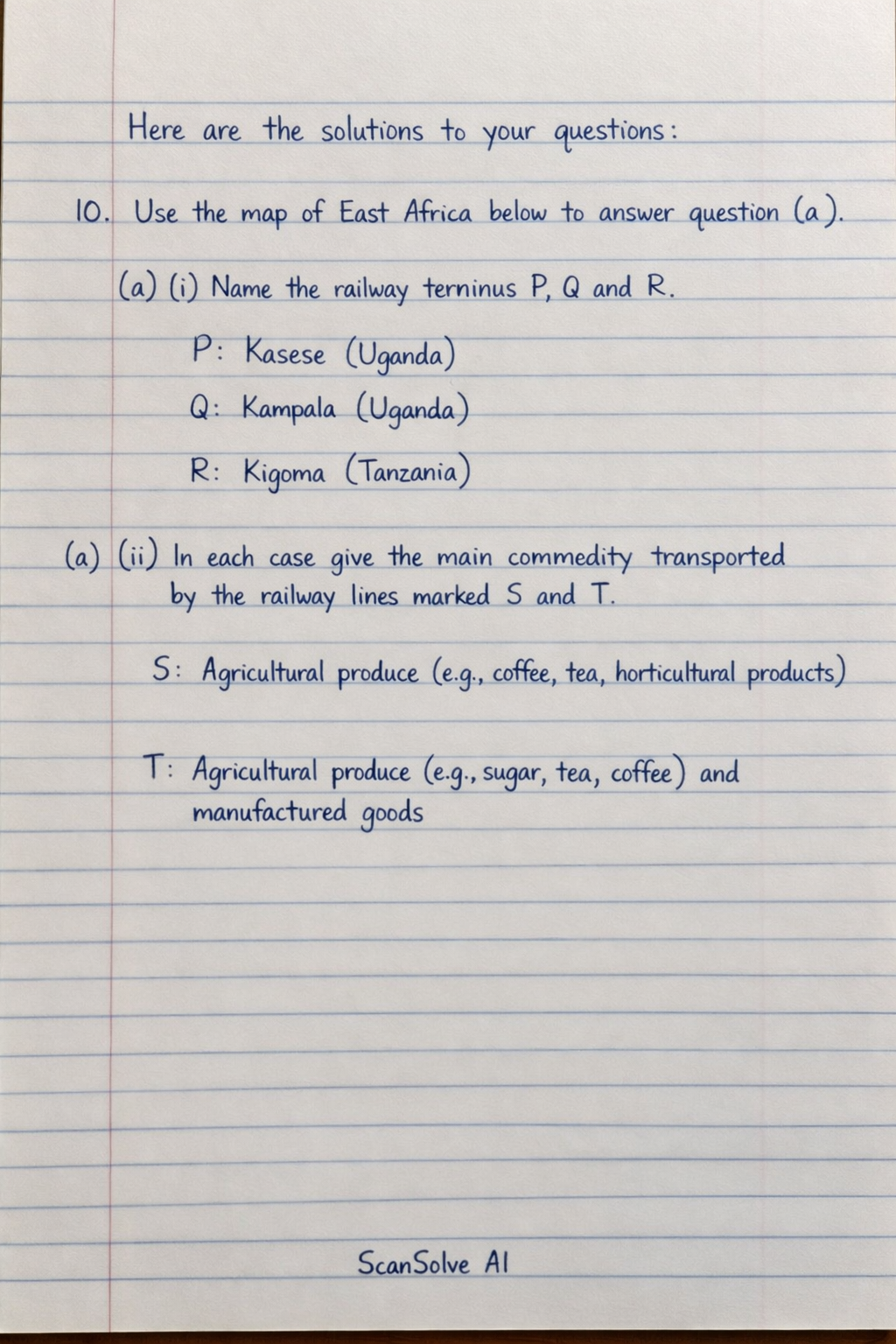
Here are the solutions to your questions:
10. Use the map of East Africa below to answer question (a).
a) (i) Name the railway terminus P, Q and R
- P: Kasese (Uganda)
- Q: Kampala (Uganda)
- R: Kigoma (Tanzania)
a) (ii) In each case give the main commodity transported by the railway lines marked S and T.
- S: Agricultural produce (e.g., coffee, tea, horticultural products)
- T: Agricultural produce (e.g., sugar, tea, coffee) and manufactured goods
a) (iii) Give four challenges facing railway transport in East Africa.
- Dilapidated infrastructure: Most railway lines are old and in poor condition, leading to slow speeds and frequent breakdowns.
- Competition from road transport: Road transport is often preferred due to its flexibility and door-to-door service, especially for shorter distances.
- High maintenance costs: Maintaining the extensive railway network and rolling stock requires significant financial investment.
- Limited network coverage: The railway network does not reach all parts of East Africa, limiting its accessibility and utility.
- Vandalism and insecurity: Theft of railway equipment and insecurity along some routes disrupt services and increase operational costs.
b) Outline three advantages of using containers while handling goods at the port of Mombasa.
- Reduced pilferage and damage: Goods are sealed inside containers, protecting them from theft, damage, and adverse weather conditions.
- Faster loading and unloading: Containers can be handled mechanically and quickly, significantly reducing turnaround time for ships and trucks.
- Facilitates multimodal transport: Containers can be easily transferred between different modes of transport (ship, rail, road) without unpacking, streamlining logistics.
- Lower handling costs: Mechanized handling of containers reduces the need for manual labor, leading to lower operational costs.
c) One of the problems facing road transport is the high frequency of accidents. Explain four measures the Kenya Government has taken to reduce motor vehicle accidents in the Country.
- Enforcement of traffic laws: The government has intensified the enforcement of traffic rules, including speed limits, drunk driving laws, and seatbelt use, through agencies like the National Transport and Safety Authority (NTSA).
- Road safety campaigns: Public awareness campaigns are regularly conducted to educate drivers and pedestrians on safe road practices and the dangers of reckless driving.
- Improvement of road infrastructure: Investment in constructing dual carriageways, improving road signage, marking, and lighting, and repairing potholes helps to create safer driving conditions.
- Vehicle inspection and maintenance: Regulations require regular inspection of public service vehicles (PSVs) and commercial vehicles to ensure they are roadworthy, and the installation of speed governors in PSVs.
- Driver training and licensing: Stricter requirements for driver training and licensing, including mandatory re-testing for some categories, aim to ensure only competent drivers are on the roads.
d) Give five reasons why there is limited use of letter writing as a means of communication in Kenya.
- Rise of faster alternatives: The widespread availability and affordability of mobile phones, email, and social media offer instant communication, making letter writing seem slow.
- High cost of postage: The cost of sending letters, especially over long distances or internationally, can be prohibitive compared to digital communication.
- Slow delivery speed: Letters can take days or even weeks to reach their destination, which is impractical for urgent communication in today's fast-paced world.
- Illiteracy levels: A significant portion of the population, particularly in rural areas, may have limited literacy skills, making letter writing and reading challenging.
- Lack of postal addresses: Many rural areas lack formal postal addresses, making it difficult to send or receive letters reliably.
- Security concerns: Letters can be lost, damaged, or intercepted, leading to concerns about the privacy and security of information.
Still stuck on this one?
Ask a follow-up, and the answer starts from this question.
More Geography Questions
Handwritten Step-by-Step Solution
Get this as a handwritten image on WhatsApp — like a tutor wrote it for you.
Try on WhatsApp