
We read your photo as:
Nigeria as a nation has (a) six geographical political zones.
History
ScanSolve AI Answer
Here are the answers to the questions:
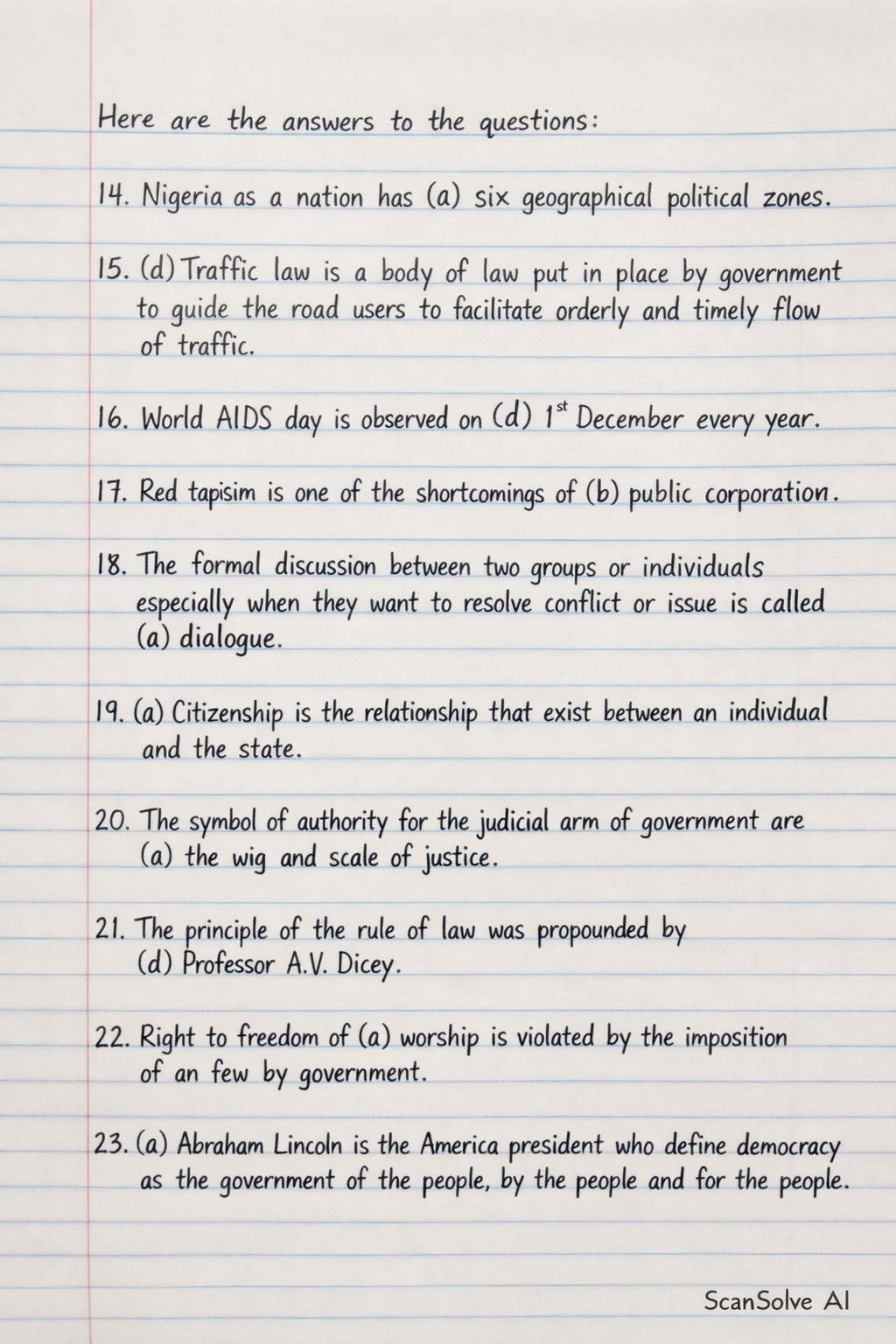
- Nigeria as a nation has (a) six geographical political zones.
- (d) traffic law is a body of law put in place by government to guide the road users to facilitate orderly and timely flow of traffic.
- World AIDS day is observed on (d) 1ˢᵗ December every year.
- Red tapism is one of the shortcomings of (b) public corporation.
- The formal discussion between two groups or individuals especially when they want to resolve conflict or issue is called (a) dialogue.
- (a) citizenship is the relationship that exist between an individual and the state.
- The symbol of authority for the judicial arm of government are (a) the wig and scale of justice.
- The principle of the rule of law was propounded by (d) Professor A.V. Dicey.
- Right to freedom of (a) worship is violated by the imposition of an few by government.
- (a) Abraham Lincoln is the America president who define democracy as the government of the people, by the people and for the people.
- In a democracy, political contest can be restricted on the basis of (c) age.
- A self reliant person can be said to be (d) independent.
- The organ responsible for implementing policies and laws made in the country is called (b) executive.
- Which of the following is not a skill that promotes inter personal relations: (d) cruelty.
- Negative attitude directed at people living with HIV/AIDS by the society is described as (b) stigmatization.
- The June 12, 1993 was annulled by former military government headed by (c) General Ibrahim Babangida.
- HIV/AIDS can be contracted through the following ways except (d) body contact.
Was this helpful?
Still stuck on this one?
Ask a follow-up, and the answer starts from this question.
Got a different question?Ask your own question
More History Questions
QState the vegetation zone in NigeriaQAnswer five questions in all, one from section A and four from section B. SECTION A 1. The data…QNigeria became an economic unit in the year Nigerian became a political unit in the year Define the…QIs Nigeria a member of united nation?Q50 GOVERNMENT JAMB PAST QUESTIONS AND ANSWERS 📚📝🧠💯 https://whatsapp.com/channel/0029VarOc8iCHDyu…
Handwritten Step-by-Step Solution
Get this as a handwritten image on WhatsApp — like a tutor wrote it for you.
Try on WhatsApp