
We read your photo as:
Answer five questions in all, one from section A and four from section B. SECTION A 1. The data below shows a hypothetical age distribution of population of a town in Nigeria.
Economics
ScanSolve AI Answer
Step-by-step solution
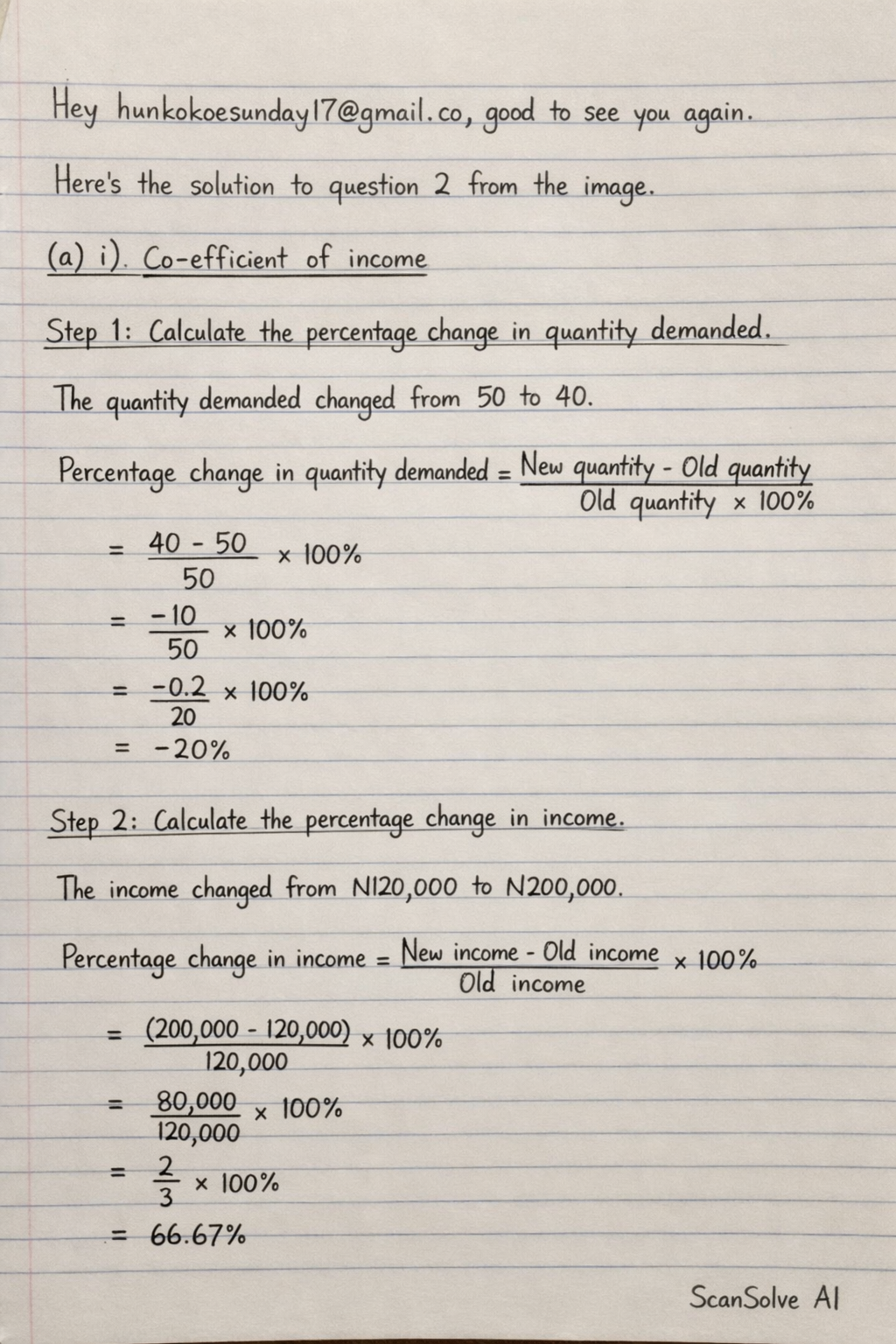
3 stepsHere's the solution to question 2 from the image.
a) i) Co-efficient of income
Calculate the percentage change in quantity demanded.
The quantity demanded changed from 50 to 40.
Calculate the percentage change in income.
The income changed from N120,000 to N200,000.
Calculate the income elasticity of demand (co-efficient of income).
The co-efficient of income is .
a) ii) What type of goods is garri to Mr. Adebowale?
Since the income elasticity of demand is negative (), garri is an inferior good to Mr. Adebowale. This means that as his income increases, his demand for garri decreases.
b) Briefly explain four factors affecting elasticity of supply.
- Availability of inputs: If inputs (raw materials, labor, capital) are readily available and can be easily sourced, supply will be more elastic. If inputs are scarce or difficult to obtain, supply will be inelastic.
- Time horizon: In the short run, supply tends to be more inelastic because producers have limited ability to change production capacity. In the long run, producers have more time to adjust their production processes and capacity, making supply more elastic.
- Storage capacity: If a good can be easily stored without significant cost or spoilage, producers can hold inventory and adjust supply more flexibly, leading to more elastic supply. Perishable goods or goods with high storage costs tend to have inelastic supply.
- Mobility of factors of production: If factors of production (like labor and capital) can be easily moved from one industry to another, producers can quickly respond to price changes by reallocating resources, making supply more elastic. If factors are specialized and immobile, supply will be inelastic.
Was this helpful?
Still stuck on this one?
Ask a follow-up, and the answer starts from this question.
Got a different question?Ask your own question
More Economics Questions
QAnswer FIVE questions, ALL THREE (3) from SECTION A and any TWO (2) from SECTION BQSECTION B: Answer Any five (5) QuestionsQBECE 2026 Social Studies Section B Practice (For Candidates) INSTRUCTION: Answer any THREE…QAnswer four questions in all, choosing any two questions from Section A and any two questions from…QGiven a list of children's ages, organize the data and answer specific questions about the age…
Handwritten Step-by-Step Solution
Get this as a handwritten image on WhatsApp — like a tutor wrote it for you.
Try on WhatsApp