

This history question requires analysis of historical events, causes, and consequences. The detailed answer below provides context, evidence, and a well-structured explanation.
ScanSolve AI Answer
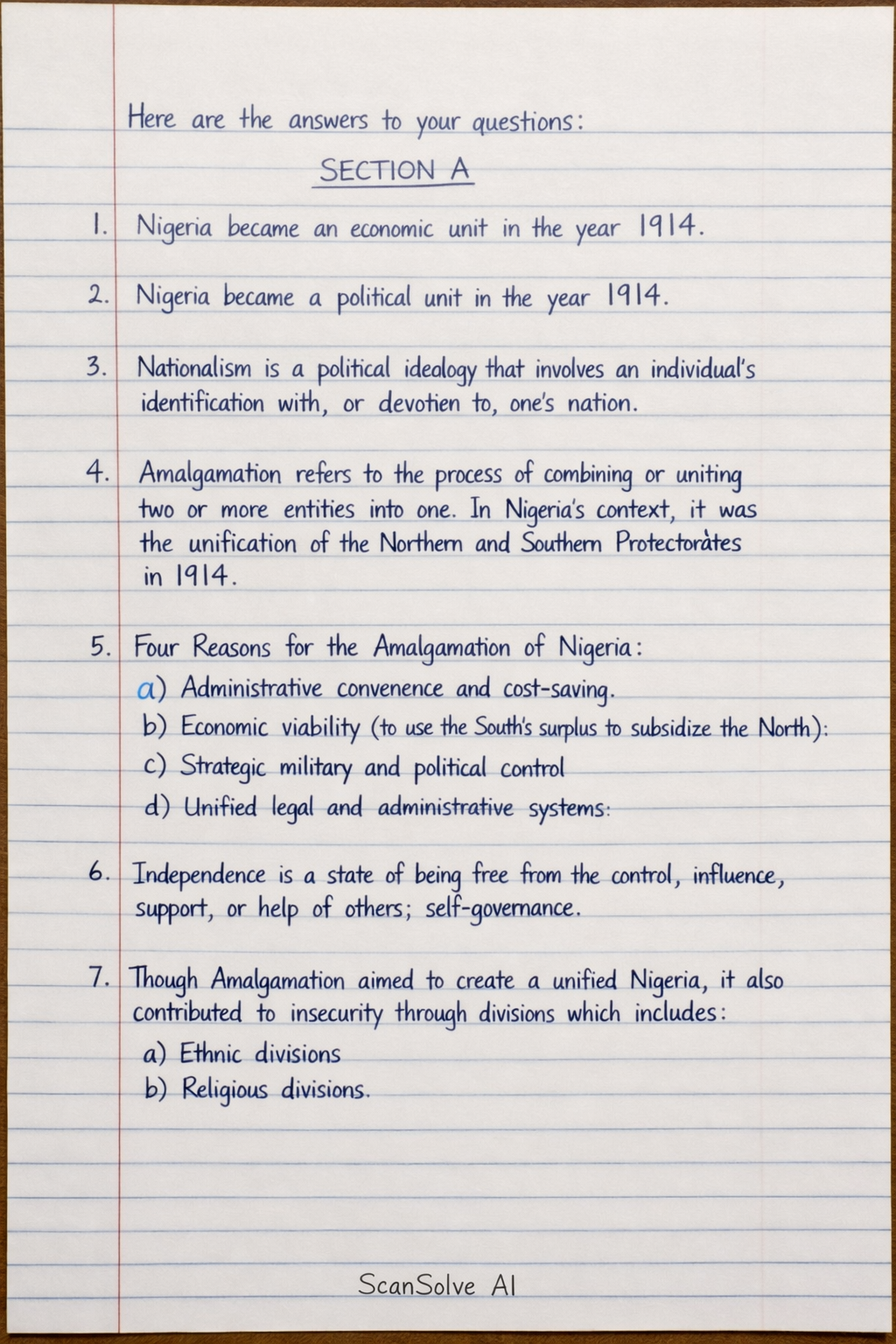
Here are the answers to your questions: SECTION A 1. Nigeria became an economic unit in the year 1914. 2. Nigerian became a political unit in the year 1914. 3. Nationalism is a political ideology that involves an individual's identification with, or devotion to, one's nation. 4. Amalgamation refers to the process of combining or uniting two or more entities into one. In Nigeria's context, it was the unification of the Northern and Southern Protectorates in 1914. 5. Four Reasons for the Amalgamation of Nigeria: a) Administrative convenience and cost-saving b) Economic viability (to use the South's surplus to subsidize the North) c) Strategic military and political control d) Unified legal and administrative systems 6. Independence is a state of being free from the control, influence, support, or help of others; self-governance. 7. Though Amalgamation aimed to create a unified Nigeria, it also contributed to insecurity through divisions which includes: a) Ethnic divisions b) Religious divisions c) Regional disparities d) Political power struggles 8. The movement that kept alive nationalist agitation was called the Nationalist Movement. 9. Two components of culture are material culture and non-material culture. 10. Cultural lag refers to the phenomenon where cultural ideas and practices fail to keep pace with new technological innovations, leading to social problems or maladjustment. 11. Population culture (assuming "Popular culture") refers to the cultural patterns that are widespread among a society's population, often associated with mass media and consumerism. 12. Three forms of popular culture are: a) Music b) Film/Television c) Fashion 13. Folkways are the traditional behavior or way of life of a particular community or group of people; they are norms for routine or casual interaction. 14. A counterculture is a subculture whose values and norms of behavior differ substantially from those of mainstream society, often in opposition to mainstream cultural mores. 15. Endogamy is the practice of marrying within a specific ethnic group, class, or social group, rejecting others on such a basis. 16. Elopement marriage is a marriage conducted without the knowledge or consent of the parents or guardians, often involving the couple running away together. 17. Pawn marriage is a traditional practice where a child is given as collateral or security for a debt, often leading to the child being married off to the creditor or their family. 18. Five main functions of the family are: a) Reproduction/Procreation b) Socialization c) Economic support d) Emotional support/Affection e) Regulation of sexual activity 19. Socialization is the lifelong process of inheriting and disseminating norms, customs, and ideologies, providing an individual with the skills and habits necessary for participating within their own society. 20. Importance of socialization includes: a) Development of self-concept b) Learning societal norms and values c) Acquisition of social roles d) Maintenance of social order 21. Agents of socialization includes: a) Family b) School c) Peer groups d) Mass media e) Religion f) Workplace 22. In Kinship Relationship is traced through the descent line. 23. In Nigeria three types of kinship relationship can be observed, They include: a) Consanguineal kinship (blood relatives) b) Affinal kinship (marriage relatives) c) Fictive kinship (socially recognized, non-blood/marriage) 24. Factors responsible for preferred marriages includes: a) Socio-economic status b) Religion c) Ethnicity/Tribe d) Education level 25. Values are a person's or society's principles or standards of behavior; one's judgment of what is important in life. 26. Ethics are moral principles that govern a person's or group's behavior, often concerned with what is good for individuals and society. 27. Why are values and ethics imperative in Nigeria: a) Promote social cohesion and unity b) Guide moral conduct and decision-making c) Combat corruption and injustice d) Foster national development and progress e) Ensure respect for human rights and dignity SECTION B 1. a) What is unity in Diversity? (5mks) Unity in diversity is a concept that describes a state of togetherness or harmony within a group of people who possess different cultural, ethnic, religious, or social backgrounds. It emphasizes that despite differences, people can coexist peacefully and work towards common goals, celebrating their unique identities while maintaining a collective bond. 2. b) Differentiate between ethnocentrism and xenocentrism (5mks) Ethnocentrism is the tendency to view one's own culture as the most important and correct, and to use it as the standard by which to judge other cultures. It often involves a belief in the superiority of one's own ethnic group or culture. Xenocentrism, conversely, is the preference for the products, styles, or ideas of another culture over one's own. It involves the belief that foreign cultures are superior to one's own, often leading to a devaluation of one's own cultural practices and products.