

This history question requires analysis of historical events, causes, and consequences. The detailed answer below provides context, evidence, and a well-structured explanation.
ScanSolve AI Answer
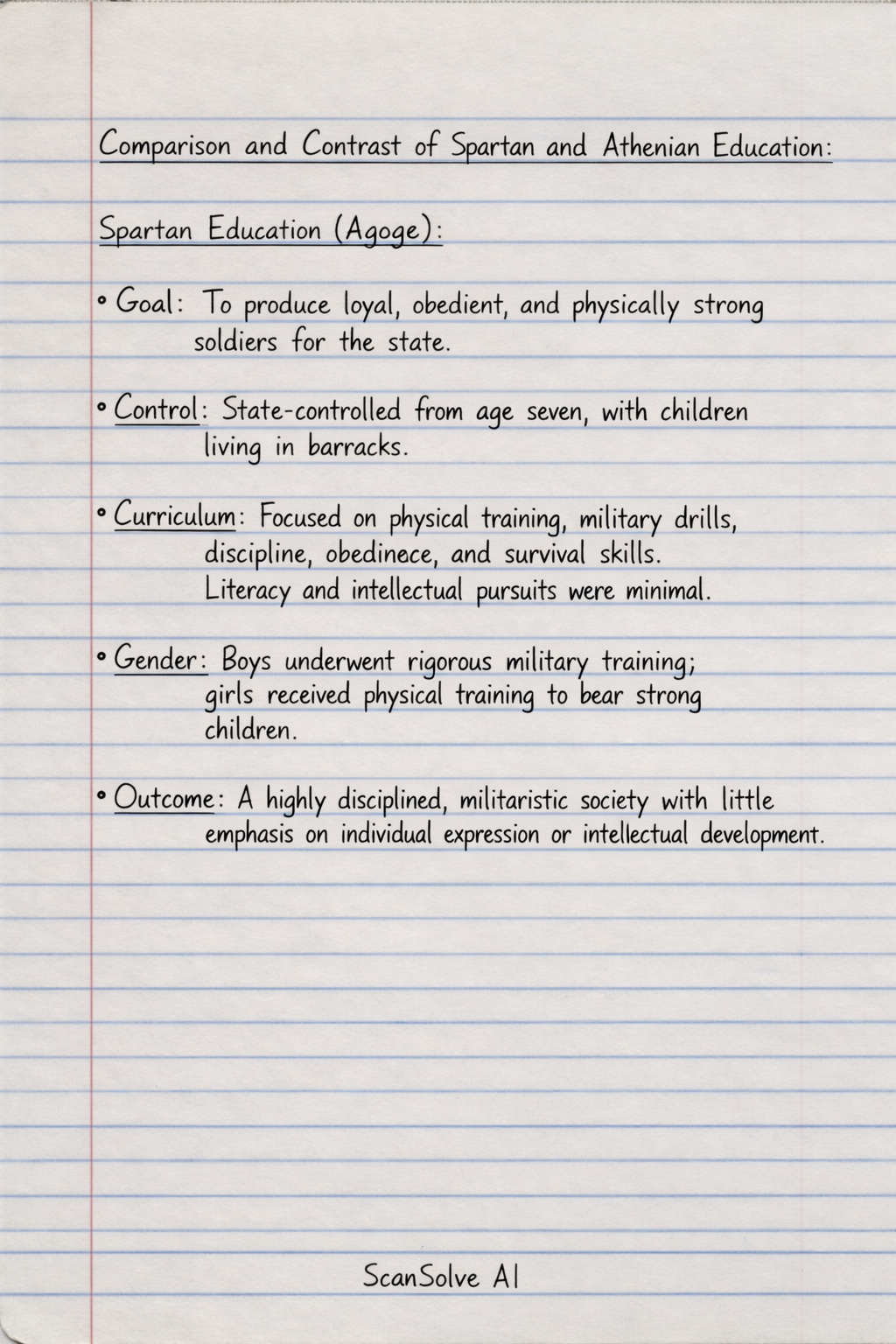
a) Compare and contrast the systems of education in ancient Sparta and Athens and point out the relevance of those experiences to the modern theory and practice of education. Comparison and Contrast of Spartan and Athenian Education: Spartan Education (Agoge): Goal: To produce loyal, obedient, and physically strong soldiers for the state. Control: State-controlled from age seven, with children living in barracks. Curriculum: Focused on physical training, military drills, discipline, obedience, and survival skills. Literacy and intellectual pursuits were minimal. Gender: Boys underwent rigorous military training; girls received physical training to bear strong children. Outcome: A highly disciplined, militaristic society with little emphasis on individual expression or intellectual development. Athenian Education: Goal: To produce well-rounded citizens capable of participating in democracy, with intellectual, moral, and physical development. Control: Primarily private, family-based, with wealthy boys attending private schools or having tutors. Curriculum: Broad, including gymnastics, music, literature, rhetoric, philosophy, and mathematics. Emphasis was on critical thinking and public speaking. Gender: Primarily for boys from wealthy families; girls received domestic training at home. Outcome: A society that valued intellectualism, art, philosophy, and democratic governance. Similarities: Both systems aimed to prepare citizens for their roles in society and included physical training. Differences: Sparta emphasized state control, military prowess, and conformity, while Athens valued individual development, intellectualism, and democratic participation. Relevance to Modern Education: Spartan Relevance: The concept of physical education and discipline in schools, as well as the idea of state-controlled public education and vocational training* for specific societal roles, can be traced back to Spartan ideals. Athenian Relevance: The Athenian ideal of holistic education (developing intellectual, physical, moral, and aesthetic aspects), the importance of liberal arts, critical thinking, and democratic citizenship education are fundamental to modern educational theory and practice. The value placed on rhetoric and communication skills* also remains highly relevant. b) Discuss the relevance of history of education to the training of teachers. The history of education is crucial for teacher training as it provides a foundational understanding of how current educational systems, theories, and practices evolved. It helps teachers to critically analyze contemporary issues by understanding their historical roots and context, preventing the repetition of past mistakes and informing effective strategies. Studying the past also fosters an appreciation for the teaching profession by highlighting the struggles and achievements of educators throughout history, thereby enhancing professional identity and commitment. Furthermore, it enables teachers to contextualize educational reforms and policies, understanding the rationale behind changes and their potential long-term impacts. c) Explain five causes of European Renaissance. 1. Increased Trade and Wealth: The growth of trade routes, particularly with the East, led to the rise of wealthy merchant classes in Italian city-states. This accumulated wealth provided significant patronage for artists, architects, and scholars, fueling the creative and intellectual explosion of the Renaissance. 2. Rediscovery of Classical Texts: Scholars rediscovered and translated numerous ancient Greek and Roman texts that had been preserved in monastic libraries and by Islamic scholars. This led to a renewed interest in classical learning, philosophy, art, and literature, inspiring new ways of thinking. 3. Humanism: This intellectual movement emphasized human potential, achievements, and values, shifting focus from purely divine matters to human experience. Humanists promoted the study of classical literature, history, and moral philosophy, fostering a spirit of inquiry and individualism. 4. Invention of the Printing Press: Johannes Gutenberg's invention of the movable type printing press around 1440 revolutionized the dissemination of knowledge. Books became cheaper and more accessible, allowing new ideas, classical texts, and scientific discoveries to spread rapidly across Europe. 5. Patronage of Arts and Sciences: Wealthy families, such as the Medici in Florence, along with the Church and various monarchs, actively sponsored artists, writers, and scientists. This financial support was essential for the creation of masterpieces in art, architecture, and literature, and for advancements in scientific thought. Send me the next one 📸