
We read your photo as:
According to Sultan Muhammad Bello's Infog al-Malsuri, the Yoruba derived from?
ScanSolve AI Answer
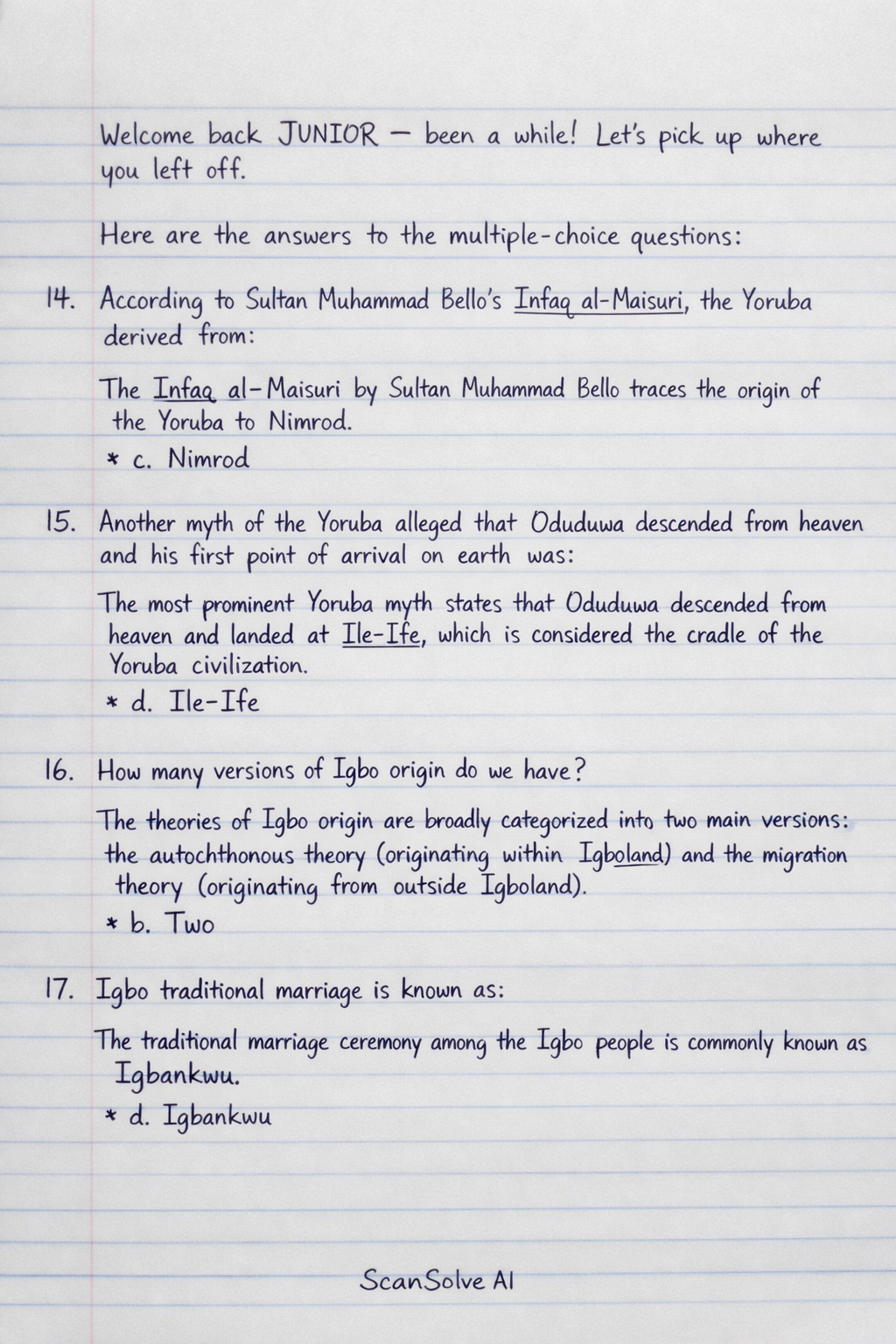
Here are the answers to the multiple-choice questions:
-
14. According to Sultan Muhammad Bello's Infaq al-Maisuri, the Yoruba derived from: The Infaq al-Maisuri by Sultan Muhammad Bello traces the origin of the Yoruba to Nimrod.
- c. Nimrod
-
15. Another myth of the Yoruba alleged that Oduduwa descended from heaven and his first point of arrival on earth was: The most prominent Yoruba myth states that Oduduwa descended from heaven and landed at Ile-Ife, which is considered the cradle of the Yoruba civilization.
- d. Ile-Ife
-
16. How many versions of Igbo origin do we have? The theories of Igbo origin are broadly categorized into two main versions: the autochthonous theory (originating within Igboland) and the migration theory (originating from outside Igboland).
- b. Two
-
17. Igbo traditional marriage is known as: The traditional marriage ceremony among the Igbo people is commonly known as Igbankwu.
- d. Igbankwu
-
18. Birth is celebrated among the Igbo while naming ceremony is usually performed on: While practices can vary, a significant naming ceremony among the Igbo is often performed on the 28th Day after birth, marking a full lunar cycle.
- d. The 28th Day
-
19. The Central zone of Nigeria is sometimes referred to as: The "Central Zone" of Nigeria is commonly known as the Middle Belt. Among the given options, which are specific place names, this question is challenging. However, if we consider historical or broader regional references, "Katsashen Bauchi" refers to the Bauchi territories, which are in the North-East but can be historically linked to broader northern regions. Given the options, this is the most encompassing geographical reference.
- a. Katsashen Bauchi
-
20. The Eastern Zone of Nigeria consists of one of the following ethnic groups: The Eastern Zone (comprising the South-East and parts of the South-South geopolitical zones) is predominantly inhabited by the Igbo, Ijaw, and Ibibio ethnic groups.
- c. Igbo, Ijaw & Ibibio
-
21. Before independence, agriculture accounted for --- percent of the GDP of Nigeria. Before the discovery and dominance of oil, agriculture was the primary economic activity in Nigeria, contributing a very significant portion to the GDP. Among the given options, 50% is the most realistic and commonly cited figure for its substantial contribution.
- c. 50%
-
22. Between 1922 and 1954, how many notable constitutions were operated in Nigeria? During this period, Nigeria operated four major constitutions: the Clifford Constitution (1922), the Richards Constitution (1946), the Macpherson Constitution (1951), and the Lyttleton Constitution (1954).
- b. 4
-
23. Many Nigerian youths have ruined their lives through the following, except: Excessive partying, armed robbery, and secret cults are generally considered detrimental activities that can ruin lives. Going to School is a positive and beneficial activity.
- d. Going to School
-
24. Political thuggery and gangsterism are becoming a fashion in Nigerian: Political thuggery and gangsterism are directly associated with and often manifest within the realm of Politics.
- b. Politics
-
25. Trans-Atlantic slave trade led to the migration of Yoruba culture to the present: The Trans-Atlantic slave trade resulted in a significant diaspora of Yoruba people, leading to a strong presence and influence of Yoruba culture, religion, and traditions in countries like Brazil and Cuba.
- a. Brazil & Cuba
Still stuck on this one?
Ask a follow-up, and the answer starts from this question.
More History Questions
Handwritten Step-by-Step Solution
Get this as a handwritten image on WhatsApp — like a tutor wrote it for you.
Try on WhatsApp