

This history question requires analysis of historical events, causes, and consequences. The detailed answer below provides context, evidence, and a well-structured explanation.
ScanSolve AI Answer
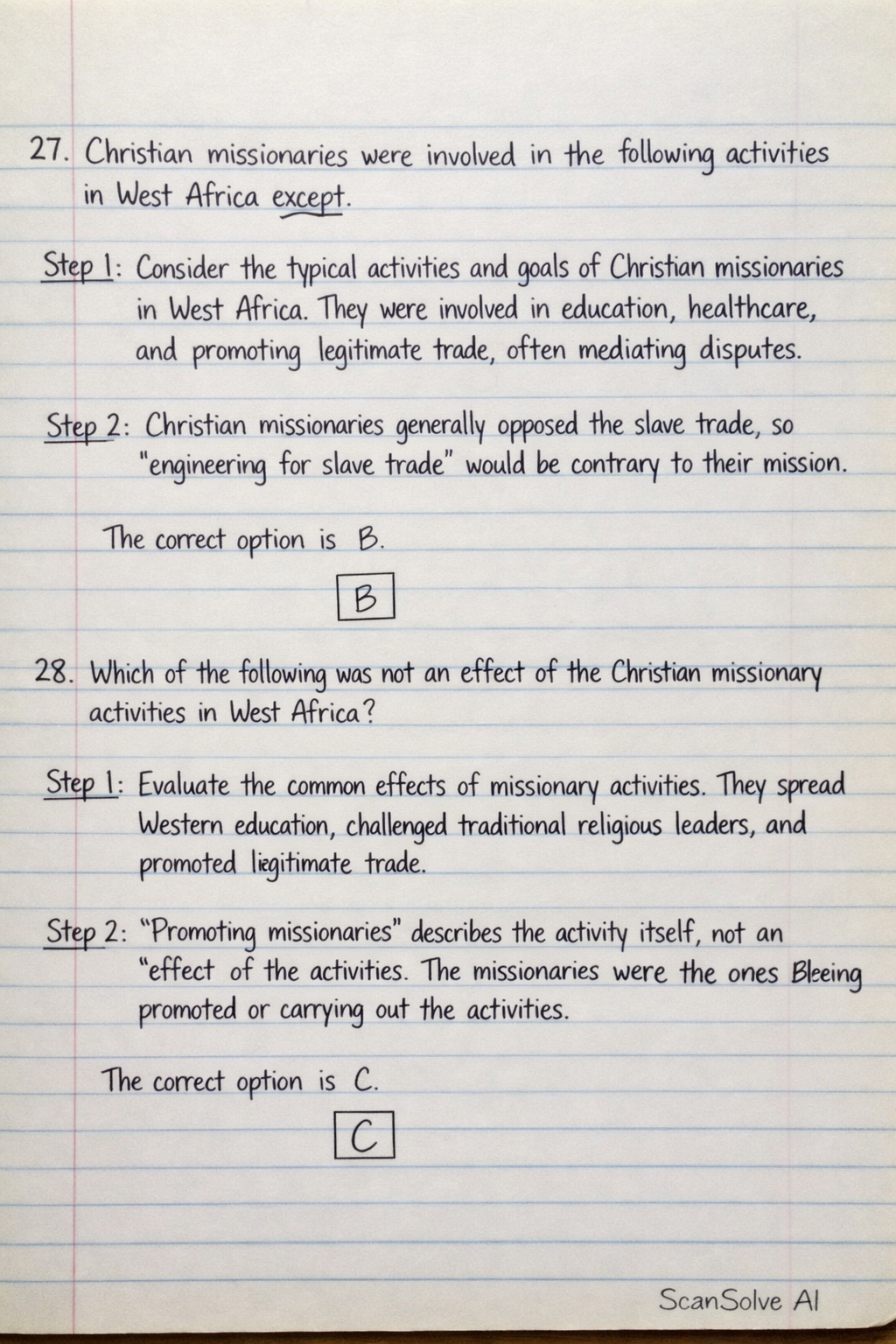
here are the answers to your questions, MARY: 27. Christian missionaries were involved in the following activities in West Africa except Step 1: Consider the typical activities and goals of Christian missionaries in West Africa. They were involved in education, healthcare, and promoting legitimate trade, often mediating disputes. Step 2: Christian missionaries generally opposed the slave trade, so "engineering for slave trade" would be contrary to their mission. The correct option is B. B 28. Which of the following was not an effect of the Christian missionary activities in West Africa? Step 1: Evaluate the common effects of missionary activities. They spread Western education, challenged traditional religious leaders, and promoted legitimate trade. Step 2: "Promoting missionaries" describes the activity itself, not an effect of the activities. The missionaries were the ones being promoted or carrying out the activities. The correct option is C. C 29. Which of the following was not an effect of the Christian missionary activities in West Africa? Step 1: Consider the broad impacts of missionary work, which often included cultural assimilation and efforts to "civilize" according to European standards. Step 2: A "report" is a document or account, not a societal or cultural effect of missionary activities. The correct option is C. C 30. The following factors contributed to the Berlin Conference except Step 1: Recall the reasons for the Berlin Conference (1884-1885). It was called due to intense European rivalries over African territory, colonial ambitions, and the desire to set rules for partitioning to avoid war among European powers. Step 2: The conference was about partitioning and establishing rules for colonial acquisition, not about setting prices for raw materials, although economic exploitation was a consequence of the partition. The correct option is D. D 31. An effect of the Industrial Revolution in West Africa was the Step 1: Understand how the Industrial Revolution in Europe impacted its relationship with Africa. European industries needed raw materials and markets. Step 2: The Industrial Revolution led to a significant increase in the exportation of industrial raw materials (like palm oil, rubber, minerals) from West Africa to feed European factories. The correct option is B. B 32. European powers annexed West African territory for the Step 1: Identify the primary motivation behind European colonization and annexation of African territories. Step 2: The main driving force for European annexation was economy, specifically to secure raw materials, markets for manufactured goods, and investment opportunities. The correct option is D. D 33. The German Chancellor that called for the Berlin Conference was Step 1: Recall the key figure associated with the convening of the Berlin Conference. Step 2: Otto Von Bismarck, the Chancellor of Germany, hosted and largely orchestrated the Berlin Conference. The correct option is B. B 34. The following were effects of the Scramble for and Partition of West Africa except Step 1: Consider the consequences of the European partition of Africa. It led to resource exploitation, conflicts, and the creation of artificial borders. Step 2: While Europeans built some infrastructure to facilitate resource extraction, building industries in West Africa for the benefit of the local population was not a primary effect or goal of the partition; rather, West Africa was seen as a source of raw materials and a market. The correct option is D. D 35. The only country that did not participate in the partitioning of West African territories was Step 1: Identify the major European colonial powers involved in West Africa. Portugal, Germany, and France were all significant players. Step 2: Russia was a major European power but did not participate in the scramble for African territories. The correct option is C. C 36. The colonial policy that allowed the preservation of traditional West African culture was Step 1: Differentiate between the main colonial administrative policies. Step 2: Indirect Rule, primarily practiced by the British, involved governing through existing traditional rulers and institutions, which often meant preserving some aspects of traditional culture and authority, albeit under colonial control. The correct option is D. D You're almost done! Send me the next one 📸