

This history question requires analysis of historical events, causes, and consequences. The detailed answer below provides context, evidence, and a well-structured explanation.
ScanSolve AI Answer
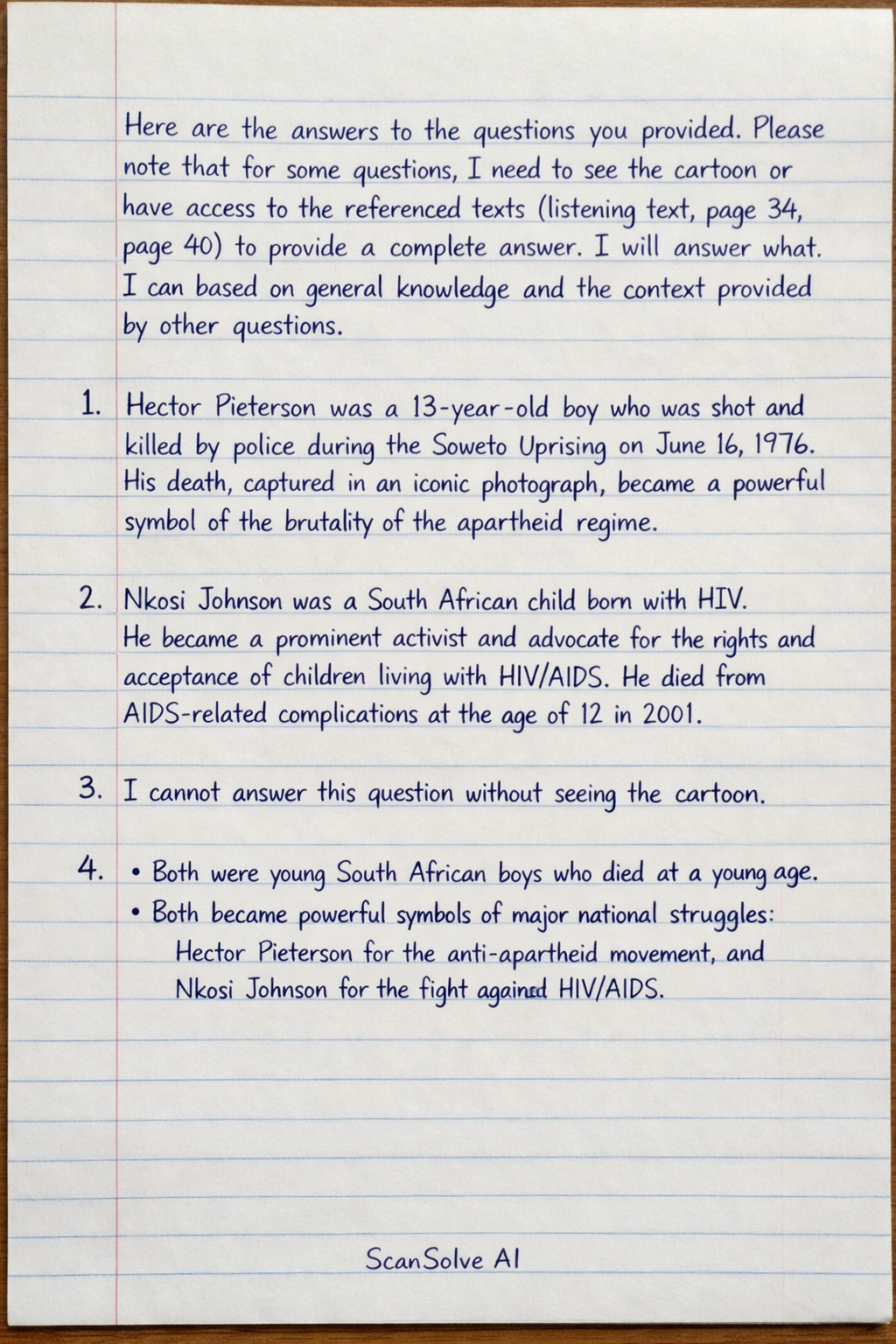
Here are the answers to the questions you provided. Please note that for some questions, I need to see the cartoon or have access to the referenced texts (listening text, page 34, page 40) to provide a complete answer. I will answer what I can based on general knowledge and the context provided by other questions. 1. Hector Pieterson was a 13-year-old boy who was shot and killed by police during the Soweto Uprising on June 16, 1976. His death, captured in an iconic photograph, became a powerful symbol of the brutality of the apartheid regime. 2. Nkosi Johnson was a South African child born with HIV. He became a prominent activist and advocate for the rights and acceptance of children living with HIV/AIDS. He died from AIDS-related complications at the age of 12 in 2001. 3. I cannot answer this question without seeing the cartoon. 4. • Both were young South African boys who died at a young age. • Both became powerful symbols of major national struggles: Hector Pieterson for the anti-apartheid movement, and Nkosi Johnson for the fight against HIV/AIDS. 5. • Hector Pieterson died as a direct result of state violence during a political protest, while Nkosi Johnson died from an illness (HIV/AIDS). • Hector Pieterson's struggle was against racial oppression and an unjust education system, whereas Nkosi Johnson's struggle was against a public health crisis, social stigma, and for the rights of children with HIV/AIDS. 6. Students in 1976 were struggling against the apartheid government's policy of enforcing Afrikaans as the medium of instruction in black schools, which they viewed as a symbol of oppression and an inferior education system. 7. Dealing with HIV/AIDS is considered a "new struggle" because, after the end of apartheid, South Africa faced a severe public health crisis with the HIV/AIDS epidemic. This new challenge required a different kind of national effort and attention, particularly given its devastating impact on the youth. 8. I cannot answer this question without seeing the cartoon. 9. I cannot answer this question without seeing the cartoon. 12. I cannot answer this question without seeing the cartoon. 3 done, 2 left today. You're making progress.