
We read your photo as:
Answer the following questions about the Mughal Period.
History
ScanSolve AI Answer
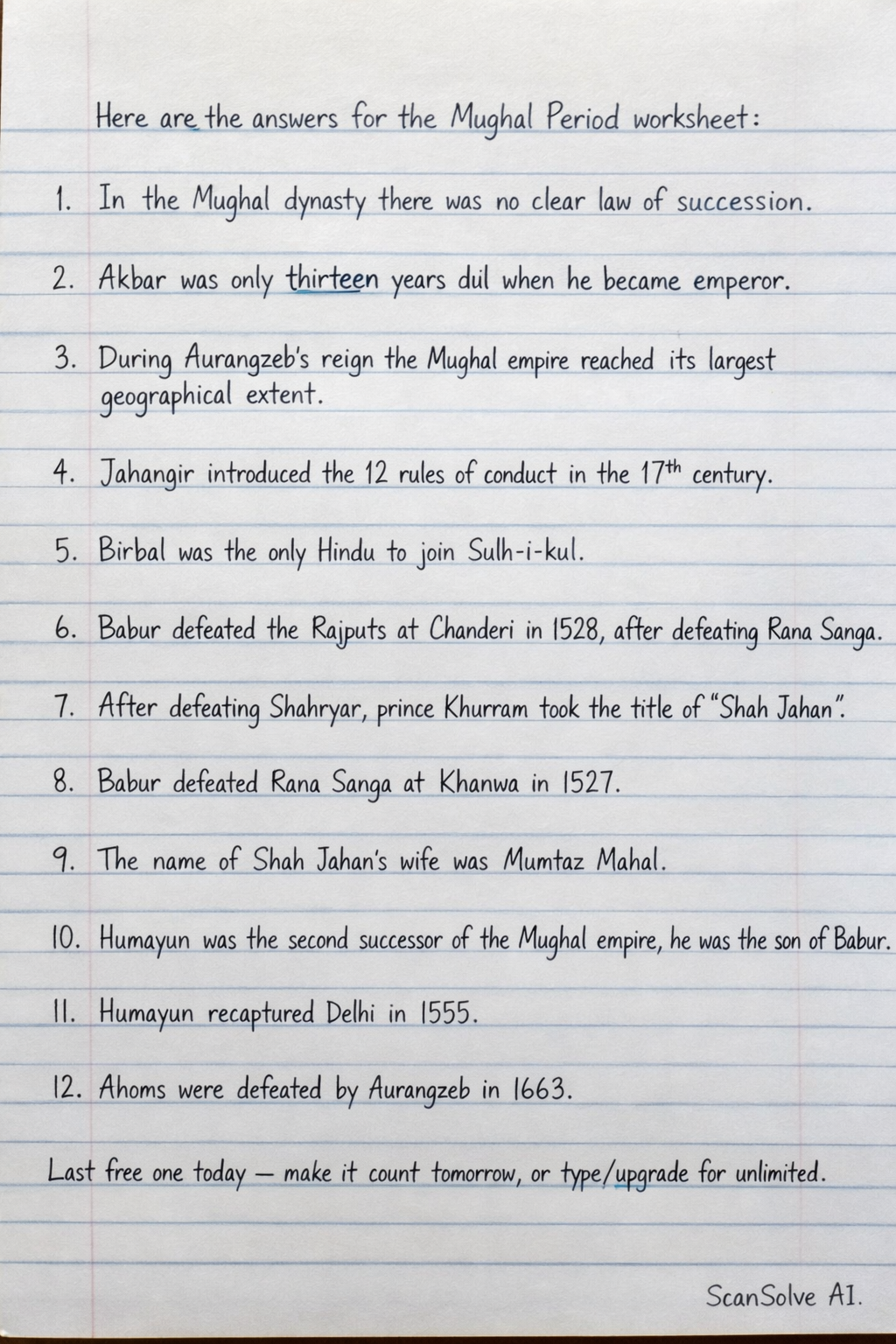
Here are the answers for the Mughal Period worksheet:
- In the Mughal dynasty there was no clear law of succession.
- Akbar was only thirteen years old when he became emperor.
- During Aurangzeb's reign the Mughal empire reached its largest geographical extent.
- Jahangir introduced the 12 rules of conduct in the 17th century.
- Birbal was the only Hindu to join Sulh-i-kul.
- Babur defeated the Rajputs at Chanderi in 1528, after defeating Rana Sanga.
- After defeating Shahryar, prince Khurram took the title of 'Shah Jahan'.
- Babur defeated Rana Sanga at Khanwa in 1527.
- The name of Shah Jahan's wife was Mumtaz Mahal.
- Humayun was the second successor of the Mughal empire, he was the son of Babur.
- Humayun recaptured Delhi in 1555.
- Ahoms were defeated by Aurangzeb in 1663.
Was this helpful?
Still stuck on this one?
Ask a follow-up, and the answer starts from this question.
Got a different question?Ask your own question
More History Questions
QPlease provide answers to the following questions in Punjabi: 1. Who was the founder of the Mughal…QWhat are the answers to these multiple-choice questions about Urdu literature and history?QAnswer the following questions: a) Who was Akbar? b) Who was Birbal? c) Who were called the…QWhat are the answers to the following questions about Indian history, including dates for the…QArrange the following events in chronological order: Vedic civilisation, Mughal empire, Indus valley…
Handwritten Step-by-Step Solution
Get this as a handwritten image on WhatsApp — like a tutor wrote it for you.
Try on WhatsApp