
We read your photo as:
It is without argument that archives differ from other information sources. Using relevant examples, describe the characteristics of archives.
ScanSolve AI Answer
Answer
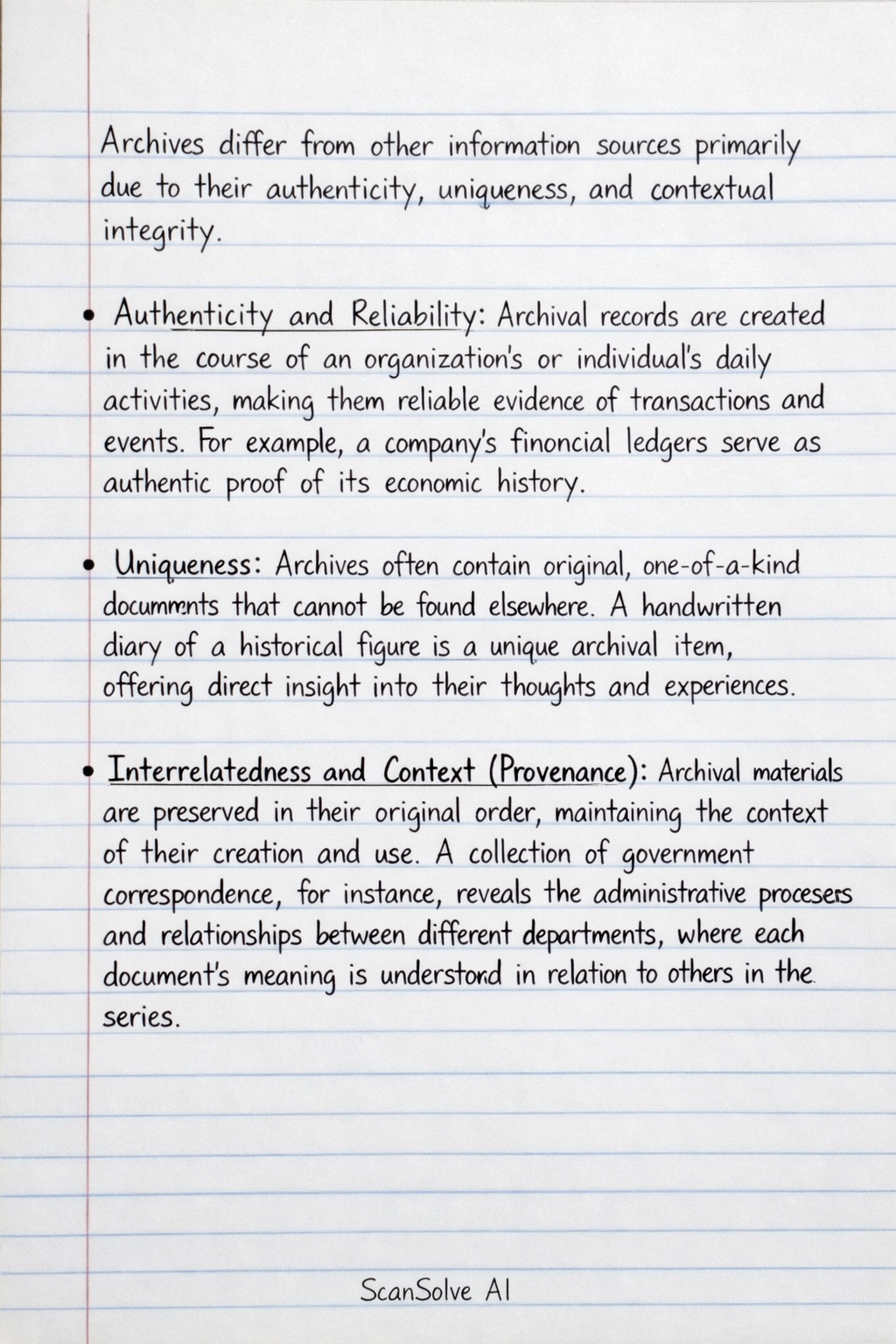
Archives differ from other information sources primarily due to their authenticity, uniqueness, and contextual integrity.
-
Authenticity and Reliability: Archival records are created in the course of an organization's or individual's daily activities, making them reliable evidence of transactions and events. For example, a company's financial ledgers serve as authentic proof of its economic history.
-
Uniqueness: Archives often contain original, one-of-a-kind documents that cannot be found elsewhere. A handwritten diary of a historical figure is a unique archival item, offering direct insight into their thoughts and experiences.
-
Interrelatedness and Context (Provenance): Archival materials are preserved in their original order, maintaining the context of their creation and use. A collection of government correspondence, for instance, reveals the administrative processes and relationships between different departments, where each document's meaning is understood in relation to others in the series.
-
Evidential Value: Archives serve as primary evidence of functions, activities, and decisions. A signed peace treaty provides irrefutable evidence of an agreement between nations.
Still stuck on this one?
Ask a follow-up, and the answer starts from this question.
More History Questions
Handwritten Step-by-Step Solution
Get this as a handwritten image on WhatsApp — like a tutor wrote it for you.
Try on WhatsApp