
We read your photo as:
Explain the factors that drove the scramble and partition of East Africa by European powers.
ScanSolve AI Answer
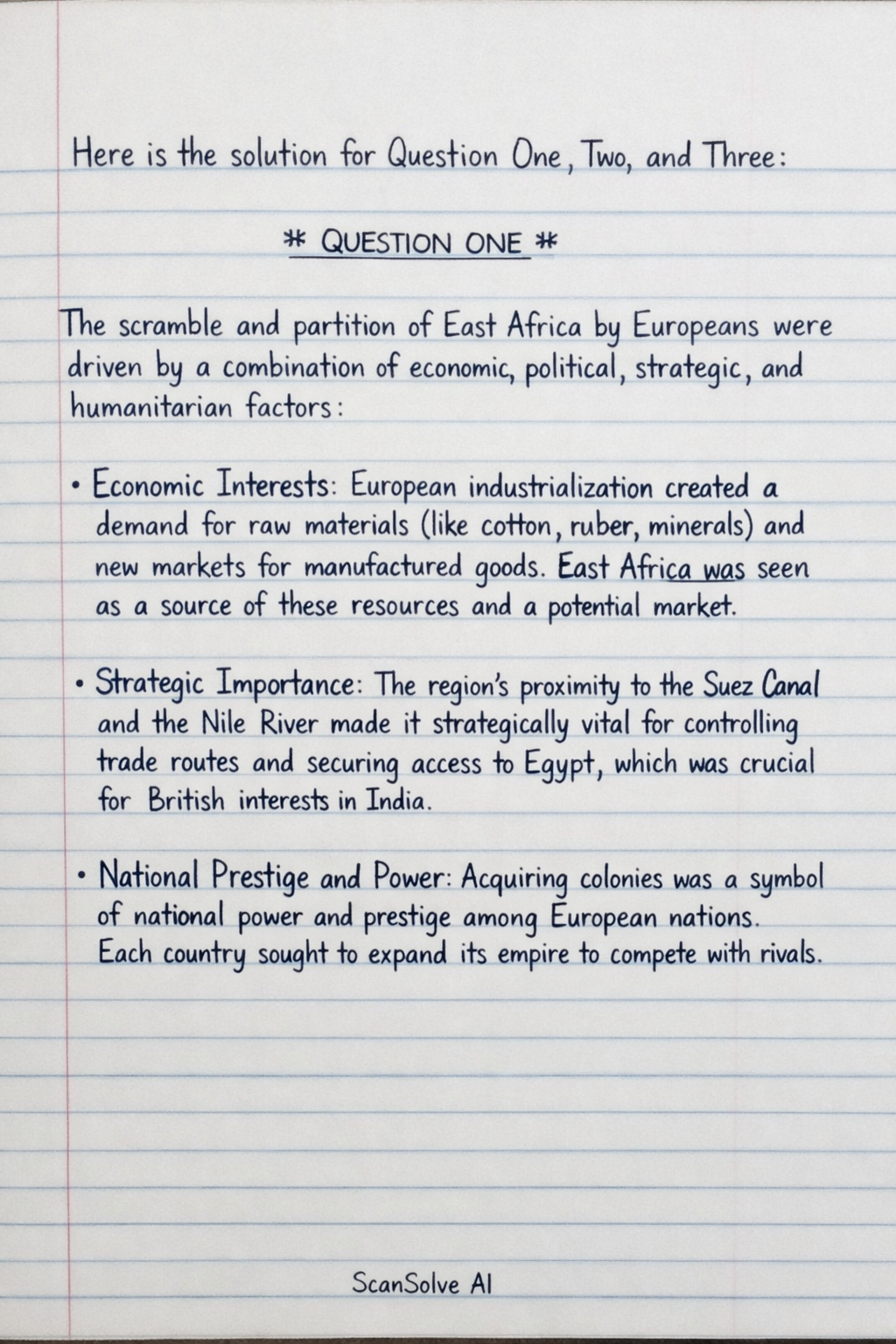
Here is the solution for Question One, Two, and Three:
QUESTION ONE
The scramble and partition of East Africa by Europeans were driven by a combination of economic, political, strategic, and humanitarian factors:
- Economic Interests: European industrialization created a demand for raw materials (like cotton, rubber, minerals) and new markets for manufactured goods. East Africa was seen as a source of these resources and a potential market.
- Strategic Importance: The region's proximity to the Suez Canal and the Nile River made it strategically vital for controlling trade routes and securing access to Egypt, which was crucial for British interests in India.
- National Prestige and Power: Acquiring colonies was a symbol of national power and prestige among European nations. Each country sought to expand its empire to compete with rivals.
- Abolition of Slave Trade and Missionary Activities: European powers, particularly Britain, claimed a moral imperative to abolish the slave trade. Missionaries also sought to spread Christianity and "civilize" Africans, often paving the way for colonial rule.
- Technological Advancements: Innovations like quinine (to combat malaria), steamships, and advanced weaponry gave Europeans a significant advantage in penetrating and controlling the interior of Africa.
- The Berlin Conference (1884-1885): This conference formalized the rules for the partition of Africa, allowing European powers to claim territories based on "effective occupation" and preventing conflicts among themselves.
QUESTION TWO
The British administration of East Africa was primarily characterized by a system of Indirect Rule, though elements of direct rule were also employed.
- Colonial Office (London): The ultimate authority rested with the Colonial Office in London, which set broad policies and appointed key officials.
- Governor: The highest authority in the colony, appointed by the British Crown. The Governor was responsible for implementing policies, maintaining law and order, and overseeing all administrative functions.
- Provincial Commissioners (PCs): Below the Governor, the colony was divided into provinces, each headed by a PC. These were British officials responsible for administering their respective provinces.
- District Commissioners (DCs): Provinces were further divided into districts, each managed by a DC. DCs were the direct link between the colonial government and the African population. They collected taxes, enforced laws, and oversaw local affairs.
- Local Chiefs and Headmen: Under Indirect Rule, the British largely governed through existing traditional African leaders (chiefs, headmen). These leaders were given official recognition and powers, becoming agents of the colonial administration. They were responsible for maintaining order, collecting taxes, and mobilizing labor at the local level, often under the supervision of DCs.
- Native Courts and Councils: Traditional judicial and administrative structures were often retained or modified to serve colonial interests, handling minor disputes and local governance.
- Legislative and Executive Councils: These councils, initially composed mainly of European officials and settlers, advised the Governor and helped in law-making, though African representation was minimal or non-existent in the early stages.
QUESTION THREE
The scramble and partition of East Africa by Europeans brought about profound political changes, fundamentally altering the region's traditional structures and laying the groundwork for modern nation-states.
- Loss of African Sovereignty: Independent African kingdoms, chiefdoms, and societies lost their autonomy and self-governance, becoming subjects of European colonial powers.
- Imposition of Artificial Boundaries: European powers drew arbitrary borders that often cut across existing ethnic, linguistic, and cultural groups, while simultaneously lumping disparate groups together. This created future sources of conflict and shaped the modern political map of East Africa.
- Centralized Colonial Administration: Diverse traditional political systems were replaced by a hierarchical, centralized colonial administration (as described in Question Two), with power flowing from the colonial capital to the local level.
- Emergence of New Political Elites: The colonial system either empowered certain traditional leaders who cooperated with the British (e.g., appointed chiefs) or fostered the rise of a new educated African elite who would later lead nationalist movements.
- Introduction of Western Political Concepts: Concepts such as the nation-state, formal legal systems, and bureaucratic governance were introduced, even if their application was often discriminatory against Africans.
- Suppression of Traditional Political Institutions: Many indigenous political structures and decision-making processes were undermined or abolished if they conflicted with colonial rule.
- Rise of African Nationalism: The shared experience of colonial oppression and the artificial unity imposed by colonial borders eventually fostered a sense of common identity among diverse groups, leading to the emergence of nationalist movements demanding self-rule and independence.
Still stuck on this one?
Ask a follow-up, and the answer starts from this question.
More History Questions
Handwritten Step-by-Step Solution
Get this as a handwritten image on WhatsApp — like a tutor wrote it for you.
Try on WhatsApp