
We read your photo as:
Explain the German annexation of Cameroon in 1884, the local reactions, and how German colonial rule was consolidated by 1916.
ScanSolve AI Answer
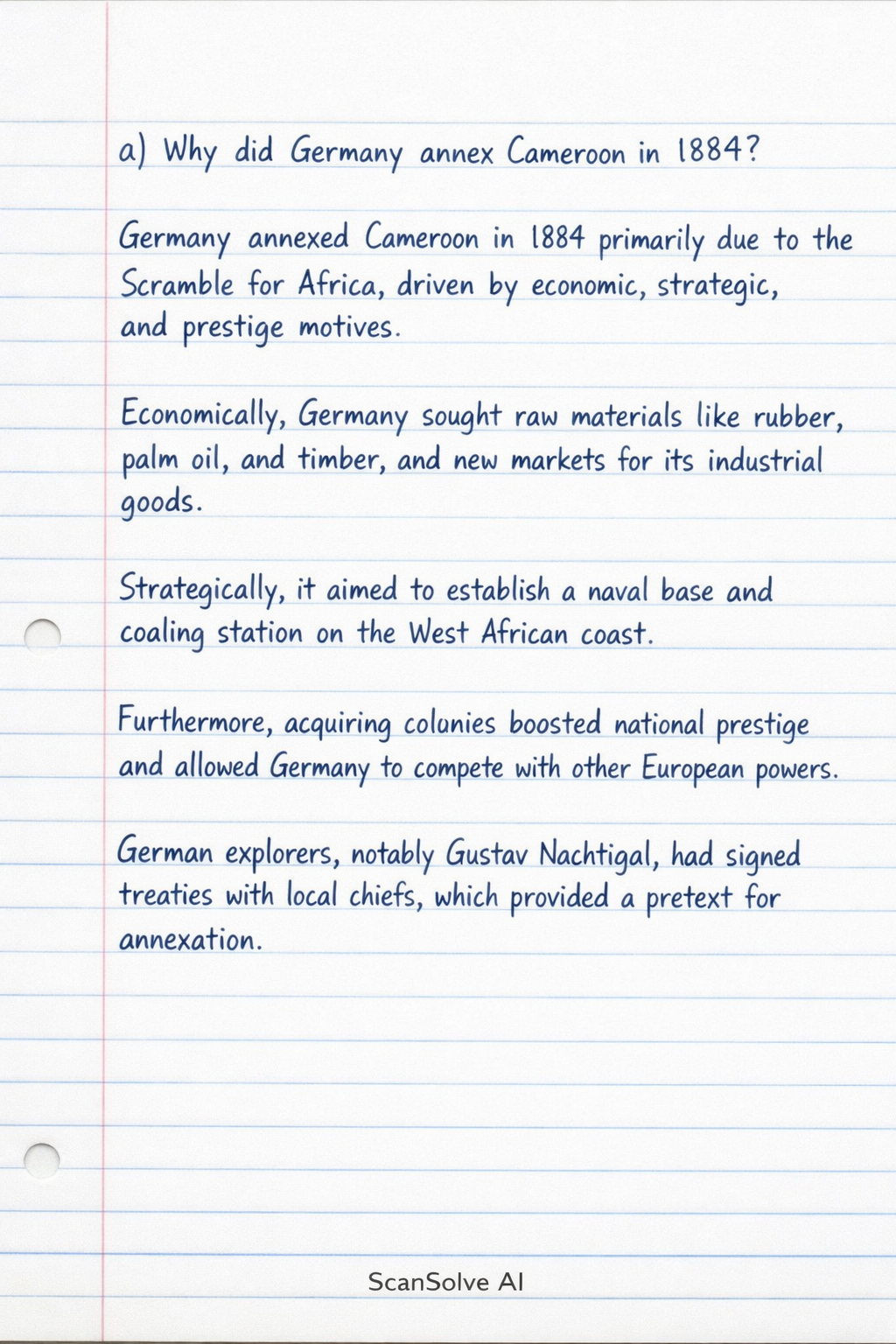
a) Why did Germany annex Cameroon in 1884?
Germany annexed Cameroon in 1884 primarily due to the Scramble for Africa, driven by economic, strategic, and prestige motives. Economically, Germany sought raw materials like rubber, palm oil, and timber, and new markets for its industrial goods. Strategically, it aimed to establish a naval base and coaling station on the West African coast. Furthermore, acquiring colonies boosted national prestige and allowed Germany to compete with other European powers. German explorers, notably Gustav Nachtigal, had signed treaties with local chiefs, which provided a pretext for annexation.
b) What were the reactions of the local people to the annexation?
The reactions of the local people to the German annexation were largely characterized by resistance, though some initial collaboration occurred. Many local chiefs, particularly those with existing trade ties to the British, initially resisted German claims and sought British protection. As German rule became more oppressive, various ethnic groups engaged in armed revolts against forced labor, taxation, and land expropriation. While some chiefs initially collaborated hoping for advantages, this often turned into resistance as German policies became harsher.
c) In what ways did the Germans consolidate German colonial rule by 1916?
The Germans consolidated their colonial rule in Cameroon by 1916 through several methods:
- Military conquest: They systematically suppressed local resistance through punitive expeditions, using superior weaponry and organization.
- Administrative structures: A centralized colonial administration was established, featuring district officers, courts, and a police force to enforce German laws.
- Economic exploitation: They imposed forced labor on the local population for plantations (e.g., rubber, cocoa) and infrastructure projects like roads and railways, alongside collecting taxes.
- Infrastructure development: Key infrastructure such as roads, railways, and ports (like Douala) were built to facilitate resource extraction and military movement.
- Land expropriation: Vast areas of land were seized from local communities for German plantations and settlers.
- Education and missions: German missionary societies were allowed to establish schools, which helped spread German influence and culture among the populace.
Still stuck on this one?
Ask a follow-up, and the answer starts from this question.
More History Questions
Handwritten Step-by-Step Solution
Get this as a handwritten image on WhatsApp — like a tutor wrote it for you.
Try on WhatsApp