
We read your photo as:
I) The Saptanga theory of Manu outlines seven essential elements of a state: Swami (King), Amatya (Minister), Janapada (Territory and Population), Durga (Fortified Capital), Kosha (Treas
ScanSolve AI Answer
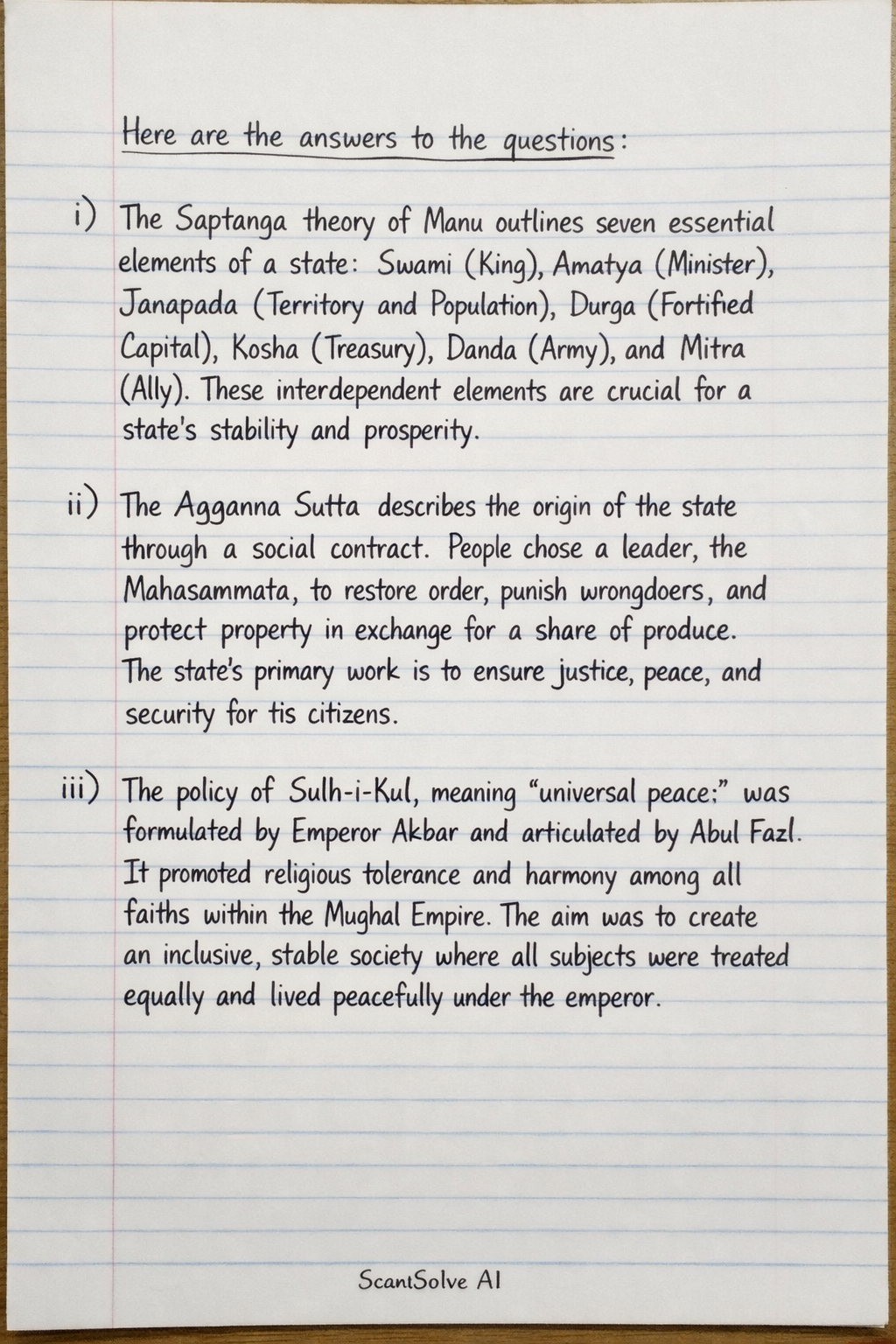
Here are the answers to the questions:
i) The Saptanga theory of Manu outlines seven essential elements of a state: Swami (King), Amatya (Minister), Janapada (Territory and Population), Durga (Fortified Capital), Kosha (Treasury), Danda (Army), and Mitra (Ally). These interdependent elements are crucial for a state's stability and prosperity.
ii) The Agganna Sutta describes the origin of the state through a social contract. People chose a leader, the Mahasammata, to restore order, punish wrongdoers, and protect property in exchange for a share of produce. The state's primary work is to ensure justice, peace, and security for its citizens.
iii) The policy of Sulh-i-Kul, meaning "universal peace," was formulated by Emperor Akbar and articulated by Abul Fazl. It promoted religious tolerance and harmony among all faiths within the Mughal Empire. The aim was to create an inclusive, stable society where all subjects were treated equally and lived peacefully under the emperor.
iv) Mahadev Govind Ranade advocated for gradual and rational social reforms. He believed in simultaneous progress across social, political, and economic spheres. Ranade championed women's education, widow remarriage, and the abolition of child marriage and caste distinctions, emphasizing reason for societal change.
Still stuck on this one?
Ask a follow-up, and the answer starts from this question.
More History Questions
Handwritten Step-by-Step Solution
Get this as a handwritten image on WhatsApp — like a tutor wrote it for you.
Try on WhatsApp