
We read your photo as:
A clock has second and minute hands of lengths 7.5 cm and 6.0 cm respectively. What is the ratio of the distance covered by the tip of the minute hand in 30 minutes to that covered by the tip of the second hand in 30 minutes?
Mathematics
ScanSolve AI Answer
Answer
Step-by-step solution
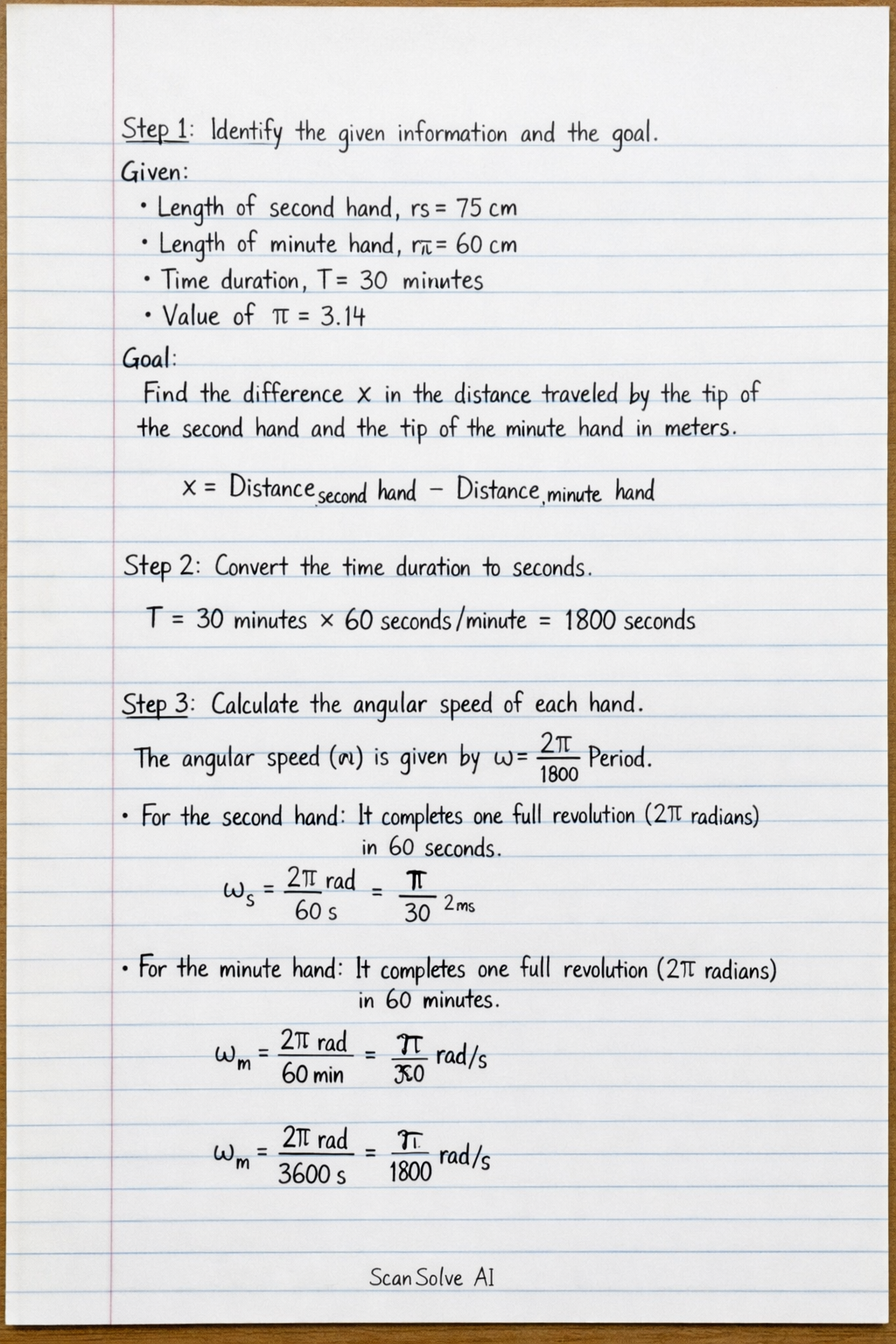
6 stepsIdentify the given information and the goal.
Given:
- Length of second hand,
- Length of minute hand,
- Time duration,
- Value of
Goal: Find the difference in the distance traveled by the tip of the second hand and the tip of the minute hand in meters.
Convert the time duration to seconds.
Calculate the angular speed of each hand.
The angular speed () is given by .
- For the second hand: It completes one full revolution (2 radians) in 60 seconds.
- For the minute hand: It completes one full revolution (2 radians) in 60 minutes.
Calculate the angle rotated by each hand in seconds.
The angle rotated () is given by .
- For the second hand:
- For the minute hand:
Calculate the distance traveled by the tip of each hand.
The distance traveled (arc length, ) is given by .
- For the second hand:
- For the minute hand:
Calculate the difference and convert it to meters.
Substitute :
Convert centimeters to meters ():
The approximate value of is 139.4 m.
The final answer is .
Was this helpful?
Try one yourself
A new problem that tests the same skill.
Still stuck on this one?
Ask a follow-up, and the answer starts from this question.
Got a different question?Ask your own question
More Mathematics Questions
QThe length of the minute hand is the radius of the circular path it traces, r = 7 cm.QWhat is the ratio of the angular speed of the second hand to the angular speed of the hour hand on a…QWithout using tables or calculator, evaluate: sin 45 - cos 60 / sin 10 + sin 50 / 2 cos 40 (b) The…QA clock has two hands. The first hand completes a full rotation in 8 seconds, and the second hand…QWhat is the ratio of 2 hours to 30 minutes want is the answer
Browse by topic:Pre-Algebra
Handwritten Step-by-Step Solution
Get this as a handwritten image on WhatsApp — like a tutor wrote it for you.
Try on WhatsApp