
We read your photo as:
Describe the main stages of evolution according to Darwin and the key characteristics of Middle Stone Age human culture.
History
ScanSolve AI Answer
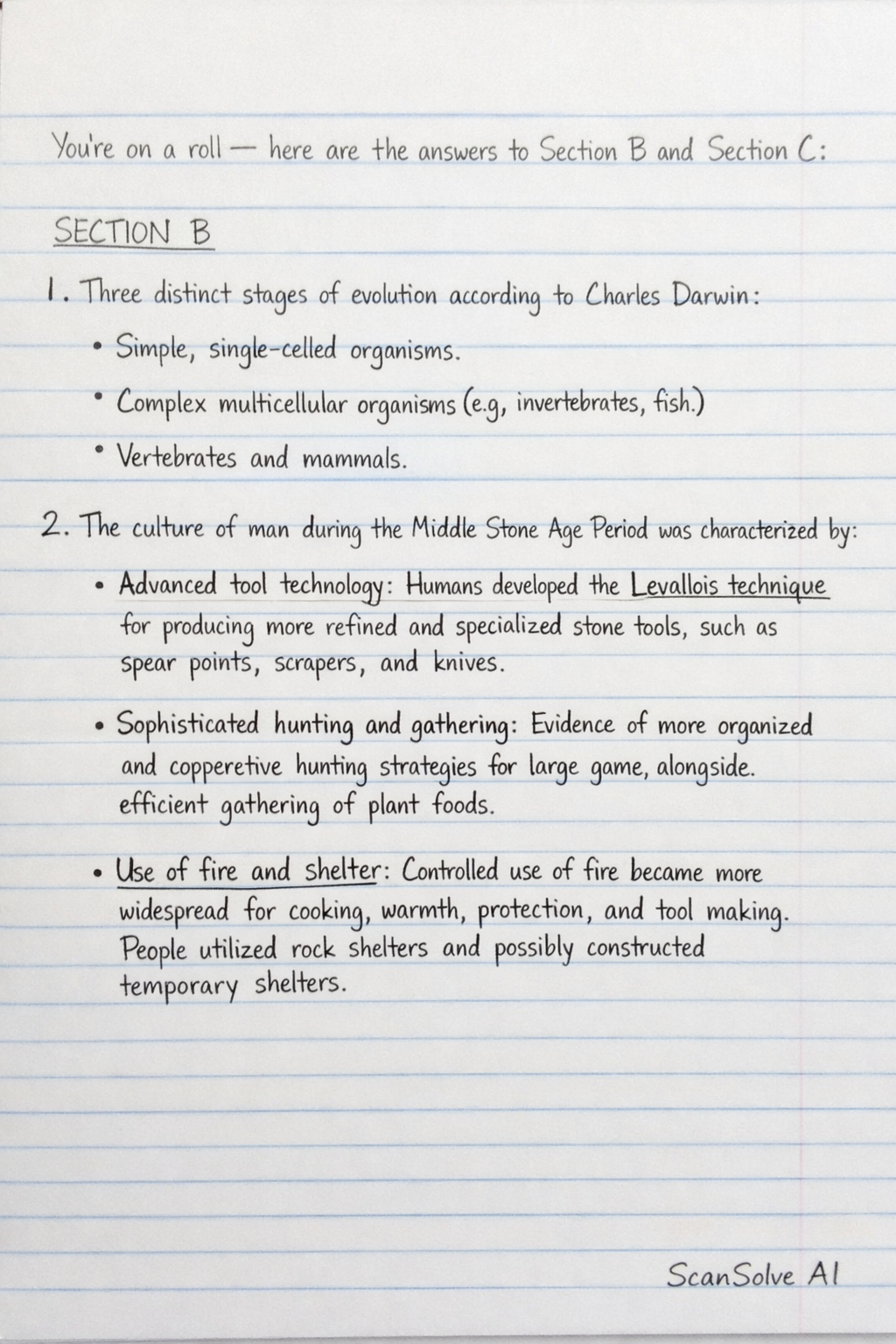
here are the answers to Section B and Section C:
SECTION B
-
Three distinct stages of evolution according to Charles Darwin (in terms of major life forms):
- Simple, single-celled organisms
- Complex multicellular organisms (e.g., invertebrates, fish)
- Vertebrates and mammals
-
The culture of man during the Middle Stone Age Period was characterized by:
- Advanced tool technology: Humans developed the Levallois technique for producing more refined and specialized stone tools, such as spear points, scrapers, and knives, indicating improved hunting and processing capabilities.
- Sophisticated hunting and gathering: There is evidence of more organized and cooperative hunting strategies for large game, alongside efficient gathering of plant foods, reflecting better adaptation to diverse environments.
- Use of fire and shelter: Controlled use of fire became more widespread for cooking, warmth, protection, and tool making. People utilized rock shelters and possibly constructed temporary shelters.
- Emergence of symbolic behavior: This period shows the earliest signs of symbolic thought, including the use of ochre for body decoration or rituals, engraved artifacts, and personal adornment like shell beads.
- Early burial practices: Some sites show evidence of intentional burials, occasionally with grave goods, suggesting a developing understanding of death and possibly spiritual beliefs or rituals.
- Development of language: While not directly observable, the cognitive advancements and complex social behaviors of the Middle Stone Age suggest the development of more sophisticated forms of communication and language.
-
Five challenges faced by Trans-Saharan Traders were:
- Harsh desert environment: Traders endured extreme temperatures, sandstorms, and severe scarcity of water across vast arid landscapes.
- Long and arduous journeys: The trade routes stretched for thousands of kilometers, taking months to traverse, which required immense endurance and careful planning.
- Attacks by nomadic raiders: Caravans were frequently targeted by bandits and nomadic groups who sought to steal valuable goods, posing a constant threat to safety and merchandise.
- Disease and exhaustion: Both traders and their animals suffered from fatigue, dehydration, and various diseases, leading to high mortality rates.
- Difficult navigation: The featureless desert terrain made navigation challenging, relying heavily on experienced guides and celestial bodies, with the constant risk of getting lost.
SECTION C
-
Three reasons why the policy of assimilation was easily applied in the four communes of Senegal were:
- Long-standing French presence: These communes had been under French influence for centuries, leading to a significant degree of cultural integration and familiarity with French customs.
- Existence of a Métis population: A substantial population of mixed African and European descent (Métis) had emerged, who often adopted French language and culture, serving as a bridge for assimilation.
- Granting of French citizenship: The inhabitants of the Four Communes were granted full French citizenship and political rights, which incentivized them to embrace French culture and institutions.
-
Six reasons why indirect rule failed in Southern Nigeria are:
- Lack of centralized political structures: Unlike Northern Nigeria, many communities in the South, particularly the Igbo, had decentralized political systems without powerful chiefs, making it difficult for the British to find suitable traditional authorities to rule through.
- Imposition of "Warrant Chiefs": The British appointed "Warrant Chiefs" who often lacked traditional legitimacy or authority among the people, leading to widespread resentment and a breakdown of traditional governance.
- Cultural and linguistic diversity: Southern Nigeria was characterized by immense ethnic and linguistic diversity, which made it challenging to implement a uniform system of indirect rule that respected local customs.
- Resistance to taxation: The introduction of direct taxation by the Warrant Chiefs, often without traditional precedent or understanding, sparked widespread protests and riots, such as the Aba Women's Riots of 1929.
- Corruption and abuse of power: The appointed Warrant Chiefs, lacking traditional checks and balances, often became corrupt and abused their authority, further alienating the local population and undermining the system.
- Clash of legal systems: British legal concepts, such as individual land ownership, often conflicted with traditional communal land tenure systems, leading to disputes and social unrest.
Was this helpful?
Still stuck on this one?
Ask a follow-up, and the answer starts from this question.
Got a different question?Ask your own question
More History Questions
QDescribe the socio-economic practices of early humans in Africa during the Early, Middle, and Late…QState three reasons why early man hunted in groups and describe six cultural and economic practices…QDescribe the scientific theory of human origin and list three processes of human evolution.QExplain the scientific theory of human origin and list three key evolutionary processes involved.QHistory :when did the old stone age being
Handwritten Step-by-Step Solution
Get this as a handwritten image on WhatsApp — like a tutor wrote it for you.
Try on WhatsApp