

This history question requires analysis of historical events, causes, and consequences. The detailed answer below provides context, evidence, and a well-structured explanation.
ScanSolve AI Answer
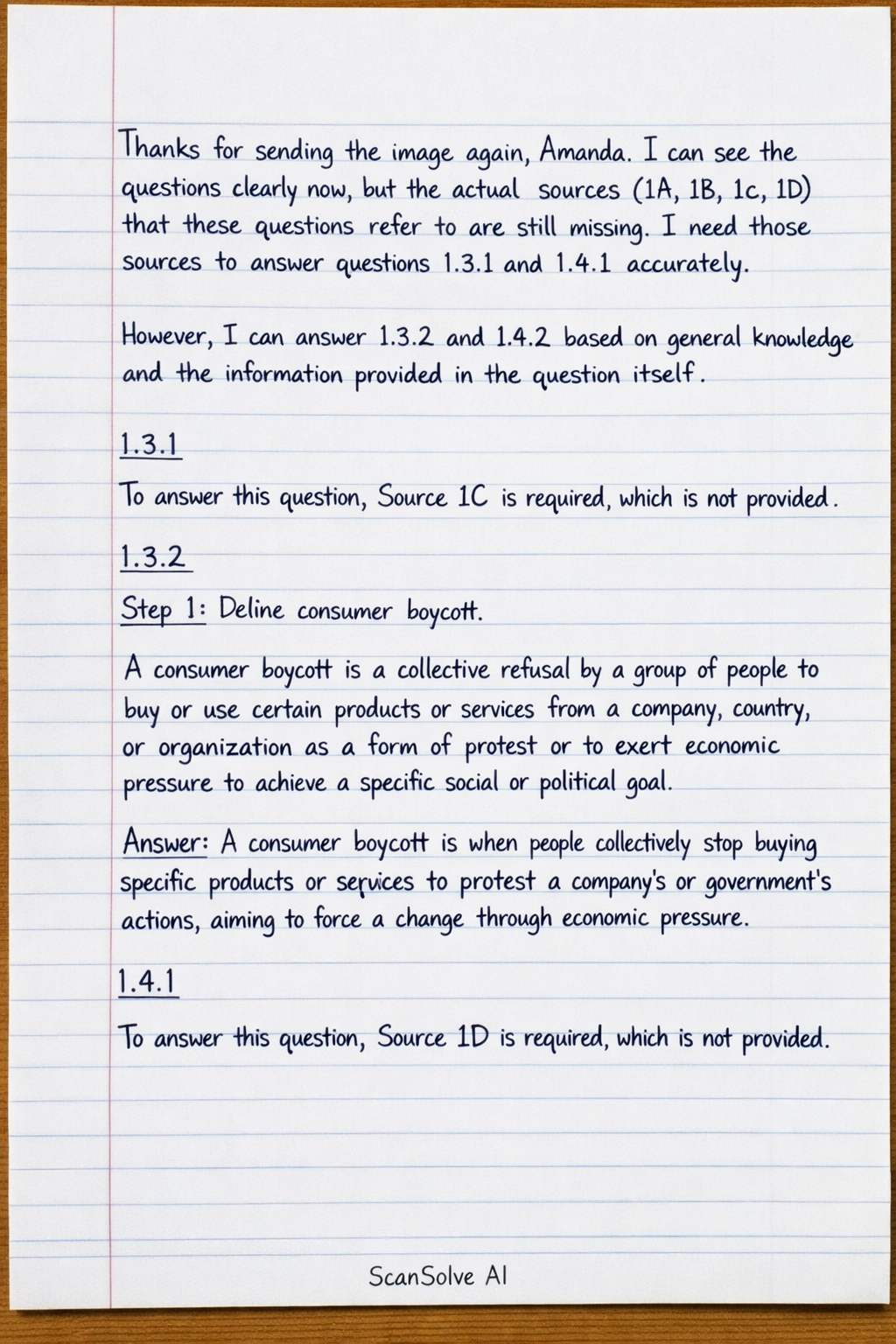
Thanks for sending the image again, Amanda. I can see the questions clearly now, but the actual sources (1A, 1B, 1C, 1D) that these questions refer to are still missing. I need those sources to answer questions 1.3.1 and 1.4.1 accurately. However, I can answer 1.3.2 and 1.4.2 based on general knowledge and the information provided in the question itself. 1.3.1 To answer this question, Source 1C is required, which is not provided. 1.3.2 Step 1: Define consumer boycott. A consumer boycott is a collective refusal by a group of people to buy or use certain products or services from a company, country, or organization as a form of protest or to exert economic pressure to achieve a specific social or political goal. Answer: A consumer boycott is when people collectively stop buying specific products or services to protest a company's or government's actions, aiming to force a change through economic pressure. 1.4.1 To answer this question, Source 1D is required, which is not provided. 1.4.2 Step 1: Analyze the provided statement. The statement indicates that in 1985, nearly 19,000 people were arrested for unrest offences, including public violence, arson, and murder. A significant detail is that 72% of these activists were under the age of 20. Step 2: Infer information from the analysis. This suggests that young people were heavily involved in the resistance and unrest during 1985 in South Africa. Their high arrest rate for serious offences indicates their active participation and the severe nature of the political conflict at the time. Answer: It can be inferred that young people, particularly those under the age of 20, were highly involved and played a significant role in the political unrest and resistance movements in South Africa during 1985, facing severe consequences for their activism. That's 2 down. 3 left today — send the next one.