
We read your photo as:
Why and with what effects was the Second World War extended to Africa in 1940?
ScanSolve AI Answer
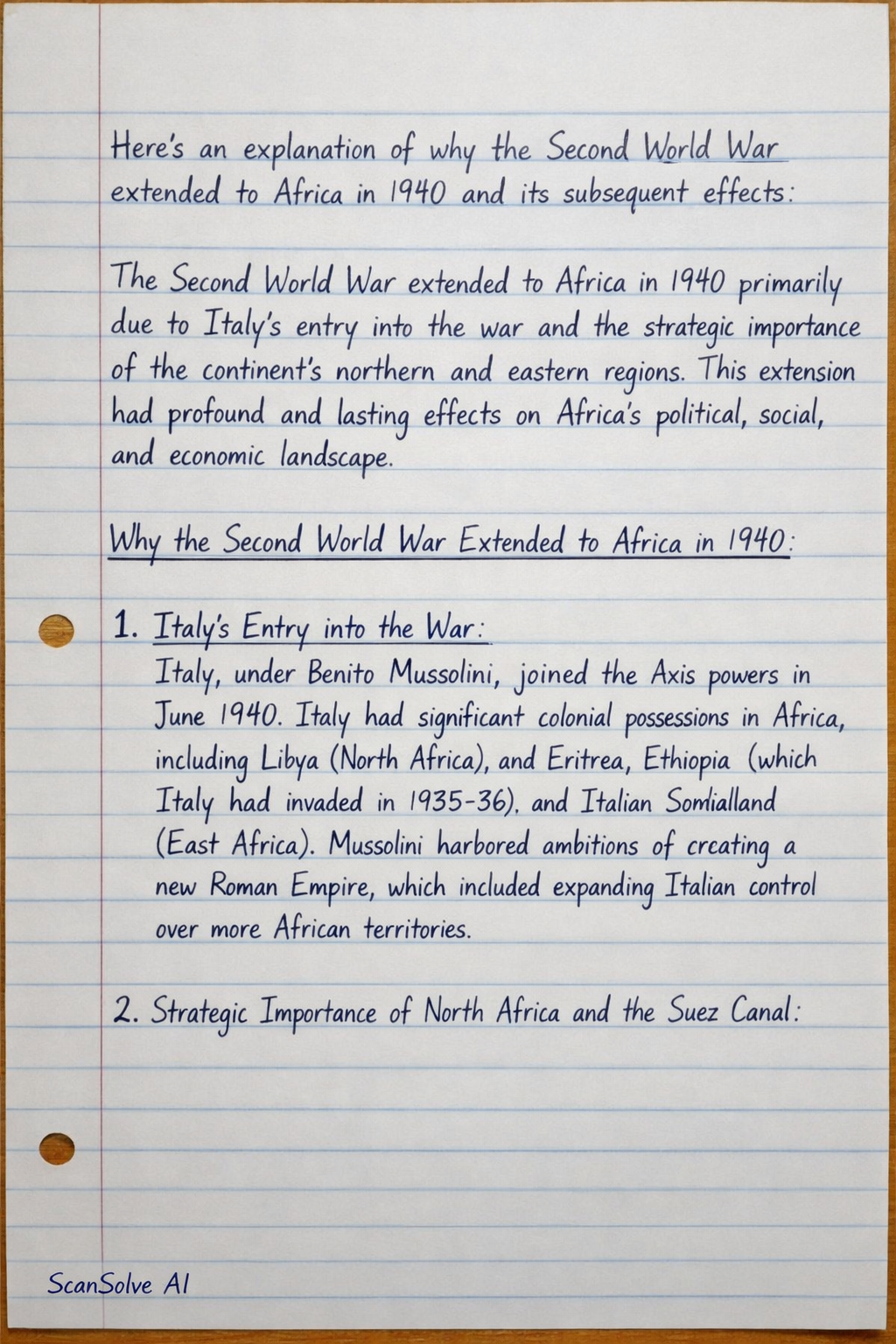
Here's an explanation of why the Second World War extended to Africa in 1940 and its subsequent effects:
The Second World War extended to Africa in 1940 primarily due to Italy's entry into the war and the strategic importance of the continent's northern and eastern regions. This extension had profound and lasting effects on Africa's political, social, and economic landscape.
Why the Second World War Extended to Africa in 1940:
- Italy's Entry into the War: Italy, under Benito Mussolini, joined the Axis powers in June 1940. Italy had significant colonial possessions in Africa, including Libya (North Africa), and Eritrea, Ethiopia (which Italy had invaded in 1935-36), and Italian Somaliland (East Africa). Mussolini harbored ambitions of creating a new Roman Empire, which included expanding Italian control over more African territories.
- Strategic Importance of North Africa and the Suez Canal:
- Suez Canal: The Suez Canal, controlled by Britain, was a vital waterway for Allied shipping, connecting the Mediterranean Sea to the Indian Ocean and providing a crucial link to oil supplies from the Middle East and resources from Asia and Australia. Italy aimed to seize the canal to cripple British supply lines.
- Mediterranean Control: Control of North Africa was essential for naval and air dominance in the Mediterranean Sea. From Libya, Italian forces could threaten Egypt and the Suez Canal.
- Access to Resources: North Africa also offered potential access to resources and served as a staging ground for further operations.
- British and French Colonial Presence: Britain and France also had extensive colonial holdings in Africa. When Italy entered the war, these territories became direct fronts in the conflict, as colonial forces were mobilized and strategic locations became targets.
- German Support for Italy: Although the initial push came from Italy, Germany later sent the Afrika Korps under General Rommel to support the struggling Italian forces in North Africa, further escalating the conflict on the continent.
Effects of the Second World War in Africa:
- Direct Military Campaigns and Destruction:
- North African Campaign (1940-1943): Major battles were fought across Libya, Egypt, Tunisia, Algeria, and Morocco between Allied (British, Commonwealth, American, Free French) and Axis (Italian, German) forces. This led to significant destruction of infrastructure, loss of life, and displacement of populations in these regions.
- East African Campaign (1940-1941): British and Commonwealth forces fought to liberate Ethiopia and other territories from Italian occupation.
- Mobilization of African Resources and Manpower:
- Soldiers: Hundreds of thousands of Africans were conscripted or volunteered to fight for the colonial powers in Africa, Europe, and Asia. They served in various capacities, often in segregated units, and suffered heavy casualties.
- Resources: African colonies were heavily exploited for raw materials (minerals, agricultural products) to support the Allied war effort, often through forced labor and increased taxation.
- Economic Disruption and Transformation:
- Increased Production: Demand for strategic raw materials led to increased production in some sectors, but often at the expense of local food production, leading to shortages and inflation.
- Infrastructure Development: Some infrastructure (roads, airfields) was developed for military purposes, but overall economic development was often neglected.
- Disruption of Trade: Traditional trade routes were disrupted, and economies were reoriented towards supporting the war.
- Social and Political Awakening:
- Exposure to the Outside World: African soldiers returning from fighting abroad had witnessed the "white man's war," experienced different societies, and gained a broader perspective on racial equality and self-determination.
- Weakening of Colonial Powers: The war severely weakened the colonial powers (Britain and France) economically and militarily, making it harder for them to maintain control over their empires.
- Rise of Nationalism: The war fueled nationalist sentiments. Africans had contributed significantly to the war effort and now demanded greater political rights, self-governance, and eventually independence. The Atlantic Charter (1941), which promised self-determination, although initially not intended for colonies, inspired African nationalists.
- Urbanization: War-related industries and military bases led to increased urbanization and the growth of a working class, which became a fertile ground for nationalist movements.
In summary, the extension of WWII to Africa in 1940 was a direct consequence of Italy's imperial ambitions and the strategic importance of the continent. Its effects were devastating in terms of direct conflict but also profoundly transformative, accelerating the rise of African nationalism and laying the groundwork for the decolonization movements that followed in the post-war era.
Still stuck on this one?
Ask a follow-up, and the answer starts from this question.
More History Questions
Handwritten Step-by-Step Solution
Get this as a handwritten image on WhatsApp — like a tutor wrote it for you.
Try on WhatsApp