
We read your photo as:
Which of the following was a major political effect of the French Revolution of 1789 on the rest of Europe?
ScanSolve AI Answer
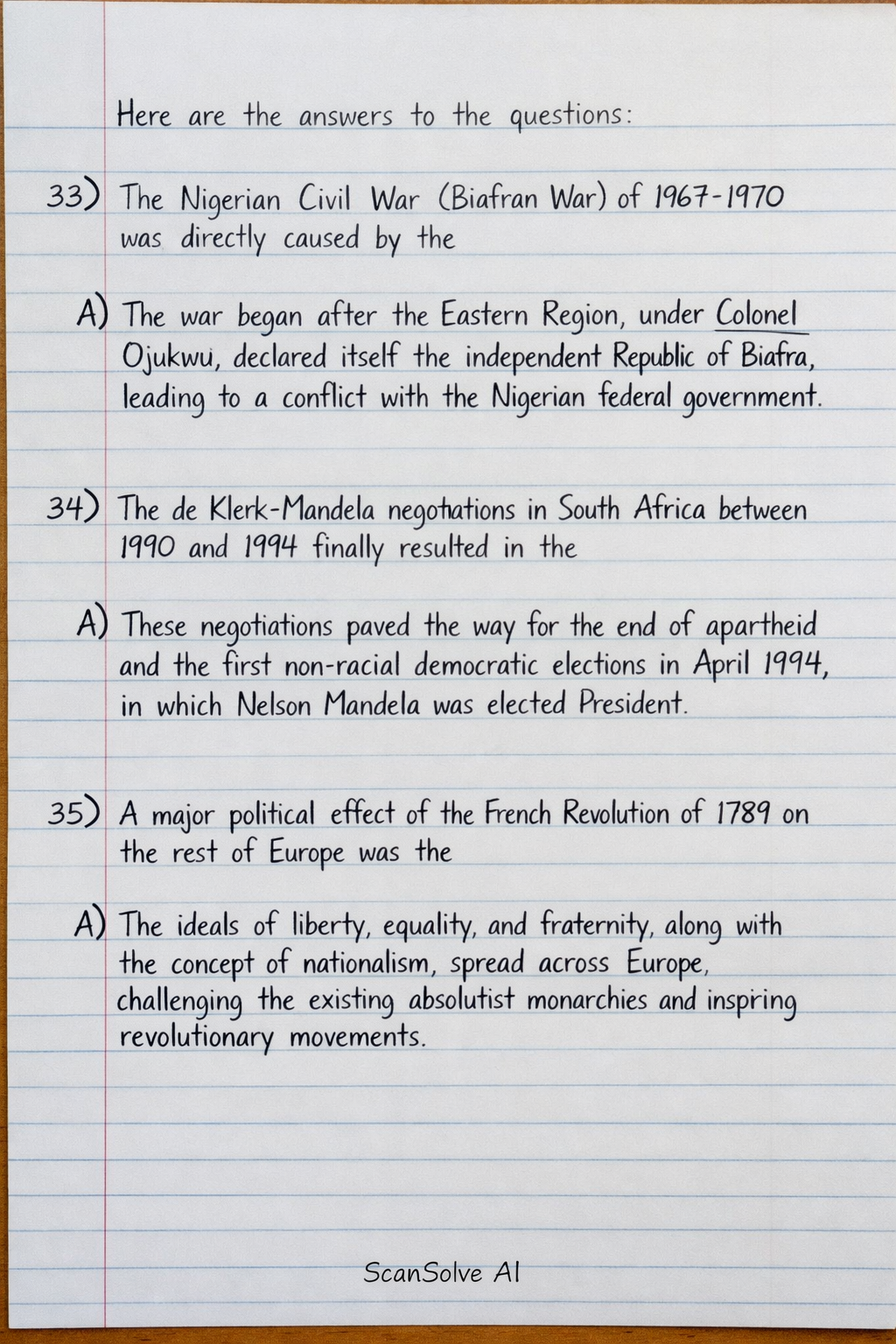
Here are the answers to the questions:
33) The Nigerian Civil War (Biafran War) of 1967-1970 was directly caused by the
- A) The war began after the Eastern Region, under Colonel Ojukwu, declared itself the independent Republic of Biafra, leading to a conflict with the Nigerian federal government.
34) The de Klerk-Mandela negotiations in South Africa between 1990 and 1994 finally resulted in the
- A) These negotiations paved the way for the end of apartheid and the first non-racial democratic elections in April 1994, in which Nelson Mandela was elected President.
35) A major political effect of the French Revolution of 1789 on the rest of Europe was the
- A) The ideals of liberty, equality, and fraternity, along with the concept of nationalism, spread across Europe, challenging the existing absolutist monarchies and inspiring revolutionary movements.
36) The Industrial Revolution which began in Britain after 1750 had its most immediate impact on the textile industry through the
- A) Early innovations like the Spinning Jenny, Water Frame, and Power Loom significantly mechanized textile production, transforming the industry.
37) The Concert of Europe established by the Congress of Vienna (1814-1815) was designed primarily to
- A) Its main goal was to prevent future major wars by maintaining a balance of power among European states and suppressing liberal and nationalist revolutionary movements that threatened the established order.
38) A major external factor that contributed to the unification of Italy by 1870 was the
- A) The military support of Napoleon III of France for Piedmont-Sardinia against Austria in the Second Italian War of Independence (1859) was crucial in weakening Austrian control over Italian territories.
39) The most important achievement of Bismarck's domestic policy in Germany after 1871 was the
- A) Bismarck introduced pioneering social insurance legislation, including sickness, accident, and old-age insurance, to improve workers' welfare and counter the appeal of socialism.
40) A major long-term cause of the First World War was the
- A) The complex web of secret alliances (e.g., Triple Alliance, Triple Entente) and the escalating arms race among European powers created a highly volatile international environment.
41) A direct outcome of the Treaty of Versailles (1919) for Europe was the
- A) The treaty significantly redrew the map of Europe, leading to the dissolution of empires and the creation of new nation-states like Poland, Czechoslovakia, and Yugoslavia based on the principle of self-determination.
42) The Wall Street Crash of October 1929 most significantly affected Europe by
- A) The crash triggered the Great Depression, a global economic crisis that destabilized democratic governments, led to widespread unemployment, and contributed to the rise of extremist ideologies like fascism and Nazism.
43) The policy of Appeasement pursued by Britain and France in the 1930s reached its lowest point at the
- A) At the Munich Conference in September 1938, Britain and France agreed to allow Germany to annex the Sudetenland region of Czechoslovakia, a clear act of appeasement towards Hitler's aggressive expansionism.
44) The most significant political consequence of the Second World War for Europe was the
- A) The war led to the division of Europe into two ideological and political blocs: the Western bloc dominated by the USA and the Eastern bloc dominated by the USSR, marking the beginning of the Cold War.
45) The Truman Doctrine of March 1947 marked a major shift in American foreign policy because it committed the United States to
- A) It established the policy of "containment," pledging US support (military and economic aid) to countries threatened by communist expansion, initially in Greece and Turkey.
46) A direct outcome of the Berlin Blockade of 1948-49 was the
- A) The Soviet blockade of West Berlin highlighted the need for a collective security alliance against Soviet aggression, directly leading to the formation of the North Atlantic Treaty Organisation (NATO) in April 1949.
47) The Bandung Conference of April 1955 was historically significant because it
- A) It brought together newly independent Asian and African nations, fostering Afro-Asian solidarity and laying the groundwork for the Non-Aligned Movement, which sought to avoid alignment with either the US or Soviet blocs during the Cold War.
Still stuck on this one?
Ask a follow-up, and the answer starts from this question.
More History Questions
Handwritten Step-by-Step Solution
Get this as a handwritten image on WhatsApp — like a tutor wrote it for you.
Try on WhatsApp