
We read your photo as:
Find out true or false: (a) Katantra was an important book during the time of Satavahana. (b) Ashvaghosha was a scholar in the royal court of the Sakas. (c) Sangam literature was written in Sanskrit.
ScanSolve AI Answer
here are the solutions to the remaining questions:
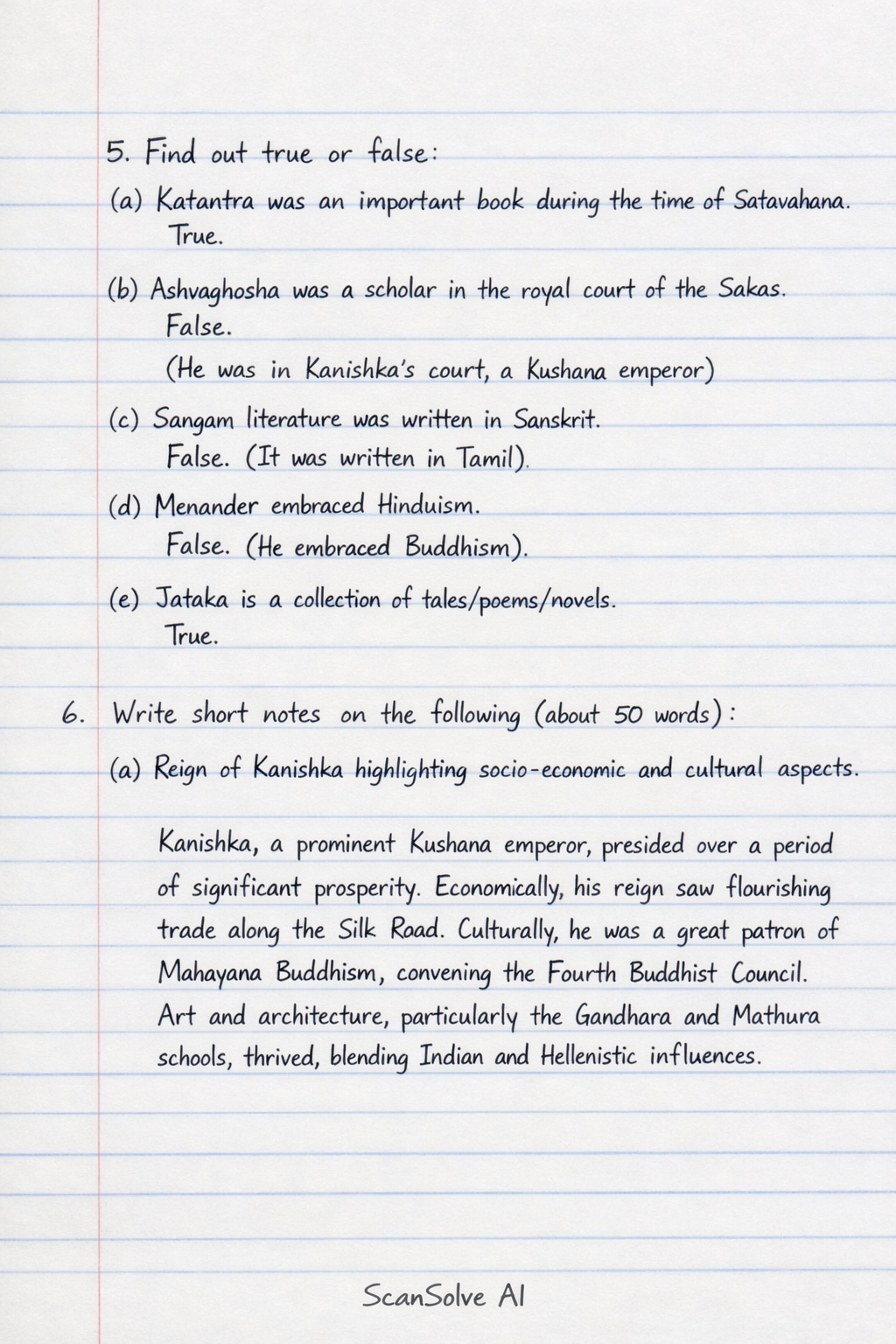
5. Find out true or false:
- (a) Katantra was an important book during the time of Satavahana.
- True
- (b) Ashvaghosha was a scholar in the royal court of the Sakas.
- False (He was in Kanishka's court, a Kushana emperor)
- (c) Sangam literature was written in Sanskrit.
- False (It was written in Tamil)
- (d) Menander embraced Hinduism.
- False (He embraced Buddhism)
- (e) Jataka is a collection of tales/poems/novels.
- True
6. Write short notes on the following (about 50 words):
-
(a) Reign of Kanishka highlighting socio-economic and cultural aspects. Kanishka, a prominent Kushana emperor, presided over a period of significant prosperity. Economically, his reign saw flourishing trade along the Silk Road. Culturally, he was a great patron of Mahayana Buddhism, convening the Fourth Buddhist Council. Art and architecture, particularly the Gandhara and Mathura schools, thrived, blending Indian and Hellenistic influences.
-
(b) Ways of living of the common people after the Mauryan period. After the Mauryan period, common people primarily lived in villages, engaged in agriculture and various crafts. Trade flourished, leading to the growth of towns and the formation of guilds (shrenis) for artisans and merchants. Society was largely agrarian and hierarchical, with Buddhism, Jainism, and Vedic traditions coexisting.
-
(c) In ancient India, gold was imported from the Roman empire. Ancient India maintained extensive trade with the Roman Empire. India exported spices, textiles, and precious stones, receiving large quantities of Roman gold coins (denarii) in return. This influx of gold significantly contributed to the economic prosperity of Indian kingdoms, with archaeological evidence supporting this trade relationship.
-
(d) Menander embraced Hinduism. This statement is false. Menander I (Milinda), an Indo-Greek king, is historically renowned for his conversion to Buddhism. His philosophical dialogues with the Buddhist monk Nagasena are documented in the Milinda Panha, a significant Pali text that details his journey to understanding and adopting Buddhist principles.
-
(e) Jataka is a collection of tales/poems/novels. This statement is true. The Jataka tales are a vast body of literature comprising stories about the previous lives of Gautama Buddha, often depicting him in both human and animal forms. These narratives serve to illustrate various moral principles and Buddhist doctrines, functioning as important ethical and spiritual teachings within the Buddhist tradition.
7. Project (Group work)
This is a group project that requires collecting pictures and observing differences in coins and notes. This type of activity is best done collaboratively in person.
Still stuck on this one?
Ask a follow-up, and the answer starts from this question.
More History Questions
Handwritten Step-by-Step Solution
Get this as a handwritten image on WhatsApp — like a tutor wrote it for you.
Try on WhatsApp