

This history question requires analysis of historical events, causes, and consequences. The detailed answer below provides context, evidence, and a well-structured explanation.
ScanSolve AI Answer
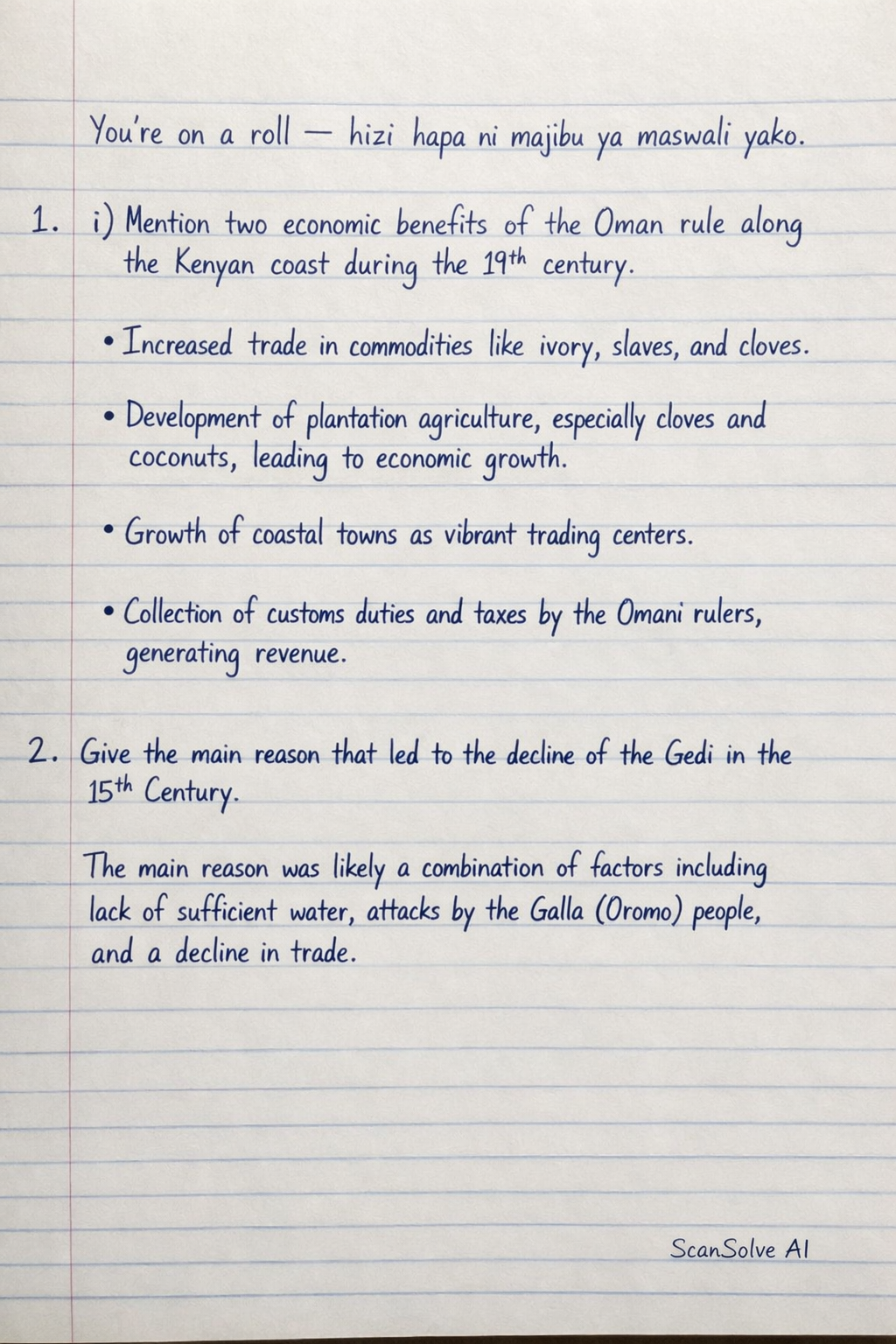
You're on a roll — hizi hapa ni majibu ya maswali yako. 1. i) Mention two economic benefits of the Oman rule along the Kenyan coast during the 19th century. • Increased trade in commodities like ivory, slaves, and cloves. • Development of plantation agriculture, especially cloves and coconuts, leading to economic growth. • Growth of coastal towns as vibrant trading centers. • Collection of customs duties and taxes by the Omani rulers, generating revenue. 2. Give the main reason that led to the decline of the Gedi in the 15th Century. The main reason was likely a combination of factors including lack of sufficient water, attacks by the Galla (Oromo) people, and a decline in trade. 3. Why did Seyyid Said transfer his capital from Muscat to Zanzibar in 1840? • Zanzibar offered a more strategic location for controlling the lucrative Indian Ocean trade. • Its fertile land was ideal for the expansion of clove plantations, which became a major source of wealth. • To escape political instability and internal conflicts in Oman. • To effectively administer and consolidate his control over the East African coast. 4. a) Describe the characteristics of the Coastal towns by 1500. • They were built with stone and coral architecture, including multi-story houses and mosques. • They were major trading centers involved in the Indian Ocean trade, exchanging goods like gold, ivory, and textiles. • They had a cosmopolitan population comprising Africans, Arabs, Persians, and Indians. • They were largely self-governing city-states, each with its own ruler or sultan. • Islam was the dominant religion, influencing law, culture, and daily life. • A unique Swahili culture and language had developed, blending African and Arab elements. • Many towns were fortified with walls for defense. b) Explain the impact of the Indian Ocean trade on the people of East Africa. • Economic prosperity: It led to the accumulation of wealth, the introduction of new currencies, and the growth of a merchant class. • Spread of Islam: The religion was introduced and adopted by many coastal communities, influencing their social and legal systems. • Development of Swahili culture: A unique blend of African Bantu and Arab cultures emerged, evident in language, architecture, and customs. • Growth of coastal towns: Settlements like Mombasa, Malindi, and Kilwa grew into powerful and wealthy city-states. • Introduction of new crops: Food crops like rice, sugarcane, and citrus fruits were introduced, diversifying agriculture. • Intermarriage: Between Arab/Persian traders and local African women, leading to new social structures. • Slavery: The demand for slaves in the Middle East and Asia led to the capture and export of Africans, causing depopulation and social disruption in some areas. • Technological transfer: New navigation techniques, dhow construction, and architectural styles were introduced. 5. Two ways through which Islam was spread in Kenya by 1500 A.D. • Through trade by Arab and Persian merchants who settled along the coast. • Through intermarriage between Muslim traders and local African women. • Through the establishment of Muslim settlements and communities along the coast. • Through missionary activities by Islamic scholars and preachers. 6. A part from the missionaries, name two other groups that provided education in colonial Kenya. • The Colonial Government (through government schools). • African Independent Schools (established by African communities). • Local Native Councils (LNCs). 7. Name two Greco - Roman records on the E. Africa coast. • The Periplus of the Erythraean Sea. • Ptolemy's Geography. 8. Two negative effects of Indian Ocean trade on the Kenyan people. • Slavery: It led to the capture and export of Africans, causing depopulation and social disruption. • Exploitation of resources: Local resources like ivory, gold, and animal skins were heavily exploited for foreign gain. • Cultural erosion: Some indigenous African customs and traditions were displaced or undermined. • Increased conflicts: Competition for trade goods and slave raiding led to conflicts among communities. 9. a) Three factors that led to the abolition of slave trade in E. Africa. • Humanitarian campaigns by abolitionists and missionaries who highlighted the brutality of the trade. • British naval patrols that intercepted slave ships and enforced anti-slavery treaties. • Economic changes in Europe, particularly the Industrial Revolution, which shifted focus from slave labor to free labor and new markets. • Diplomatic and military pressure exerted by the British government on the Sultan of Zanzibar. b) Six positive consequences of long distance trade. • Economic prosperity: It led to the accumulation of wealth, the growth of markets, and the development of a merchant class. • Spread of Islam: The religion was introduced and adopted, influencing culture, law, and education. • Growth of urban centers: Major trading towns developed into bustling cities and centers of learning. • Introduction of new crops: Food crops like rice, sugarcane, and citrus fruits were introduced, diversifying agriculture. • Technological transfer: New tools, building techniques, and navigation methods (e.g., dhows) were introduced. • Development of new languages and cultures: The blending of African and foreign cultures led to the emergence of unique identities like Swahili. • Political centralization: Wealth from trade enabled rulers to consolidate power and establish powerful kingdoms. • Access to new goods: Local people gained access to foreign manufactured goods like textiles and pottery. 10. Identify one commodity that was imported from China to the Kenyan coast during the Indian Ocean trade. • Porcelain/Ceramics. • Silk. 11. a) State three reasons why the Omani Arabs appointed local Arab families to control the East African coast on their behalf after defeating the Portuguese. • Lack of sufficient Omani personnel to directly administer the vast coast. • Familiarity with local conditions, customs, and languages by the local Arab families. • To ensure loyalty and support from families who had aided them against the Portuguese. • It was a cost-effective way to administer the region compared to sending and maintaining Omani officials. b) Explain the results of the development of plantation agriculture on the East African coast by Seyyid Said. • Economic boom: It led to immense wealth for the Omani rulers and Arab landowners, particularly from clove and coconut plantations. • Increased demand for slave labor: This fueled a massive expansion of the slave trade to provide workers for the plantations. • Growth of Zanzibar's importance: Zanzibar became the economic and political hub of the East African coast. • Urbanization: Towns like Zanzibar and Mombasa grew significantly due to increased economic activity and population. • Social stratification: It created a rigid social hierarchy with wealthy Arab landowners at the top and a large enslaved African population at the bottom. • Introduction of new crops: The cultivation of cash crops like cloves, coconuts, and dates expanded significantly. • Strengthened Omani influence: It solidified Omani political and economic control over the coast. • Development of infrastructure: Ports and trade routes were improved to facilitate the export of agricultural products. • Environmental impact: Extensive cultivation led to deforestation and land degradation in some areas. 12. Give reasons why the Arabs migrated to the Kenyan coast before 1500 A.D. • To engage in the lucrative Indian Ocean trade. • To escape religious or political persecution in their homelands. • To search for new settlements due to population pressure or desire for new lands. • The East African coast offered *favorable climate and